Mad, Mad, Mad Sword
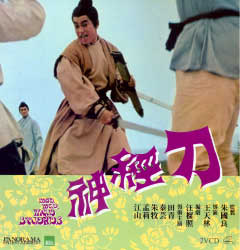
Director: Wong Tin-lam
Year: 1969
Rating: 5.0
By the time of this film in 1969 Cathay was in
a precarious financial situation. Since their founder and visionary, Loke
Wan Tho, had died in an airplane crash in 1964 the film company had slowly
lost its moorings and its position as the most prominent filmmaker in Hong
Kong to the Shaw Brothers. They had built their reputation on their legendary
female stars, but by the end of the decade these actresses had all either
retired or moved elsewhere and they had been unable to replace them. The
new wave of top actresses were now working at Shaw’s who had created a far
reaching recruiting and training division. Another problem facing them was
that female driven films were no longer in vogue – the tremendous popularity
of martial arts films had finished that and a new type of male actor was
on the rise – no longer effete and polished but instead audiences wanted
them rough and masculine like Jimmy Wang Yu and soon Ti Lung.
Cathay had actually approached the Shaws with an offer to merge the two
companies, but felt that the Shaws wanted too much control and so distanced
themselves from this offer eventually. The company had no choice therefore
but to enter the martial arts derby themselves but they had no ingrown talent
to do so – no experienced directors of this genre, no action choreographers
and perhaps most importantly no stars who had been trained in the art of
movie fighting. Some of them went on a very fast crash course! Their first
attempt was the 1967 film “The First Sword” which starred Zhao Lei and Melinda
Chen Manling. They followed this with a few other titles usually starring
one or both of these two actors – “Travel with a Sword”, “The Desperate Seven
(co-starring Betty Loh Ti) and “The Smiling Swordsman” (choreographed by
Han Yingjie of “Dragon Inn” fame). After “Mad, Mad, Mad Sword” Cathay was
to make two other wuxia films – both large budgeted ones in which they pretty
much bet their future on – “Escort Over Tiger Hills” (1969) with their old
star Roy Chiao and “From the Highway” (1970). “From the Highway” is credited
as being the first film to introduce kung fu as opposed to wuxia – with Shaw
soon following in their footsteps. These weren’t enough though to keep the
company running and in 1971 they closed down.
Unfortunately, at the time of this writing the only one of these films available
on video is this one – though “Escort over Tiger Hills” has been shown in
a few festivals – and it doesn’t really get your hopes up about the others.
Directed by Wang Tianlin who had done every possible genre over his long career,
this is sadly a tepid comedy about martial arts that never thrills and only
rarely hits a comic nerve. With its series of parodies of Zatoichi, the One-Armed
Swordsman and a cute one of “Dragon Inn” (rapidly circling the Eunuch), this
may have seemed clever and fresh at the time – I can’t think of any other
martial arts comedy around this period – but it hasn’t aged well and simply
drags interminably. The fact that the film was shot in “Cathay Scope” but
presented in full-screen mode probably doesn’t help the viewing experience,
as it looks quite shoddy.
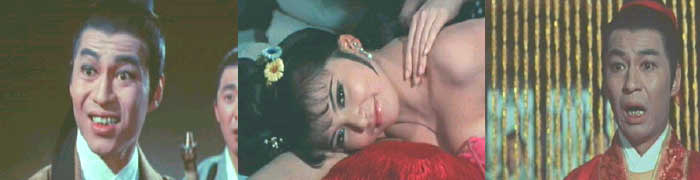
One issue is the leading man – Tien Ching had been a stable part of their
line-up since the late 1950’s and had shown up in a multitude of light contemporary
comedies and romances – to name just a few – “Our Sister Hedy”, “Cinderella
and her Little Angels”, “Spring Song”, “It’s Always Spring” and “Ladies First”.
Martial arts was a stretch – even a comedic one though he no doubt gave it
his best. He also wasn’t a leading man – almost always playing second fiddle
to another male character and always in the shadow of the female stars. Born
in 1935 in Shanghai, he moved to Hong Kong in 1949 and was in the film business
by 1956. After Cathay he was to become one of the more ubiquitous character
actors in Hong Kong – in numerous Shaw films and then later into the 1980’s
(“Peking Opera Blues”) and onto his early death at 58 in 1993.
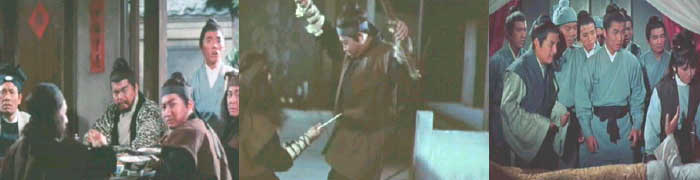
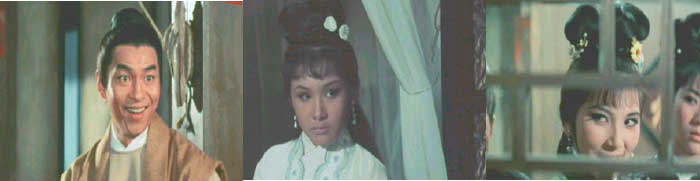
Chen (Tien Ching) is a bit of a coward and when three masters challenge
his martial arts school, he manages to avoid fighting and dying like most
of the other master’s pupil’s. On his deathbed, the sifu names Chen as his
successor and also to marry his daughter. She refuses to do so though until
he reestablishes the honor of the school by performing some heroic actions
– so out on the road he goes with his servant to become a hero. And he manages
to do so – though not through his martial arts skills but mainly through
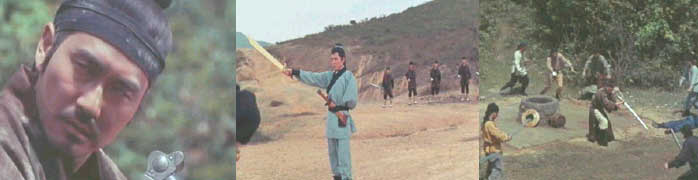
luck, cunning and when necessary cheating. He defeats the One-Armed Swordsman
by pretending also to have lost an arm, the White Crane by delaying the match
until his opponent is in agonizing pain for not having gone the bathroom,
the powerful leg kicker by plying the ground with a slick oil and the one
who practices Virgin Kung Fu by getting his friendly neighborhood prostitute
to wear him out sexually the night before. It is not as much fun as it may
sound. One of the few highlights is spotting Sammo - he plays one of
the major minions of the town bully and gets a fare amount of background
time.
Note – the historical information comes from
the book – The Cathay Story and in particular from an article by Stephen
Teo.