Jiang Hu: The Triad Zone
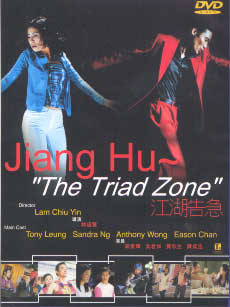
Reviewed by YTSL
In large part, it's because I'm subtitle dependent
when I watch Hong Kong films. Another factor to take into account is
that there sometimes is so much more crammed into them than the human eye
and mind may be able to adequately deal with, particularly in a single, continuous
go. Something else to consider is that more than a few of these offerings
have a multi-layer and/or mixed-genre nature that can still take some getting
used to for someone whose cinematic experience has been dominated for a large
part of her life by Hollywood works. For whatever reason, I do find
that many Hong Kong movies improve upon my viewing them a second -- or third,
sometimes still more...! -- time.
However, such did not prove to be the case with
the critically but not commercially well received JIANG HU: THE TRIAD
ZONE. Instead, I actually reckon that my appreciation of that which
is certainly ambitiously innovative -- but may be too much so for its own
good -- went down a notch upon my not once, but twice, feeling that:
Although this Dante Lam helmed HKFA Best Picture nominee most certainly has
its compelling and entertaining moments, they really don't seem to come and
hang together all that well. This having been said, I nonetheless will
point out that the ultimately too loose feeling work intrigued this (re)viewer
enough the first time around to make me want to re-watch and better get a
handle on it (And, despite my being a fan of repeat viewings, this is not
something that I think of doing with all that many movies).
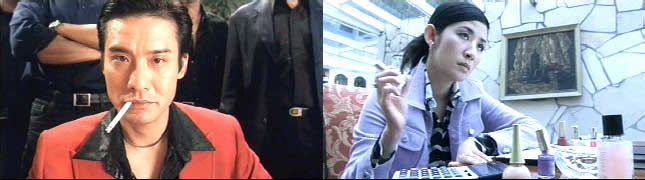
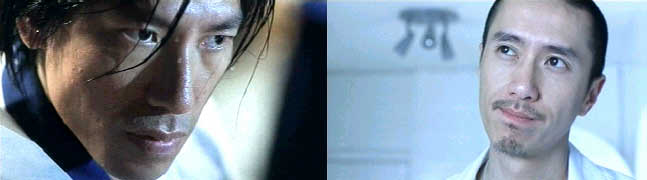
The first few minutes of the film that precede the on screen appearance of
the words JIANG HU: THE TRIAD ZONE are as showy and good a start to
a movie as any I have ever seen. In this short time, we are given a
concise working definition of Jiang Hu -- as a place without law but with
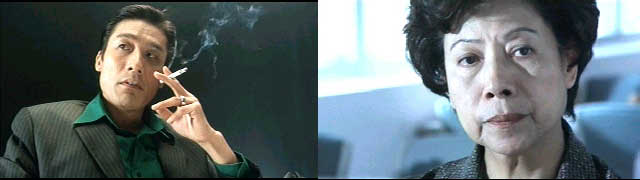
rules, honor and rivalries -- by a Triad boss named Jim Yam as well as an
action-oriented introduction to this interesting character (who gets played
with aplomb by Tony Leung Kar Fai). This is quickly followed by brief
but informative -- and often amusing -- introductions to some of the people
whose lives are intertwined with the offering's main man: His chief
bodyguard (Yue comes in the form of Roy Cheung); his (legal) counselor (Wai
is portrayed by the impressive Chan Fai Hung); his young mistress (Jo Jo
is confidently played by newcomer, Lee San San); and his complexly-drawn
wife (Sophie -- whose name is pronounced more like So-fa -- is a role that
Sandra Ng can thoroughly sink her teeth into).
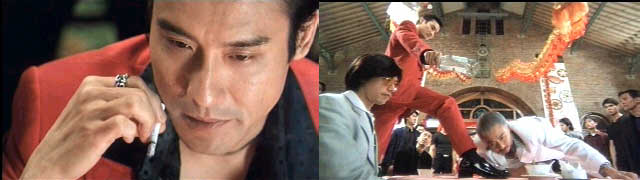
Before too long, it also gets revealed that someone wants Jim Yam dead.
Even as the underworld leader seeks to uncover the identity of this individual
(or group of individuals), he is making plans to use the latest unsuccessful
murder attempt as an excuse to get rid of his chief rivals (or at least deprive
them of their territory and power). Although much of this may sound
like old hat to those familiar with the tons of Triad dramas churned out
in past decades by Hong Kong movie makers, it -- and what ensues in the rest
of JIANG HU: THE TRIAD ZONE -- sure gets played out -- and also shot
(by Cheung Man-Po) -- in ways that do come across as rather novel as well
as unexpected. For example, the first attack on Jim Yam's person plays
more as a dark comedy than serious event. Then there are the plot twists
that comes from at least a couple of the other Triad kingpins (who are played
by Lee Siu Kei and Siu Leung) turning out to be more concerned with health
and biological family than criminal and other matters.
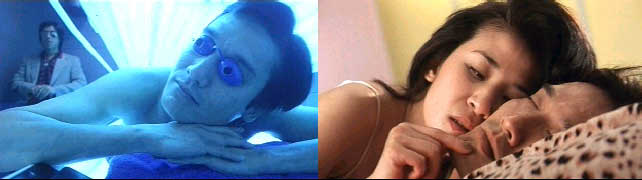
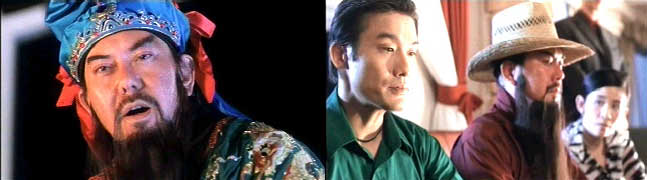
The quirkiness quotient in JIANG HU: THE TRIAD ZONE gets upped more
with the appearance onto the scene of Master Kwan Wan Cheung (who Anthony
Wong portrays with a degree of seriousness that can seem to be truly at odds
with the fact that his character is an appropriately unworldly Taoist god).
At the same time, Master Kwan and Sophie end up sharing a pool-side conversation
about contemporary perceptions of loyalty that -- together with a more emotional
one that takes place in a prison between a previously unknown character named
Jeff (Eric Tsang putting on yet another stunning performance in a small role)
and Jim Yam along with a revelation from Yue as to why he is willing to die
for the man in whose company he has spent much time -- seems to really cut
to the core of certain key issues that the film's makers are trying to address,
and not so much deconstruct but instead reveal as sometimes being crucially
differently enacted from the way they are often assumed to be.
If only JIANG HU: THE TRIAD ZONE had elaborated as well as focused
more on that which was only parceled out in too tiny pieces and at times
was in danger of getting lost in the parade of amusing -- but insignificant,
plot-wise -- cameo appearances by other famous names and faces (who include
Cantopop star Eason Chan, veteran actor Richard Ng, Piggy Chan -- of "Chungking
Express" fame -- plus directors Ann Hui and Lee Lik Chi). I also felt
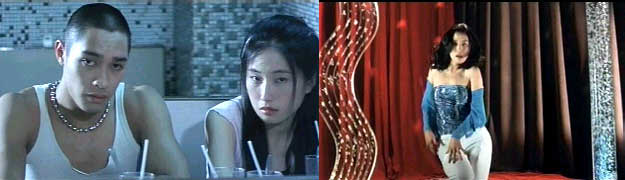
that greater and better use ought to have been made of the Young Turk pair
of Tiger (newcomer Samuel Pang looks like someone who bears watching out
for in the future) and his girlfriend (Jo Kuk has a face capable of expressions
that once seen, are hard to forget) even while recognizing how inspired was
the decision to let Kei's widow have the part to play in proceedings that
she did (Helena Law Lan provides the film with one of its most arresting
moments).
Still, what I found particularly unsatisfactory about JIANG HU: THE
TRIAD ZONE were two of the film's final scenes. With regards to one
of them: It wasn't so much the violence but the incongruously pleasant
music that played as it was being enacted. As for the other:
Let's just say that it makes me suspect that the screenwriting pair of Chan
Hing Kar and Amy Chin (who also served as this busy effort's executive producers)
differed with regards to their thoughts on what ought to be the fate of the
movie's principal character (and thus had the work end -- on the incomplete
as well as less than conclusive feeling note that it did).
My rating for this film: 7.
Reviewed by Brian
Jiang Hu was very nearly my favorite Hong
Kong film from last year (Only Spacked Out ranked higher) and it continues
to surprise me upon further viewings. It is a film with an overwhelming sense
of style that can barely contain itself upon the screen. Dante Lam concocts
such a visual gluttony of lurid colors, images and angles that one might suspect
that the film is much more style than substance. But that to me is the true
brilliance of this film – that underneath all the cinematic bravado and its
constant playing with our expectations is a story that works on various levels
and delivers a truly humanistic message.
The viewer might initially assume that they are in yet another triad film,
but it soon becomes clear that Dante Lam is slyly poking fun at the genre
with some absolutely hilarious deadpan tongue in cheek humor. With an obvious
jesting nod to Milkyway’s The Mission, the plot seemingly revolves around
some unknown party trying to kill the triad head – even with an under the
car/sniping scene that is more humorous than tense. But instead of a minimalist
and focused plot, this story riffs repeatedly in all sorts of unexpected
directions. The basic plot is really only an excuse for Dante to examine
the life of this triad leader, of the triad life style, of the concept of
loyalty or the lack of it in the modern world and of the depths of love.
Underneath the cinematic theatrics and the deadpan humor lies the real heart
of this film – a sense of being human, of being mortal, of being unique,
of dealing with a changing world that flies by all too quickly . Almost in
a sneaky manner, by the end of the film Lam has constructed some of the most
realized characters ever in a triad film. Not only does he create a highly
complex main character in Jim Yan who is very flawed - devious at times,
cruel at times - and yet still somehow good and generous and in love with
his wife – but Dante also wonderfully fills in the characters of the supporting
players. In what other triad film has the wife of the boss had such depth,
or has the bodyguard been much more than a silent heroic type or the lawyer
been more than a mouthpiece – but here they all have very distinct personalities.
Dante gives them a wistful sense of being real – of existing away from the
camera’s lens. And that though Jim Yan is the main focus of this film – every
character in it has their life outside and apart from his - whether
it be his wife or his mistress or the young tough couple or his rivals –
they all matter. By the end of the film, Jim Yan has embraced this humanistic
notion and the forgiveness he shows redeems him completely.
My rating for this film: 8.0