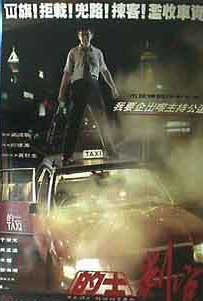
Taxi Hunter
Reviewed by YTSL
At the 2000 Hong Kong International Film Festival,
Anthony Wong -- together with Lau Ching Wan and Francis Ng -- was acclaimed
as being the most sought-after local character actors of the last decade of
the 20th century. From all accounts, the HKFA Best Actor winner --
for the notoriously grissly “Bunman: The Untold Story” -- is also quite
the character in real life, a loose cannon of sorts who is on the record
as stating that working with John Woo (on “Hard Boiled”) was “a nightmare”
and also that “I don’t think he is a particularly good director and I don’t
know why Hollywood thinks that he is...” (cf. Miles Wood’s “Cine East”, 1998:136).
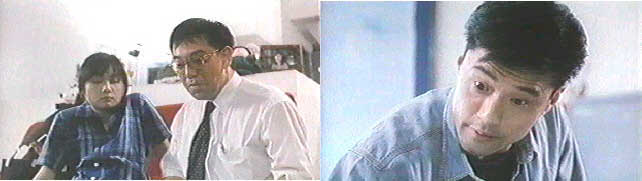
On the other side of the coin, Herman Yau appears to be Anthony Wong’s favorite
director as well as good friend. The outspoken actor has additionally
named a work helmed by Yau -- i.e., the Category III rated TAXI HUNTER --
as his favorite of all the films that he has worked on (which have included
dramas like “Ordinary Heroes” and comedies like “Now You See Love...Now You
Don’t” along with actioners and a whole range of Cat. III productions).
This reason seemed as good as any for this (re)viewer to want to check out
the 1993 effort in which Anthony Wong portrays a mild-mannered insurance
agent turned anti-taxi driver vigilante who a fellow Hong Konger has described
as: A “little man citizen who stands up to injustice in society”; plus
is less of an outright (anti-)hero or villain than a complex individual who
“recognizes no fine moral divide and exists in the contradictory realm of
the gray area between good and bad” (Stephen Shin, in his “The Professionals”
chapter of the “Hong Kong Panorama 1999-2000”, 2000:94).
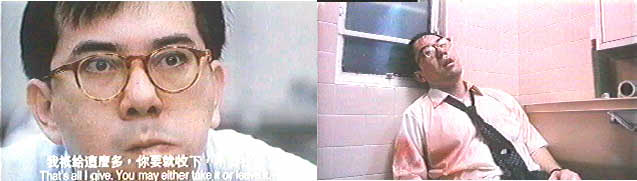
What with my being (more) used to seeing Anthony Wong play often deceptively
ordinary looking maniacs as well as obviously colorful characters, it felt
strange watching a bespectacled him acting like the Volvo-driving white collar
worker and doting husband that his Ah Kit character primarily and sincerely
appeared to be in the first 20 minutes or so of TAXI HUNTER. Actually,
even after he is given cause to hate a whole host of almost unbelievably
callous and ill-mannered taxi drivers with a vengeance (by way of his pregnant
wife -- who is played by Perry Lai -- and unborn child losing their lives
as a result of one such cabbie), Ah Kit may still be one of the less generally
frightening and deranged personae that Anthony Wong has essayed. As
such, this movie is much less the horrifically ultra-violent flick that I
had anticipated it would be than a sympathetic account of how a good man
could get moved to want to kill certain of his fellow human beings (who may
not be the nicest people in the world but still are individuals with jobs,
friends plus -- in all probability -- family for whom they lavish love and
care).
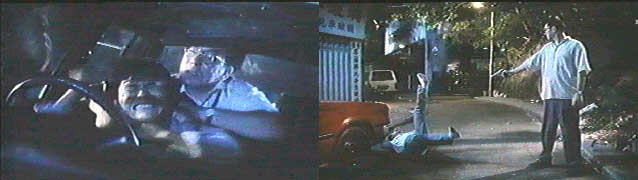
In some other films (in which murders are committed and the police are detailed
to identify the criminal and get him -- or her -- off the streets), the clean
cut Sergeant Yu Kai Chang character portrayed by Yu Rong Guang would be the
hero of the piece. Instead, in TAXI HUNTER, his principal relevance
to the main story comes by way of his being the best friend -- and maybe
even close relative (since he can be heard addressing Ah Kit’s wife as “sister-in-law”)
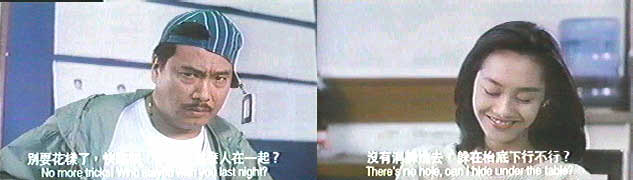
-- of the film’s protagonist. Although Ng Man Tat’s Mak Si Gao -- who
is Sergeant Yu’s way less professional partner -- and Athena Chu’s Mak Suet
Yan -- a TV reporter who also happens to be Mak Si Gao’s daughter -- initially
look like they only are around to be the comic relief and love interest respectively,
they end up having more meaningful roles to play in this crime drama.
Alternatively, the role of Senior Inspector T. M. Chan does appear to be
not much more than an extended cameo opportunity for the very recognizable
Woo Fung.
In “Sex & Zen and A Bullet in the Head”, Stefan Hammond and Mike Wilkins
asserted that in the year of TAXI HUNTER’s production and release, “HK taxi
drivers came under fire for all sorts of rude behavior: cruising around
with “Out of Service” notices that disappear at the wave of an HK$100 note,
levying illegal surcharges in bad weather, and refusing to take people short
distances. A sizeable groundswell of ill will spiked up” (1996:170).
It thus is almost surprising that -- unlike with Herman Yau’s “The Untold
Story” and “From the Queen to the Chief Executive” -- this offering’s main
events are not based on -- but, instead, only inspired by -- real life happenings.
On the other hand, I must confess to being somewhat flabbergasted to learn
that the work is considered by some Hong Kong movie critics as a black comedy
since I tend towards the view that it can be read as a sad indictment of
how arch-capitalist and anti-social tendencies can move people to be terribly
inconsiderate of strangers (who nonetheless are fellow denizens of their
territory)!
My rating for the film: 7.