Undercover Blues
Reviewed by YTSL
In the first few minutes of a 2000 film that he
co-produced (with Peter Chan Chi Keung (who oughtn’t be confused with U.F.O.
doyen, Peter Chan Ho San), Ray Lui intones that “the world has changed faster
than me”. Twice during the crime drama whose script he co-wrote (along
with Edward Pang), Simon Loui is heard to similarly say that “I haven’t changed
but the world has changed”. Far less opaque in meaning and implication
for me though were those statistics -- none of which I feel any particular
reason to think of as entirely unfounded -- brandished before this movie
drew to a close that told of it being so that: At any one time 250
of Hong Kong’s 34,000 police officers are involved in undercover work; and
upon their completion of these assigned undercover stints, 50% of the individuals
involved return to more conventional policing duties, 30% of them decide
to leave the police force while the remaining 20% end up really joining the
Triads, are killed or...vanish.

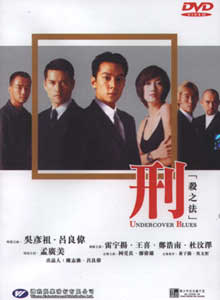
UNDERCOVER BLUES centers on the efforts of four undercover policemen sent
on a 48 hour mission to retrieve another undercover operative feared to be
in particular danger upon his going to Kuala Lumpur, Malaysia to take part
in effecting a major drug deal for his Hong Kong-based “boss”. When
word is received that the deal involved HK$50 million worth of “ice”, some
people start to suspect that the possibly “lost” young undercover, Joe Wong
(who is played by Daniel Wu), had given in to temptation and genuinely crossed
over to the criminal side. However, this thought is not one that Frankie
Chan, the high-ranking cop put in charge of this special operation (and portrayed
by Ray Lui), is willing to entertain at the outset.

One reason given for this is that orphan Joe seems to be Frankie’s main protege.
Another is that up until two months ago (i.e., before Joe went undercover),
the two of them had been firm friends who hung out quite a bit together.
Fred (who is menacingly essayed by Simon Loui), is someone else in the rescue
party who could be considered to be a friend of Joe. Unlike Frankie
though, he is less certain of Joe’s ability to stay on the straight and narrow.
After all, like Fred pointed out to the senior officer, what’s involved in
this particular drug deal were amounts of admittedly illegal goods and cash
whose monetary amount was way more than any policeman could possibly think
to legally earn in his entire working life, if not lifetime. If he
were in Joe’s position, Fred told Frankie, he would take the merchandise
and money and run.

Neither of the two others on the 48 hour mission seems to have specific opinions
about whether or not Joe is a good cop turned bad. Or, at least, we
are spared their musings re their brother officer (who only briefly crossed
paths with one of them and is a complete stranger to the other). As
such, Simon (a not 100% “clean” erstwhile undercover policeman who comes
in the form of a bleached blonde Mark Cheng) and Charles (a solid guy played
by Wong Hei who also has the case of the UNDERCOVER BLUES, courtesy of his
police work having caused him marital problems) really do seem to be just
there to do a job at the request of Frankie, who had handpicked this squad
of four.

Seeing as the Billy Chung directed effort’s focus is as much about the four
undercover policemen sent on assignment to Malaysia as well as the operation
they undertake, I can see why comparisons have been made between UNDERCOVER
BLUES and Johnnie To’s “The Mission”. However, as far as this (re)viewer
is concerned, that which also features appearances by Jessy Meng (as the
estranged girlfriend of Frankie who the group encounters by chance in a nightclub
that Joe’s trail had led them to), Chapman To (as the Hong Kongers’ Malaysian
contact) and Blackie Ko (as the man named Lo Hung, AKA Spanner, whose “business”
Joe had been assigned to learn more about) is really not in the same league
at all with the Milkyway Image production. Perhaps I would have felt
differently if the budget offering’s cinematographer had not had such an
irritating propensity to saturate the picture(s) with moody blues and related
greens. As it stands though, I consider this tightly-plotted movie
with an interesting premise to be -- in more ways than one -- not colorful
enough for my liking.
My rating for the film: 5.5