The Story of a Discharged
Prisoner
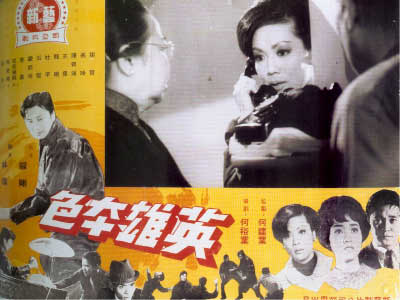
Director: Lung Kong
Year: 1967
Rating: 7.5
Though best known
to modern Hong Kong film fans as the inspiration for JohnWoo’s A Better Tomorrow,
this 1967 film was an important film on it’s own merits. At the time of its
release the Cantonese film industry had fallen victim to plummeting attendance
and was in danger of completely disappearing. The Mandarin speaking films
being produced primarily by the Shaw Brothers but also those from companies
like MP & GI had come to completely dominate the film industry during
the 1960’s with their much higher budgeted films. The Cantonese films on
the other hand were produced on a shoestring budget and had come to be known
as “weeklies” – both the amount of time it usually took to make them and
the amount of time they played in theaters. The Mandarin films also had a
much larger distribution network throughout Taiwan and the overseas Chinese
communities.
The main attraction that kept Cantonese films from completely floundering
were a group of charismatic young stars such as Josephine Siao, Connie Chan,
Nancy Sit, Woo Fung and Patrick Tse Yin. Needing to attract an audience certain
Cantonese directors also began producing edgy contemporary films with a social
message. Chor Yuen was the leader of this group of directors with films like
The Black Rose and The Joys and Sorrows of Youth that explored issues of
social inequality. Following on the steps of Chor Yuen were the social realism
films of Lung Kong in the late 60s. In his films he addressed issues such
as juvenile delinquents (Teddy Girls), prostitution (Call Girls), atomic
war (Hiroshima 28), the breakdown of the social fabric (Yesterday, Today
and Tomorrow) and in The Story of a Discharged Prisoner Lung Kong relates
the difficulty that ex-prisoners face on the outside. The films of Lung Kong
and Chor Yuen did not revitalize Cantonese cinema (that was left to the Hui
brothers), but they kept the flame flickering and their films greatly influenced
the Cantonese New Wave directors of the early 80’s.
Looking back at this film from today’s perspective, it certainly shows its
age and the low production values – but is still a very enjoyable film to
view. The stark black and white photography and formal method of acting make
it look more like a Hollywood film of the 1940s than one of the 60s. The
terrific jazzy music score also brings many of the film noirs from that period
to mind. With the use of this score, location filming, quick editing and
fluid camera movement, Lung gives the film a real rhythm, energy and a pace
that continuously pushes the story. The film is also populated with a group
of diverse and interesting – if somewhat one-dimensional characters.
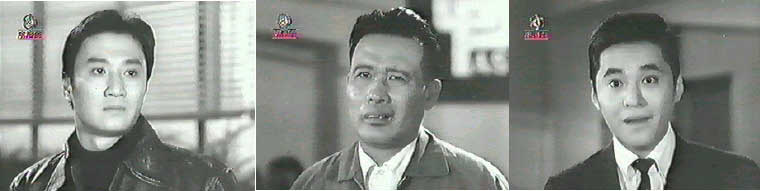
In the opening sequence Patrick Tse Yin (father of Nicholas Tse and a huge
star at that time) is captured after breaking into a safe when he returns
to help one of his wounded men. He goes to Stanley Prison for a long stretch
and during that time decides that he will go straight when he gets out. While
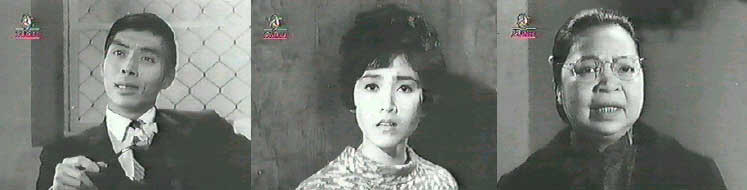
inside, his brother (Wong Wai) is told that Tse Yin is a businessman in Singapore
– and after being released Tse Yin stays away from his brother and mother
(Mak Kai?) for fear of bringing shame on them and hurting his brother’s chances
of advancing in his job.
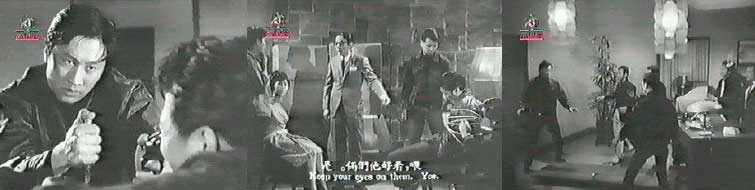
Instead Tse Yin looks up his old partner (Sai Gwa Pau?) and stays with him
in a very poor area of Hong Kong. He only wants to find a job and stay out
of trouble, but this doesn’t prove to be an easy thing to do. He is squeezed
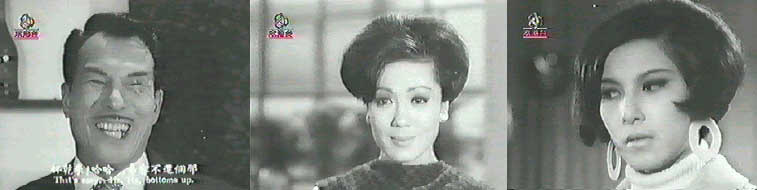
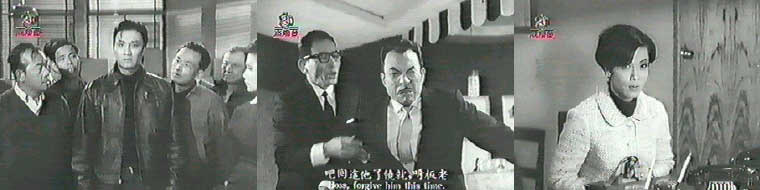
from both sides as criminal boss Sek Kin (in a terrifically campy one-eyed
performance) wants his services back and a fanatic police Inspector (played
by Lung Kong) wants him to become an informer in Sek Kin’s gang. Though one
is a crime boss and the other a cop, they are simply two sides of the same
coin and Tse is pushed into a desperate corner, as his friends are beat up,
his employers are forced to fire him and the cops constantly harass him.
Only the supervisor of a rehabilitation center (Ka Ling - one of Tse Yin's
most popular romantic film partners) and his ex-girlfriend (Monita Lopez?)
stand on his side, but when Sek Kin kidnaps the brother and his fiancé
(Chan Chai Chung?), Tse decides it is time to take up the gun again and finish
what needs to be finished. Though some of the themes of this film are carried
into A Better Tomorrow - particularly the love and sacrifice of the older
brother for his younger brother - this is much more a drama than an action
extravaganza. There are a few action scenes in the film though with Tse Yin
showing some kung fu moves and some gunplay - but they are extremely mild
in comparison to Woo's film.
I am just guessing at some of the names of the
cast members - if anyone knows differently please let me know. Thanks.