Gunmen
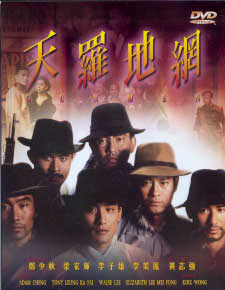
Director: Kirk Wong
Year: 1988
Rating: 7.0
One of the more enjoyable
traits about Hong Kong action is its ability to often integrate an emotional
wallop alongside the action and thus make the entire experience almost cathartic
at times. Wonderful examples of this are Pedicab Driver and Once Upon a Time
in China. Gunmen attempts to do this with a volatile mix of frantic, frenzied
gunplay and high melodrama, but oddly it never quite connects. Looking at
the men behind the camera – Kirk Wong as the director and Tsui Hark as the
producer – one might conjecture that Wong provided the action while Tsui
injected the melodrama into the script. In his role as producer for many
films, the extent to which Tsui gets involved is always open to question
– it is often rumored that he had a very forceful hand even to the point
of directing sections of some of those films. In his dealings with John Woo
(A Better Tomorrow, The Killer) his constant oversight led to an angry rift
between the two men.
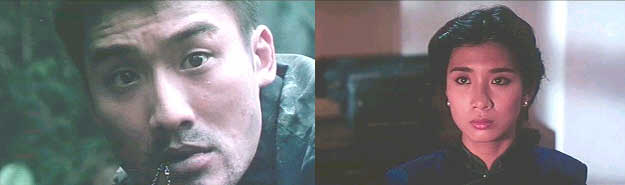
The action here is terrific – visceral, brutal at times, with rapid editing
and a splendid sense of motion – often chaotic but visually eye-grabbing.
In his book, Planet Hong Kong, David Bordwell often refers to this film as
an example of how Hong Kong does action sequences so much differently and
more effectively than Hollywood – he says of this film, it “achieves a nervous
vigor and, particularly in the finale, a genuine sense of life at risk, down
to the bare bones, everything reduced to the settling of scores”. The action
is often in your face close and personal – a bayonet through the stomach,
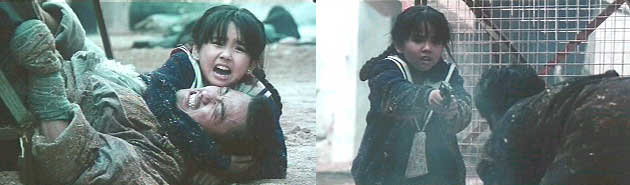
a close shot to the head, a man on fire and in its most famous scene a small
girl picking up a gun and blowing away the bad guy with a bullet to his chest.
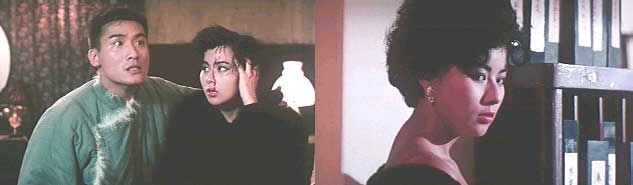
The dramatic narrative though doesn’t complement the action as well as it
could have. The characters are all one dimensional stock personalities –
Tony Leung Ka Fai as the honest cop, Carrie Ng as the devoted wife, Elizabeth
Lee as the prostitute with a heart of gold – and they never really generate
a lot of empathy or interest. Their story plays out like a Taiwanese weepie
as every time Tony and Elizabeth come into contact, Carrie coincidentally
comes along and sees them and draws her own conclusions and drops whatever
she is holding. This being in a large city like Shanghai it feels very contrived
and silly. The film also loses some dramatic tension by quickly jumping ahead
in time or making blink of the eye scene transitions with no explanation
and leaving it to the viewer to catch up with this moving train of a film.
It is as if Wong simply doesn’t want to waste a moment on exposition if he
doesn’t have to – but by not developing the characters and plot beyond his
shorthand characterizations, the film loses a lot of its potential emotional
impact.
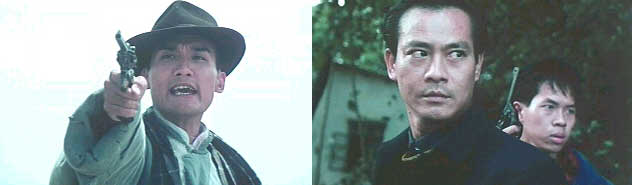
During a nameless war in the 1920s (though apparently the laserdisc identifies
it as the 1926 Chinese Civil War), Tony and his three friends (Mark Cheng,
Waise Lee and David Wu) are about to be tortured and executed by Adam Cheng
when the war ends suddenly and the men are on their way home to their families.
Tony meets Carrie and in one of those quick jumps – he is next a cop in Shanghai
fighting the opium trade with his Captain (played by Yuen Bun). The Captain
is killed by a mobster who turns out to be the same man who was about to
execute Tony, Adam Cheng – and soon Cheng’s boss dies and he blames Tony
- leading to both men desperately wanting revenge.
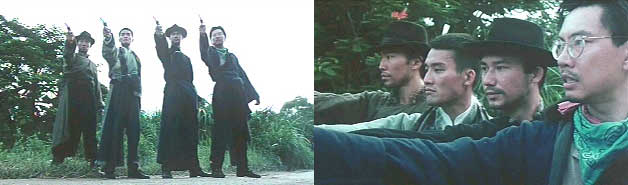
The film takes on vestiges of The Untouchables as Tony recruits his three
uncorrupt friends to fight the mob and to fight the police bureaucracy symbolized
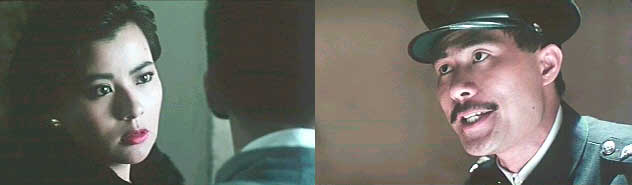
by the by the book superintendent (Tsui Kam Kong). Elizabeth is a lovely
prostitute that Tony recruits as an informer and it appears that business
turns to pleasure at one point. It all leads to the big finale in which everyone
gets involved in the bloodletting from Tony and his men, Tsui Kam Kong, Elizabeth
and even Carrie and their daughter – against a horde of bad guys. The film
could have been much better with some added time and care paid to the story,
but the action and cinematography still make it a very solid effort.
DVD Information:
Distributed by Media Asia/Mega Star
The transfer is excellent - sharp, good colors
- very nice al around.
Letterboxed
Cantonese and Mandarin language tracks
9 Chapters
The subtitles are Chinese, English Japanese or
Korean.
There is a trailer for this film but no others
except the Media Asia promo.
There are bios for Tony Leung and Waise Lee .