Arrest the Restless
Reviewed by YTSL
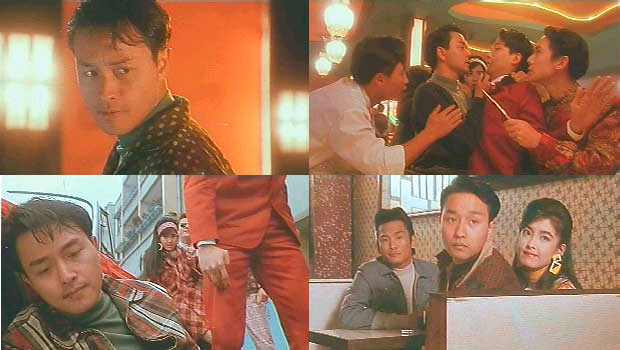
As Paul Fonoroff observed in his review of this
1992 work, “The critical and box office success of [1991’s] “To Be Number
One” and “Lee Rock” ushered in a new mini-trend in Cantonese cinema: loosely
based-on-fact biographies of 1960s-era big shots” (See his “At the Hong Kong
Movies: 600 Reviews from 1988 till the Handover”, 1998:226). In many
ways, this atmospheric effort -- which shares the same director (Lawrence
Ah Mon) as the two-part 1991 productions that similarly focused on a less
than “clean” cop -- is an obvious example of this type of period offerings
(that appears to have had its day). Indeed, its makers’ attempts to
ally itself with those two influential films can be seen by their deciding
to insert the earlier movies’ leading characters into this later release’s
proceedings.
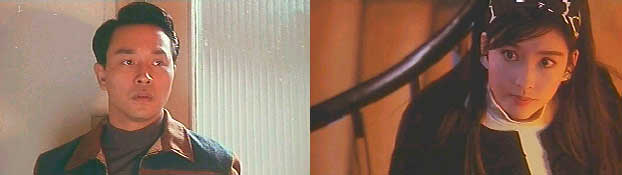
This fact notwithstanding, Gimpy Ho and Lee Rock are but side characters
in this movie that asks -- plus seeks to furnish answers as to -- whether
a corrupt member of the police force or designated juvenile delinquent is
a worse menace to society. Instead, ARREST THE RESTLESS’s spotlight
is trained on a couple of apparently less influential individuals.
This main pair’s adult member is a bribe-seeking, but otherwise honorable,
police detective whose re-assignment early in the film to head the Juvenile
Section can be seen as a demotion (Sergeant Lam Kong is played by Charles
Heung, who also co-produced this offering with his brother Jimmy).
The stylish looking work’s primary “teddy boy” -- whose law-breaking deeds,
like those of his “gang” and enemies, fall under “Lam Sir”’s section’s jurisdiction
-- is a charmer referred to as Teddy in the effort’s English subtitles but
Fei on its Cantonese soundtrack (like with the similarly rebellious, albeit
older, personality who Leslie Cheung had memorably essayed two years earlier
in “Days of Being Wild”).
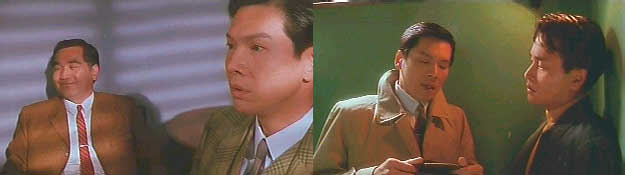
In view of Charles Heung’s often coming across as expression-less even when
he might not have been trying to appear this way, it comes as a bit of a
relief that many of the sections of ARREST THE RESTLESS in which Sergeant
Lam Kong takes center-stage also have two of his more lively looking plus
acting subordinates figuring in them. If I am not mistaken, one of
them -- the bespectacled Whiz -- actually is portrayed by Fruit Chan (i.e.,
the director of “Made in Hong Kong” and other critically acclaimed films).
Should this be the case, it constitutes fodder for my contention that this
offering’s casting choices -- which also brought Paul Chun Pui (as the corrupt
Sergeant in Chief, Ngan Tung), Lee Siu Kei (as Spunky), Henry Fong Ping (as
the movie’s lead female character’s record shop owning father), Guk Fung
(as a martial arts sifu who also is versed in the healing arts in the tradition
of Wong Fei Hung) and Joe Cheung (as the not necessarily completely upright
Sir Chow Tung) into the picture -- are among its more interesting aspects.
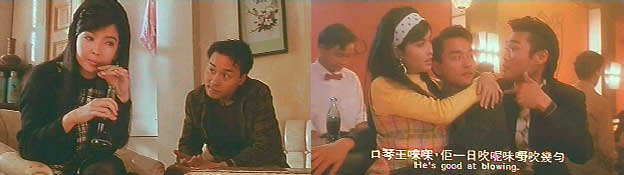
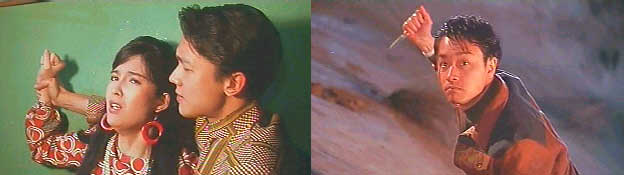
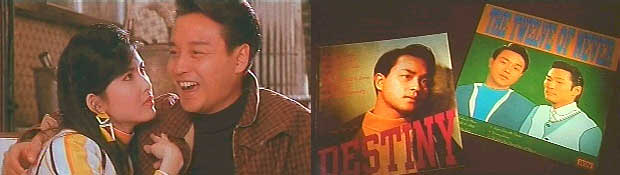
Additionally, while it might have seemed like a mistake on paper for the
then 36 year old Leslie Cheung to be given the role of a juvenile, it is
this (re)viewer’s opinion that the boyish faced personality was pretty convincing
as a troubled youth. By the same token, for all of Vivian Chow having
had her share of critics, she was suitably fluffy looking and innocent acting
as Siu Man -- the gal who Fei loved, yet was apt to forsake whenever his
male buddies came calling for help. Indeed, if I were to single out
one person as the weakest member of the cast of ARREST THE RESTLESS, it wouldn’t
be its main actress as well as first bill sharing actors or those who are
better known for their behind the camera than on screen work. Instead,
the performer in this very nicely lensed (by David Chung) production I’m
most inclined to point an accusing finger at would be Deannie Yip (who surely
is guilty of over-acting in her portrayal of Fei’s admittedly far from conventional
mother).
Admittedly, the veteran actress is accorded few favors by her major debt
owing, gambling addict character being -- along with a spoilt brat named
Sam Chow (who is Fei’s opposite in many ways, including in terms of family
background but also general disposition) -- the most likely to drag down
the “teddy boy” about whom Sergeant Lam had seriously opined actually was
“a smart kid with a future”; and this despite his own protestations that
“I do not think of the future”. In any event, it can appear to be so
that without her character being in the picture, the life of ARREST THE RESTLESS’s
most charismatic individual probably would have been less rife with problems
and frustrations; and the movie itself -- whose Chinese title apparently
is “The Lam Kong Story” -- might, for better or worse, have focused more
on the elder of its two main males.
My rating for this film: 6.