PTU
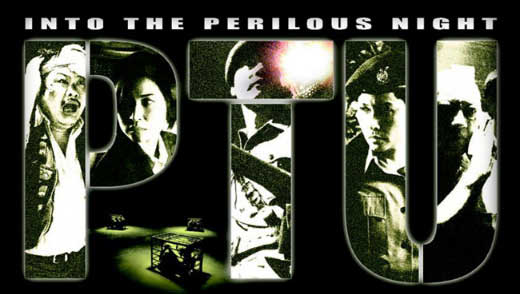
Director: Johnnie To
Year: 2003
Rating: 8.0
Darkness descends
on Kowloon and the chaotic multitudes that traverse her steamy streets during
the day begin to dissipate like a lingering mirage to their safe homes behind
locked doors. As nighttime makes its steady progress, the storekeepers
slowly close shop and bring down the metal gates to mark the end of another
day. Soon the streets are nearly deserted and only shabby little restaurants
remain open as lit outposts in the darkness. These hours belong to the night
creatures on both sides of the law – small units of police (PTU – Police
Tactical Units) who cautiously patrol their area with a God like sense of
ownership and the triads who are open for business 24 hours a day. Between
these two forces there is constant probing – looking for weaknesses or co-operation
– as they warily dance around one another like boxers wanting to go the distance.
It is in this noirish milieu that Johnny To unravels his tale of crisscrossing
fates one late night in Kowloon over a radius of a few blocks of turf that
they all call their own. In the shadows of the night there are only grays
– no white and black – and each side does what they have to do to gain respect
and to assert control.
So it turns out that Johnnie To’s brains haven’t turned into mush after all.
Since turning away from his run of exquisite minimalistic crime films of
the 90’s to more commercial ventures one might have wondered. None of the
Milkyway crime films did particularly well at the box office – even his acclaimed
masterpiece The Mission brought in only HK$ 4.6 million (US$ 600,000) and
so beginning in 2000 To joined the production company “One Hundred Years
of Film” and began making more commercially viable films. This was probably
a pretty good idea since the owner of the company is Charles Heung whose
brother is one of the triad’s top big boys! So out came Needing You, which
was a huge hit (HK$ 35 million) and other popular comedies were soon to follow
– Wu Yen, Love on a Diet, Fat Choi Spirit, My Left Eye Sees Ghosts and Love
for all Seasons. To also directed two crime films – Full Time Killer and
Running Out of Time II – but these were big splashy empty-headed affairs
that were completely missing his earlier poetic nuances and complexities.
PTU harkens back to those lean Milkyway days with a tense narrative relaying
overlapping plot lines, a myriad of wonderfully depicted characters, terse
dialogue and stylish cinematic flourishes. The film is about the rhythm of
the night and of the life these people have chosen. It is about eyeing each
other up in a hot pot restaurant, it is about treading the darkened streets
in watchful formation, it is about loyalty to your comrades, it is about
going up lonely stairs not knowing what is waiting for you, it is about surviving
the night. Much like The Mission, the film is about the process – the waiting
time, the stillness, the job and the anticipation before something happens.
There is very little action in this film - really none until the finale
– and it isn’t a character driven film either as we learn next to nothing
about these people (though To does a masterful job in making them all very
real with a few quick swipes of his brush) – it’s a very simple film in many
ways – it is about a few hectic hours on one hot night in Kowloon in September
2000 in which a number of people seem fated to come together and some seem
fated to die.
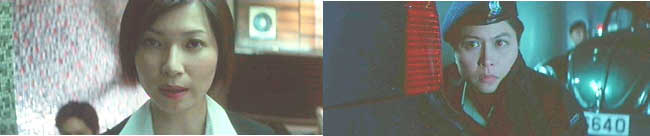
Two PTU units of four cops each are beginning their evening shifts – one
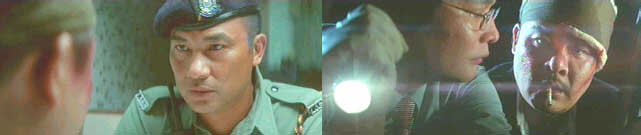
headed by Mike (Simon Yam with Raymond Wong as a member of his unit) and
the other by hard-nosed Kat (Maggie Siu). News comes over the police van
radio that a policeman has been killed and the young cops joke about it until
Yam quiets them with a stern admonishment “Anyone wearing the uniform is
one of our own” and Maggie adds, “Whatever happens, nothing beats returning
home safely”. Soon they are dropped off to begin their patrols and there
are no more light moments from that point on – it’s all business. A few blocks
away plainclothes cop Sergeant Lo (Lam Suet) is playing sly power games with
Ponytail and his four followers by showing them up in a small restaurant.
Not to lose face, Ponytail has his gang brothers set up an ambush for Lo
– not to kill him – but just to show him that this is a two way game. In
the ensuing incident Lo is knocked unconscious and when he wakes up his gun
is gone – and so too are his prospects for a promotion if he doesn’t get
the gun back before his supervisors find out.
Over the objections of Kat, Lo enlists the aid of his fellow cop Mike to
help him find the gun – but a deadline is issued – if the gun isn’t found
by 6 a.m. its disappearance has to be reported. Mike turns his unit into
a walking punch and as they wade through the seedy joints of Kowloon looking
for answers anyway he can get them. Lo is searching as well and is soon faced
by a dilemma as to how far is he willing to bend the law or even break it
in order to get his gun back as he finds himself between two rival triad
gangs. While all this is happening, an added complexity comes in the straight
arrow form of CID Inspector Leigh (Ruby Wong) who is investigating a triad
hit and keeps coming across the furtive tracks of Lo and wonders what he
is up to. It plays out wonderfully well and comes together in a slam-bang
ending that felt like a winking joke dealt by the heavens.
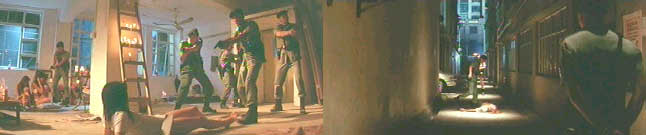
The pacing of the film is slow and methodical – it has its own inner logic
and plays out truthfully to the situation. To never feels the need to rush
the proceedings or to give it a sudden jolt of adrenaline by throwing in
an action piece – this is old time noir where the mood, the designs, the
shadows, the moral grayness is allowed to take root and To utilizes stark
but beautifully framed cinematography to amplify it. There are numerous shots
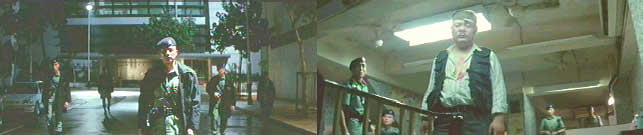
simply of the PTU unit walking their patrols – allowing light and darkness
to create a sense of constant danger - or one of them changing into
slickers with a sudden rain - mood pieces but admittedly it all makes them
look quite heroic and cool. Contrasted to their spick and span professionalism
is Sgt. Lo – appearing for most of the film like something the cat dragged
in – constantly sweating - always looking for an angle or an edge – clearly
playing his own game. Though not given nearly the screen time as the cops,
the triad members that To ushers into the story are an interesting lot –
in some ways more honorable and personable than the cops.
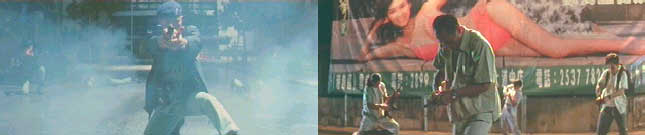
It is difficult to discern what To’s attitude to the cops is here – the PTU
group is certainly filmed from a heroic perspective – four men making the
streets safe – always at risk – grim and straight jawed, but at the same
time their acts of brutal interrogation are slaps in the face – heroes don’t
beat a helpless man till he almost dies or force someone to rub off their
tattoo until it is a bloody mess. And yet this is exactly the gray world
that To throws his viewers into and allows them to ponder all this. It is
a master filmmaker back in form again with this sleek layered minimalist
tale of cops and triads – sort of where he belongs.