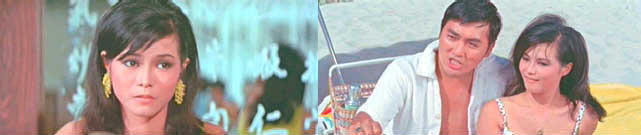
Dairy of a Lady Killer
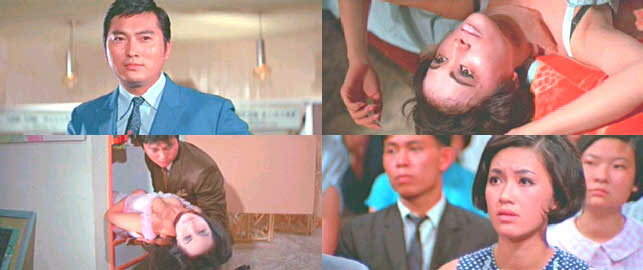
Director: Yeung Shu-hei aka Koh Nakahira
Year: 1969
Rating: 5.5
During the 1960’s
the Shaw Brothers reached out a number of times to Japan to gain some of
their cinematic skills in technology and style. It began initially when the
Shaw’s witnessed the popularity of the Japanese Chambara films in Hong Kong
and wanted to incorporate some of these qualities – graphic violence, faster
action choreography and stylish designs – into their wuxia films. They did
this by bringing some Japanese directors and technicians to Hong Kong and
by also sending some of their staff to Japan. They later used Japanese directors
for films other than wuxia – in particular utilizing Inoue Umetsugu who directed
over fifteen films for Shaw – many of them lavish musicals. Another Japanese
director was Matsuo Akinori (Mai Chi-ho) who directed two Hong Kong films,
The Lady Professional and Asia-Pol.
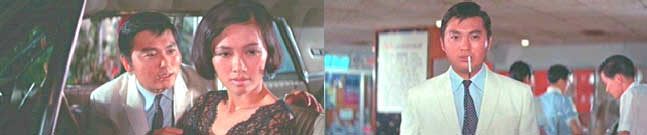
Dairy of a Lady Killer also comes via Japan – directed by Koh Nakahira/ Nakahira
Yasushi (Chinese name,Yang Shu-hsi). Nakahira had worked with both Akira
Kurosawa and Suzuki Seijun back in Japan and had directed a number of films
there before coming to Hong Kong in 1967. He was considered one of the premier
post WWII New Wave directors with his themes of youth and sex. He directed
four films for the Shaw Brothers – Inter-Pol, Trapeze Girl, Summer Heat and
this one. Three of them including Diary were remakes of some of his Japanese
films – Diary from a film called The Hunters Diary produced by Nikkatsu in
1964. He brings a nice eye for design style as all the Japanese directors
seemed to and a willingness to film outside of the confines of the Shaw studio
sets.
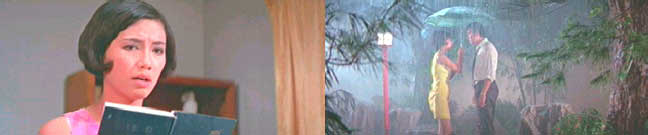
The film though doesn’t generate as much excitement or tension as the premise
might lead one to hope. It feels a bit slow and ponderous at times and the
supposed mystery of the film carries the suspense of a brown bag lunch from
home. Not having seen the original, I can’t say whether the sexual content
of the film was toned down, but this definitely has little sizzle in that
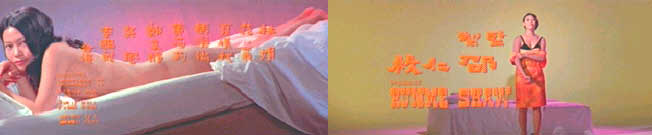
regard. In an odd choice, most of the erotic substance of the film takes
place during the opening credit sequence with a few nude shots - one
of Tina Leung/Tina Ti – but in the film itself there is very little – only
a quick shower scene with Fannie Fan. By the end the film was testing my
patience in a number of ways, as the killer had been obvious for a very long
time if one was staying awake and I was getting annoyed with everyone – that
was still alive.
The film opens nicely as the camera slowly pans a typing pool of young women
– one desk has no one sitting there though and the camera zooms to an open
window with her shoes lying there. She is hanging outside from the ledge
on the verge of suicide – and suddenly lets go and falls to her death. Her
sister begins to look into the cause of her unhappiness and of course finds
a man behind it. Chin Han (the one who married Ivy Ling Po) is a modern day
lothario – a lady-killer in the old fashioned vernacular. With his tight
stylish suits, good looks and reputable job, there are few women who can
resist his charms. He hits the streets of Hong Kong when the mood strikes
him (often) and looks for a suitably lonely looking target to ply with drinks
and sweet words. More often than not they fall for his lines like a starving
fish and end up back at his hotel room for a roll in the sheets. The next
day Chin bids them adieu and rarely looks back. Wanting to keep a record
of his trophy taking, he keeps a diary of his conquests with all the details
of how he seduced them.
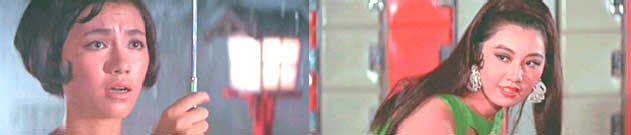
He has a fiancée (Fang Ying), but she is a proper girl that sternly
refuses his whimpering advances and tells him to wait till they get married.
One night after being rejected again, he bangs his head in frustration on
the steering wheel and sets out for a little fun, feeling fully justified
for cheating on Fang. He heads for that well-known pick up spot – a bowling
alley – where he quickly spots and sizes up Fanny Fan decked out in sexy
green and with a lurid smile that spells “available”. He shows her his bowling
skills and she is suitably impressed enough to want to see his other skills
– strike!

One night with Fanny is enough and he is soon on to other targets – the next
night he spies Margaret Tu Chuan through the window of a record store and
follows her to a Japanese movie that is playing (bonus points to anyone who
can I.D. the film being played) and she is soon mewing back at his place
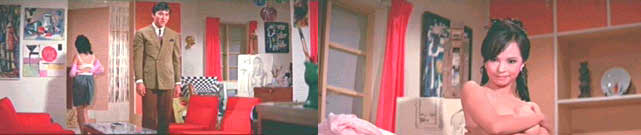
like a lost kitten. The next day it’s an artist he sees painting – he pretends
to be an art dealer and a few drinks later Tina Ti has invited him to her
place. As an art connoisseur he insists on seeing her best artwork – her
nude body and she mildly resists until her roommate comes in and spoils the
fun.
He takes some time out from his activities – when does this guy work anyway?
– and notices that some of his conquests are getting into the paper – unfortunately
in the obituary section – murdered soon after he had seen them. Coincidence
or not – the cops don’t think so. Fang finds out about his nocturnal activities
by reading his diary, but instead of giving him the heave-ho like he deserved,
she suggests he take care of this sex addiction – I think Michael Douglas
has a number he can use. At about this point I started losing interest in
the film as she goes about trying to prove his innocence.
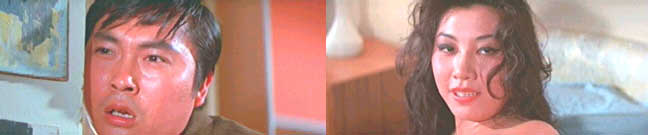
This was the last film for both Fanny Fan and Margaret Tu Chuan – both well-known
actresses during the 1960’s for their libidinous roles. Fanny married and
retired from the business. She had been in films since winning a beauty contest
and joining Shaw in 1957. At first she was in the Cantonese division under
the name Wan Li Hong, but she soon switched to the Mandarin film division,
changed her name and soon found success in the film Pink Murder and notoriety
for her sexy role in Golden Buddha. Her curvaceous figure earned her the
nickname “the Oriental Brigitte Bardot”. It was Margaret’s final film for
a very different and tragic reason – she was soon afterwards to commit suicide
with her reputed female lover. Nicknamed the “Wild Girl” for her lifestyle
she had begun in film in 1957 with Cathay but soon moved to the Shaw Brothers.
She became a star in the 1960 film How to Marry a Millionaire, but over the
next few years her career soured and her marriage into one of Hong Kong’s
more elite families went bad and she turned to sleeping pills on November
30th 1969.
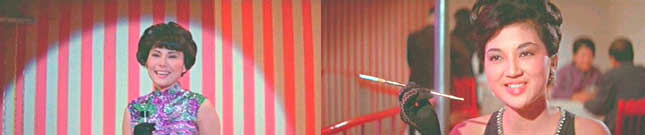
The film also has a few other cameos of note – Helen Ma and Shirley Huang
show up as old girlfriends of Chin Han’s and there is a nightclub number
that I think may be sung by Mona Fong. I can’t find any supporting evidence
of this but it looks so much like the singer in Mambo Girl, but that had
been 10 years earlier. Mona had sung some theme songs for Shaw previously
and actually joined the company in 1969 – so perhaps this was just a thank
you to Shaw.