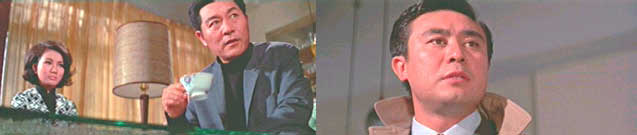
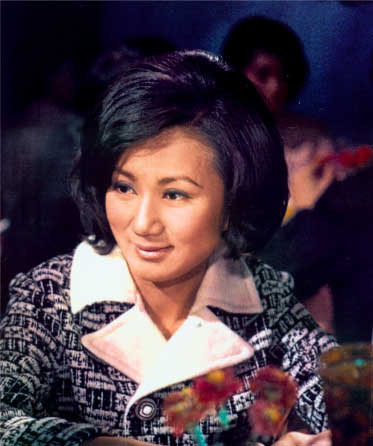
A Cause to Kill
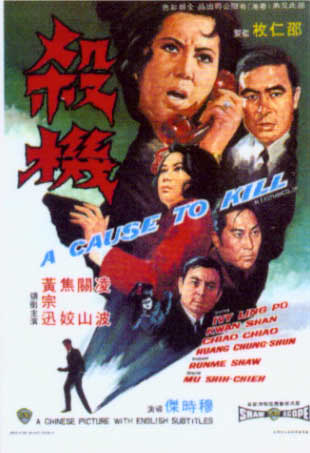
Director: Murayama Mitsuo
Year: 1970
Rating: 6.5
Though most of the
Shaw Brother’s films seem to have been either original scripts or derived
from Chinese literary sources, some of them were clearly based on Hollywood
films. The Umetsugu musicals have Hollywood written all over them in style
and plot, The Lady Professional has echoes of “Point Blank”, Torrent
of Desires follows the plotlines of "Written on the Wind", The Sexy Killer
owes much to the Blaxploitation film “Coffy” and A Cause to Kill (1969) is
a direct “borrowing” of the Alfred Hitchcock film, “Dial M for Murder” (1954).
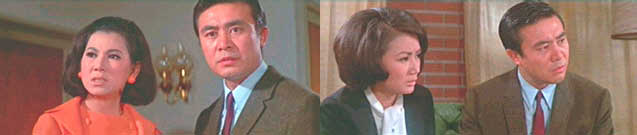
A Cause to Kill makes a few intriguing changes though that actually give
the film a grittier and grayer moral balance, but it doesn’t approach the
levels of suspense that Hitchcock could elicit from his film – though admittedly
knowing the plot of “Dial M for Murder” certainly lessened lots of potential
tension on my part. If you haven’t seen the Hitchcock film (go see it!),
then this film may take on a much higher pitch of anxiety. There are two
major switches that director Mu Shih-chieh throws at the viewer – first he
changes genders around so that instead of a male (Ray Milland) trying to
kill his wife (Grace Kelly), Ivy Ling Po wants to do away with her husband,
Kwan Shan. Secondly in “Dial M” the intended victim is as innocent as a tollhouse
cookie, while here the wife has a good reason to murder her husband – thus
the title. This adds an interesting sympathetic level to the murder plot
that the original didn’t have and leads to an ending that has some tragic
overtones.
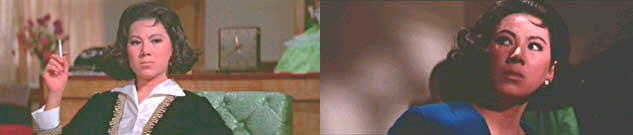
This was certainly a different sort of role for Ivy as she approached the
end of her active career. During this very lengthy career that began in the
early 1950’s at the age of fourteen, she did not have many negative roles.
She was primarily famous for her “huang mei” (Chinese opera) roles as a man
or as a swordswoman in films such as “Lady General Hua Mulan”, but here as
the very calculating and quick thinking wife, she is terrific – hard on the
outside, fragile on the inside. This role must have been fun for her and
a rare opportunity to dress up in chic contemporary clothes and smoke!
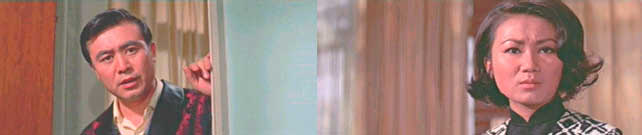
Ivy learns that her husband (Kwan Shan, never looking more like his daughter
Rosamund) had an affair with a female novelist (Chiao Chiao – One Armed Swordsman,
Trail of the Broken Blade) and if he had come to her and confessed his faithlessness
she would have forgiven him. But he never did and her bitterness has grown
like a cancer and all she wants is to kill her husband and have his ex-lover
attend his funeral. So she puts a plot in motion to accomplish this. She
is an ex-movie star – but announces that she is coming out of retirement
and that she wants Chiao Chiao to write the script for her new vehicle. This
forces Chiao Chiao to come from Singapore to Hong Kong.
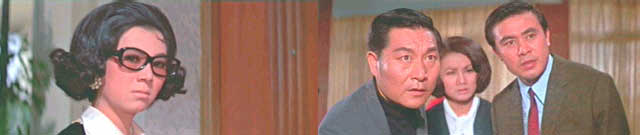
She then hires a killer to murder Kwan one evening when she is out to dinner
– she will call him at a certain time to see if her husband is dead. The
plan goes awry though when instead Kwan turns the tables and stabs the killer
to death. Not one to lose an opportunity though, Ivy quickly sets up evidence
to frame her husband for murder and he is arrested. Kwan’s only hope is the
determined Chiao Chiao and a policeman (Huang Tsung-hsun) who feels something
is just not right with the set up – just how did the victim get into the
apartment?
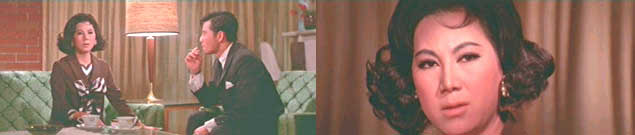
Though nearly the entire film takes place inside the home of Ivy and Kwan
(showing its theatrical lineage), it is nicely shot and the camera moves
about at will to get various angles, it is also well acted with the three
main roles being taken up by legends at that time and the décor gives
the film a nice sleek feel to it. I am sure I would have enjoyed it much
more if I hadn’t already known the plot, but even as it is I found it entertaining.
As a minor note of interest, Chiao Chiao and Huang had been married at one
point in real life, but were divorced by the time they made this film together.
Mu Shih-chieh was actually the director’s Chinese name, but his real name
was Sanro Murakami – yet another Japanese filmmaker that the Shaws brought
over. He made two other films for them – Dark Rendezvous and Hellgate.