Tiger on the Beat
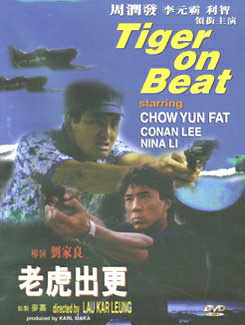
Reviewed by James Chang
Liu Chia Liang (1935 -) (a.k.a.Lau Kar Leung)
is a maestro in Chinese martial arts and the genre of ' kung fu ' films. He
was the man who restored kung fu films to their traditional roots. In the
early 70s, when Bruce Lee invented his new style of fighting, introducing
exotic elements into traditional wushu, everyone tried to imitate him (without
success) by introducing all sorts of strange stances into local king fu cinema.
There was Tae Kwon Do, Judo, Karate, Indian martial arts --- everything you
can think of was put onto the silver screen. Liu was different; he purified
the genre by adopting the most traditional style in his works --- the Hung
Gar. Every single move of his actors can be identified. However, in the late
80s, his career waned, mainly due to the fact that his major works in Shaw
Studio were too ' old school ', lacking the freshness, the glamour and the
flashy style of modern Hong Kong action films. After a few years of being
on the sidelines, in 1988 Karl Maka of Cinema City requested that he make
a modern day action thriller, Tiger on the Beat. With the assistance of Cinema
City, Liu finally became a ' modern day film maker '.

Like many HK flicks*, the story of this film was inspired by Hollywood productions
such as Walter Hill' s 48 Hours (1982) and Richard Donner's Lethal Weapon
(1986). There are two cops working in a team – one of them being tough and
cool and mighty and the other being a cunning scoundrel, who gleefully pokes
fun at his unfortunate partner. Chow Yun Fat does a fine job playing the
devious cop, and the rest of the cast including Nina Li, Conan Lee and Tsui
Siu Keung (Norman Chu) also give solid performances. The director made good
use of their personal characteristics. In smaller roles James Wong plays
the police captain and David Chiang the police supervisor.
The story is again very simple. Chow and Conan
are police partners - Chow is a bit of a coward with a reputation for being
lazy on the job while Conan is the righteous young man who fights ferociously
against crime. They soon tracked down Nina Li Chi, who plays the sister of
a heroine smuggler (Phillip Ko). Her brother is considered a traitor of the
smugglers' gang and is killed by Norman Chu, the chief of the gang. After
getting seriously smacked around by Chow, she agrees to co-operate with the
police and with her lead, Chow and Conan finally come to the den of the smugglers.
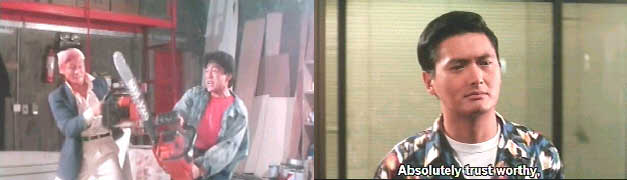
After an extremely bloody duel between Conan and Gordon Liu (using a chainsaw!),
Norman is arrested.
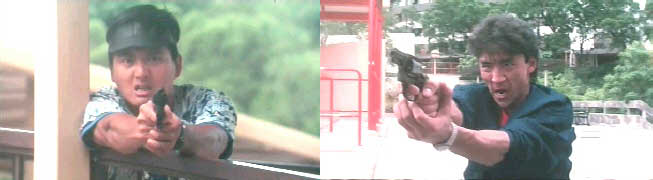
Basically, I do not appreciate films like this. No, please don't take me
wrong. I do enjoy watching gangster films, gunfight films and crime thrillers,
but at least, all the violence and exploitation should have a reasonable
reason behind it and should be executed in a more graceful way. Look at John
Woo and his heroic bloodshed, look at the massacre of Warren Beatty and Faye
Dunaway in Bonnie and Clyde (1967) under the sunshine. They were beautifully
shot. Even the gory scenes in Macbeth (1971), much more bloody than here,
had reasons and motives behind them. The violence used in the killing scenes
was so unnecessary and ridiculous that together with Chow's behavior, they
almost made me laugh.
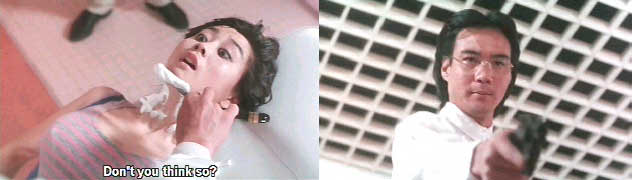
On the other hand, I must admit that CYF' s acting was quite good. The scene
where he urinated in his trousers after having a pistol shoved in his mouth
at the beginning was really quite funny. It should be pointed out that the
popularity of CYF in HK mainly came from his grass-root image (and background)
and his comedic efforts rather than his cooler roles in The Killer and others.
(His character in A Better Tomorrow was a mixture of both images.) His box
office popularity should be able to explain this.
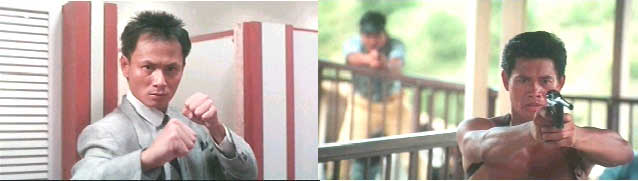
Besides being bloody in an awkward way, another aspect of this film that
annoys me was its discrimination against females and non-Cantonese. Leading
actress Nina Li was obviously used as an object to be mocked by Chow's character.
She was slapped on the face and then thrown to the floor through a glass
table. Everyone in HK knew that Nina Li was not a Cantonese (as she can only
speak heavily accented Cantonese dialect) and everyone knew that CYF was
a native denizen of Hong Kong Island. Therefore, CYF 's insult can be understood
as the hostility of local Cantonese society against mainlanders (who are
very often better educated professionals). The filmmakers also tried to please
the female audience by slapping Nina ' s character since more often than
not Nina Li was described as ' bimbo-like ' by local females.
Of course, every film has its positive aspects. In Tiger on the Beat, the
stunts and the choreography were excellent and Conan Lee was quite good as
an acrobat. Besides, all actors/actresses performed their own stunts, as
required by the director. As CYF himself stated in an interview, ' When I
was ordered to slap Li Chi, I tried not to slap her so hard near her ears,
as it may cause permanent deafness.' It was this willingness to sacrifice
that made HK films in those days so enjoyable.
My rating of this film: 7.0
* Other examples include Prison on Fire ,
adapted from Papillon(1973) , City on Fire , inspired by Serpico (1973) (
both of them about undercover cop ) , Easy Money (1987) , copied from Topkapi
(1964) , etc ..
Just a short review from me on this one.
I had read about Chow Yun Fat’s brutal scene with Nina Li beforehand, but
I was still unprepared for how nasty it is. Part of my visceral negative reaction
to this may partly stem from how much I like Nina Li the actress, but it
still felt unnecessarily rough and reflects quite badly on Chow’s character.
What is almost as bad though is how quickly she forgives him and in fact
seems to fall in love with him!

Chow’s character is easily one of the least likeable that he portrayed during
this period of his career – manipulative, clownish, irresponsible – and he
clearly has the worst wardrobe of any of his characters – wearing loud shirts
and a skipper cap throughout. For much of the film Chow alternates between
coy charm and shrill testiness – and it is really only in the final confrontation
in which he takes on anything near heroic proportions. But even then his
final exclamation of “we will be promoted again!” puts to waste the sacrifice
and pain of what preceded it. It is an interesting performance from Chow
and he shows a willingness to take chances – but it was not a character that
I particularly enjoyed following.
There are a number of pluses here though.
Conan is certainly impressive in some of his stunts – such as jumping on
to the hood of a moving car and somehow holding on and also leaping down
from a walkway to a bus below and then on to the street. And then the final
brawl is quite excellent as Chow and Conan walk into the bad guy’s hideout
and just start killing them in imaginative ways.
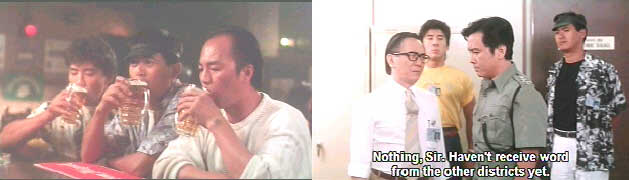
I also enjoyed a couple of the cameos – one from Shing Fui On as a not very
bright husband whose wife Chow is fooling around with, Ti Lung as a bar owner
who shows Conan that he hasn’t lost a thing in the martial arts department
– and the exchange between Chow and Lydia Shum. I have a fondness for HK
film references in HK movies – and there are a few in this film. This was
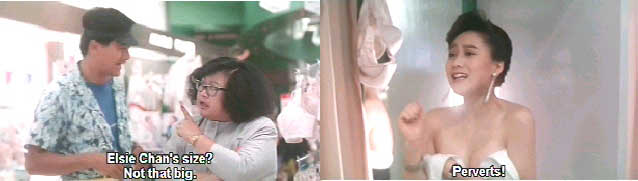
a classic though – Lydia is a salesperson at the brassiere section of a store
and while following Nina, Chow pretends that he wants to buy one for his
made up wife. Lydia wants to know what size he needs:
Lydia: How big are they?
Chow: I forgot to ask today
Lydia: Elsie Chan's size?
Chow: Not that big.
Lydia: Pat Ha’s?
Chow: She doesn’t have any!
Lydia: Anita Mui?
Chow: She keeps changing her size!
My rating for this film: 6.0