Final Justice
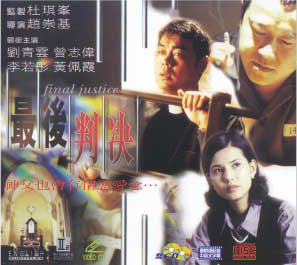
Reviewed by YTSL
Hong Kong movies centering on Catholic priests
are not exactly a dime a dozen. Yet as luck would have it, I have now
viewed two in the past couple of months; and both the light-hearted "Tri-Star"
and this more dramatic Milkway Image effort have a character played by Lau
Ching Wan figuring prominently in proceedings. Somewhat coincidentally
too (or perhaps not), neither are among the best works which bear the imprint
of two of the HKSAR's most prominent -- and not particularly famously religious
-- film people: Tsui Hark and Johnnie To respectively (though in fairness,
To produced but handed over the directing reins to Derek Chiu for what appears
to be the least heralded offering from the company he founded in 1996).
From reading such as the HKMDB reviews of it, I have gotten the impression
that FINAL JUSTICE is really disliked by those Western fans of Hong Kong
movies who have seen it. Such as a "heavy, misogynistic plot" and "script
[that] couldn't decide on a point of view or a style in which to tell the
story" is what makes it deemed by at least one individual as: "A true
must not see." Yet the Hong Kong based -- and notoriously negative
-- Paul Fonoroff actually considered it "one of the more contemplative Cantonese
films in recent months", whose story successfully "weaves in so many moral
issues" (In a review written in early 1997). So...what is going on
and accounts for this not very usual critical state of affairs?
Perhaps the answer lies rather simply in FINAL JUSTICE being a movie:
Whose main touchy focus is on a thirty-something year old priest getting
accused of rape by a young woman whose confession he had recently heard;
where the key incident was shot in a way that leaves no doubt as to who is
the guilty and innocent party involved in the matter; and that possesses
what might be described as a contemporary Hong Kong point of view that does
not mesh well with the North American PC perspective. If this is the
case, what may well be a more interesting question to probe concerns why
this film was made, and what was the thinking behind the presentation of
its particular perspectives as well as the choice of highlighted topic(s)?
The way I see it, the salient primary issue in FINAL JUSTICE is not so much
the voluntary or involuntary enactment of a single sex act between Father
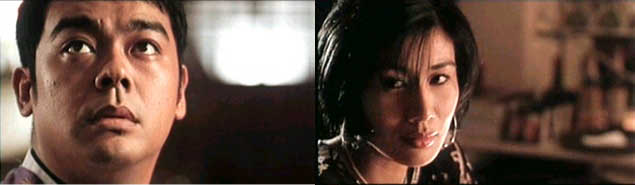
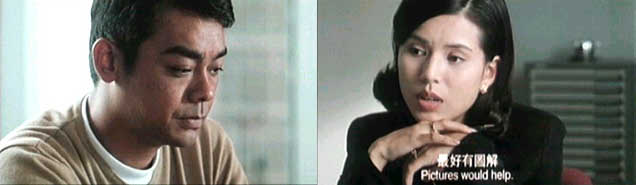
Li Siu Ho (Lau Ching Wan gives another utterly believable performance) and
Donna Cheung (Almen Wong in eye-catching form) as how the religious authorities
and the courts handle a case that has both moral and legal facets.
When the work is looked at from this perspective, this explains the prominent
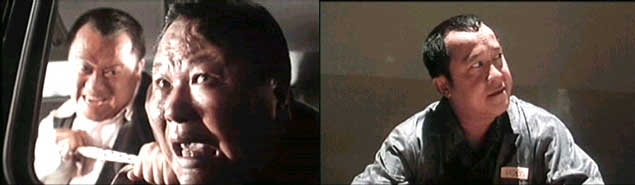
part played in the movie of a not very pleasant underworld character complexly
portrayed by Eric Tsang. In this way too, added meaning gets conferred
on the verbal exchanges and drawing of parallels -- as well as contrasts
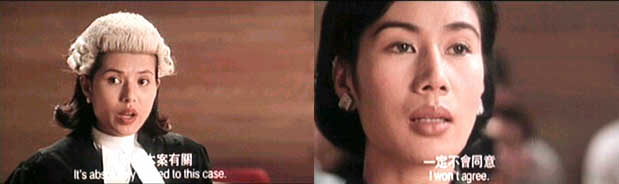
-- between Father Li and the woman who Eric Tsang's Kim Shun Fat hires as
the legal counsel of the childhood friend he regularly confesses his sins
to, so that he can be forgiven by God and have peace of mind (Fans of the
second billed Carmen Lee ought to realize that her Koo May character only
enters into the picture in the 51st minute of the film).
At this point in the review, it should be apparent that I don't find this
well-acted effort to be a bad movie. In fact, I'd even hazard an opinion
that FINAL JUSTICE contains -- and not in a terrible way at all -- some thought-provoking
arguments and qualities. Still, this is not to say that I don't have
any beef with this production (and/or the brains behind it). Hopefully
without spoiling things too much for those who have yet to view it (and plan
to do so), here's stating my feeling that this early 1997 piece may have
been too negatively affected by pre-Handover blues. Consequently, it
is saddled with too bleak -- if not downright cynical -- a general outlook
on life, people and the ability of non-criminal systems to justly deal with
matters that one would like to hope they can handle (better).
My rating for this film: 6.5