I am Sorry
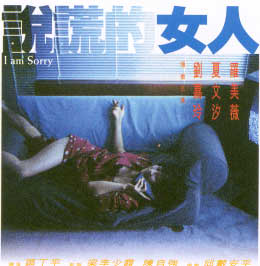
Reviewed by YTSL
Dramas about prostitutes constitute a definite
Hong Kong filmic genre. Although the same might not be true with regards
to movies about mistresses (a.k.a. unofficial secondary wives and concubines),
this 1989 Tony Au directed effort is one more of those works that I have
now viewed. Interestingly, while it did garner a HKFA Best Actress
nomination for its lead performer, it still seems to me to be a far less
worthy star vehicle for Carina Lau than the similarly focused Sylvia Chang
helmed "Mary from Beijing" was for Gong Li and Crystal Kwok's"The Mistress"
was for the young but assured Jacqueline Peng.
In all honesty, I feel obliged to register my
shock as well as disappointment that a production graced by the presence of
the charismatic Patricia Ha and Rosamund Kwan in addition to a four time
HKFA Best Actress nominee could be as slapdashingly bad as I AM SORRY (a.k.a.
HER BEAUTIFUL LIFE LIES). This especially so when it also is realized
that that which is listed in the HKMDB as a drama -- but just comes across
more as a laughable, even if not consciously laughter-inducing, piece of
work -- was under the directorial supervision of the man who had sensitively
helmed the atmospheric "Dream Lovers" three years previously.
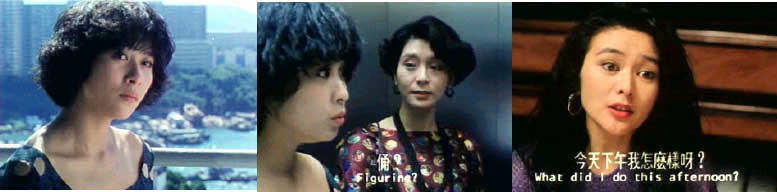
In all likelihood, these individuals -- and probably also others in I AM
SORRY's cast and crew -- were let down by a terrible script (which I am going
to make sound more logical than it is when I do such as describe how it is
that the movie's five main characters are socially connected with one another).
It definitely didn't help that Carina Lau's impulsive and aggressive -- as
well as terribly bubble-headed plus perm-haired -- character is one who is
neither very sympathetic nor all that rational in her actions; what with
Carol Cheung being a woman who is not above going up to tell off and pick
a fight with a trio of squabbling strangers who happen to be within earshot
of her at a posh restaurant.
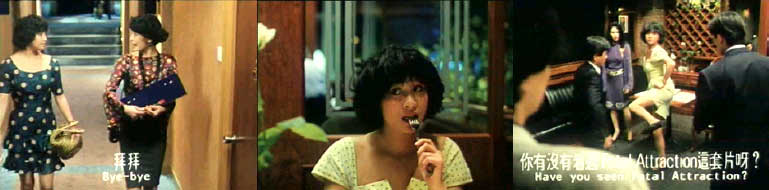
In any case, that particular incident was what brought the also formidable
Alice (the character portrayed by Rosamund Kwan doesn't have that much screen
time but prominently figures in the thoughts of individuals with larger parts
in I AM SORRY) and the contrastingly soft Edgar (Lawrence Ng plays him as
a quivery lipped man) into Carol's consciousness. Soon, despite her
actually being the kept woman of a rich older fellow named Edward Sung (who
comes in the form of Kenneth Tsang -- someone who really seems to have played
all manner of men in his movie career!) and professing more than once in
the movie that she is someone who can only love one male at a time, Carol
is consorting with both Edgar and Edward, at times within a single 24 hour
period.
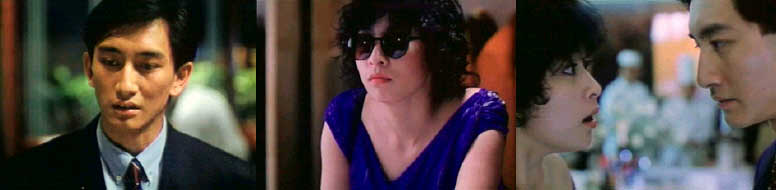
As some people might expect, this state of affairs proves to be less ideal
for all involved, and brings on a series of events -- to add to the previously
many -- in which the movie's lead character finds herself uttering the phrase
that is the film's title. More than by the way, lest it be assumed
that I AM SORRY takes a sexist stance in terms of it being okay for men but
not women to have more than one love (or lust), it will be pointed out here
that: Those of Carol's friends (two of them played by May Lo and Elaine
Kam) -- who have names like Doll as well as Sabrina and Cindy -- who also
have sugar daddies of their own are not at all adverse to engaging gigolos
to service them (for those times when they know that the main men in their
lives are sleeping with their legal wives). Then there's Carol's neighbor,
Sheng Wen Yueh, the individual who comes across as being the most level headed
in this silly -- if not plain stupid -- offering (who is portrayed with quite
a bit of aplomb by Patricia Ha), being depicted as someone thoroughly at
ease with what seems like a multitude of males flitting in and out of her
life.
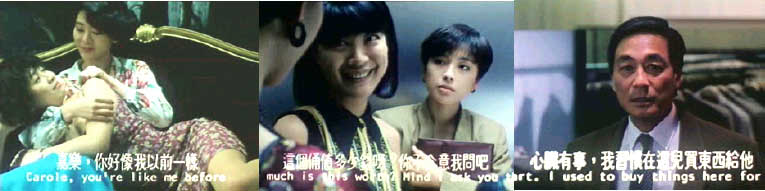
IMHO, the makers of I AM SORRY had the potential to paint an insightful,
poignant or actually amusing portrait of the lives of women and men who have
less uncommon extra-marital arrangements than some people would like to think
or know is the case. The great problem seems to be that it tried to
be a little of both plus have the kind of happy ending that cautionary tales
ought not to have and truly light-hearted accounts would enact with greater
flamboyance than occurred in this weak work. Consequently, it turned
lines such as "I walk alone unfettered by men", "Breaking [out of] the cocoon,
I see the pretty world" and "Alone but no longer in a void" in the Sally
Yeh song that's heard twice -- at supposedly key moments -- in the movie
into lies, and dramatically loses out from doing so.
My rating for this film: 3.