Red Rose White Rose
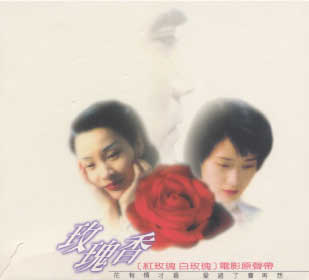
Reviewed by YTSL
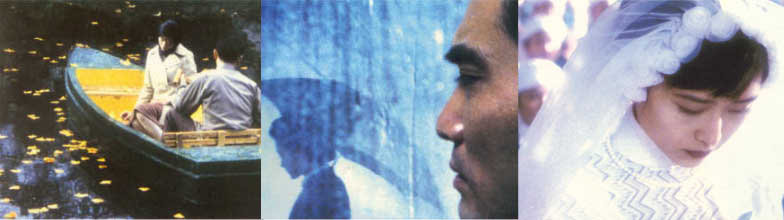
This visually distinctive 1994 work is Stanley
Kwan's stylish -- and stylized -- adaptation of Eileen Chang's tale of a
man who wants absolute control over females and two women -- a passionate
lover who he called his Red Rose and the chaste wife he refers to as his White
Rose -- who had contrasting parts in his life. Featuring a copious
amount of quotations on screen, it is a film that relies more than most others
on written words. When one adds to the equation the not insignificant
amount of voice-over narrative sections in this high-brow feeling effort,
the overall effect seems to be that the work's viewers get rather emotionally
distanced from its main as well as minor characters; this particularly being
so in view of the Shanghai born novelist's writing being ironic in style
(Something I detected even before reading Mr. Kwan's opinion that this is
indeed the case).
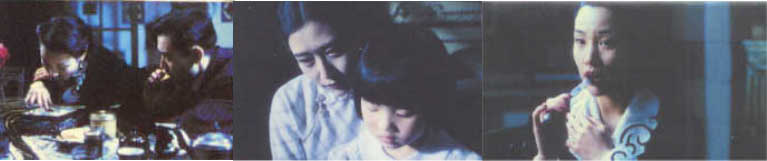
To be honest, I am not sure that this pervasive sense of detachment is a
good thing. In all fairness, it did allow me to be more observant of
the visual details of this expertly lensed -- by Christopher Doyle -- costume
piece without experiencing sensory overload. This favored approach
may also have ensured my greater appreciation of many of RED ROSE WHITE ROSE's
printed observations and stated comments (which either originated from Eileen
Chang or actually come from the more contemporary pens of co-scriptwriters
Edward Lam and Liu Heng). However, it all appears to have come about
at the expense of my ending up having little sympathy for -- forget empathy
with -- the interesting but not particularly understandable characters whose
not very satisfied lives are the focus of that which can at times come across
as a psychological portrait. This is rather unfortunate since the individuals
in question are in many ways a pretty intriguing trio.
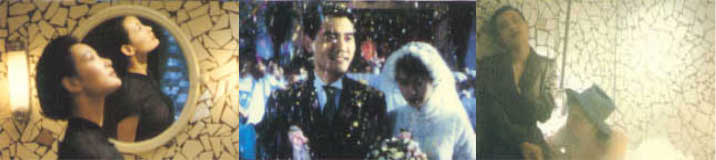
At relevant points in RED ROSE WHITE ROSE, the film's audience is informed
that Tung Zhen Bao is "from head to toe the archetypal Chinese man of his
era" and that the period in question was one when "[p]erhaps every man has
two...women, at least". As it turns out, Winston Chao's hardly non-establishment
character -- who is not adverse to seriously opining that "Everybody has
a duty to society" -- is shown to have had multiple women in his life (in
addition to his mother, whose influence ought not to be discounted).
The first two -- a Parisian prostitute, and his first love who he encountered
while he was a student in Edinburgh -- of the four who impacted his emotional
state more than others are shown only briefly.
The third important woman in Tung Zhen Bao's life
is one whom RED ROSE WHITE ROSE's deceptively gentlemanly looking "practical
man" (and his younger brother) is first introduced to as the wife of his
best friend and host in Shanghai. Coming as she does in the form of
Joan Chen, she is the kind of daringly lively creature that many men find
sexually irresistible. The colorful Mrs. Wong Jiao Rui -- who is given
to stating such as "I love doing the wrong thing" and "My heart is just a
hotel" -- seemingly almost inevitably gets involved with the individual who
observes of her that: "She speaks her mind but her mind is still innocent
and naive". Too naive (or is it idealistic and hopeful?), as it turns
out.
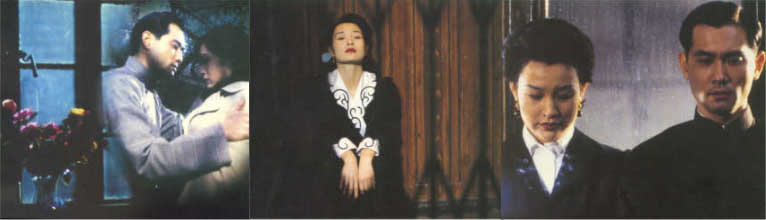
The same might also be said of Yan Li, the modest woman Tung Zhen Bao opts
to take as his wife. In almost every other way though, not-very-quotable
she differs from the other females known to the film's main man. This
also is probably true about this character vis a vis all others who Veronica
Yip has portrayed. Hence its being so that on at least one level then,
the section of RED ROSE WHITE ROSE in which she shares the limelight with
Winston Chao is interesting to view. Unfortunately, because her character
is undoubtedly quirky but still oh so colorless, it pales in contrast to
the portion of the production in which Joan Chen's character brightened up
proceedings. Consequently, even while I admired Veronica Yip's acting
ability, I chaffed at the 123 minute long movie's devoting as much (its audience's)
attention and time as it did to the joyless woman she was charged with portraying.
In summary then: RED ROSE WHITE ROSE possesses a structure that theoretically
makes quite a bit of sense. However, the viewing experience turned
out -- at least for me -- to be less than evenly satisfactory; with this
filmic work getting off to an intriguing start and being entirely interesting
for quite a while but losing much of my interest in its latter half before
ending with what seemed to be an inappropriately abrupt whimper of a note.
My rating for this at times -- but unfortunately
not entirely -- brilliant film: 6.5