Diamond Hill
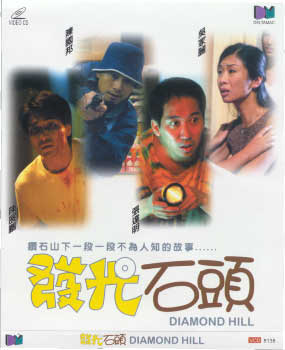
Review by YTSL
People run, run, running. A boy and a girl
running hand in hand, looking like they didn't have a care in the world.
A young man racing -- in spite of his having a head injury and bare feet
-- through the streets and alleyways of Hong Kong, with another man in breathless
pursuit. A school uniform wearing teenage girl hurrying from her home,
next seen dashing back and forth between a pharmacy and a toilet where she
was -- one by one -- administering a bunch of pregnancy tests on herself,
then gettng chased by a plainclothes policeman plus followed by a stranger
who turned out to be of help to her.
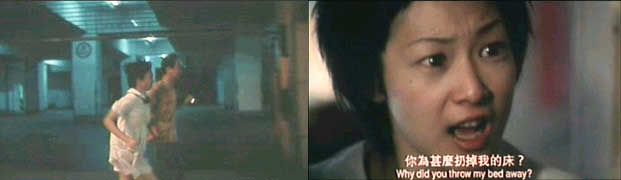
These are some of the at times haunting images that should stay for a while
with whoever decides to check out DIAMOND HILL, one of the most personal
as well as low budget feeling films this (re)viewer has ever seen.
Other vivid -- and seemingly assorted -- pictures from this interestingly
shot (by Lam Wah Chuen), innovatively edited (by Angie Lam) and surely rather
idiosyncratically directed (by Cheang Pou-Soi) digital video (DV) production
that I reckon will get lodged in one's memory include those of: A glistening
block of tall luxury apartments (situated in the Hong Kong locale that this
offering is named after); an ancestral altar table, atop which a diamond
ring lies hiding behind an incense stick holder; a glass ring made from a
Coke bottle's rim; a girl's deceptively ordinary looking bedroom; the kind
of scenic view that people would love to be able to look out at from their
windows; and a kitchen in which a pot of soup is simmering on the top of
the stove.
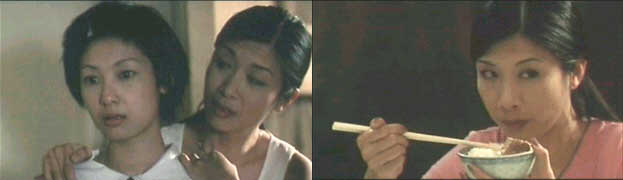
They all pale though when placed next to the thought and vision of that which
came from the five year long sacrificial act of an orphan boy (played as
a young adult by Chang Chin Pang and in his more youthful reincarnation by
an expressive faced actor whose name I do not know) upon his finding that
his younger sister (May is portrayed by Maggie Poon (Spacked Out) and a younger
actress -- whose name I am guessing is Karine Kwok -- who also deserves kudos
for her work here) was cared for as much as she was by a woman who so wanted
to be addressed as Mummy (Carrie Ng is utterly convincing as a character
who is miles away in temperament from "Naked Killer"'s Princess). A
note to potential viewers of DIAMOND HILL: Much of the film's emotional
impact will be lost if great incredulity -- which absolutely cannot be allowed
to overwhelm everything else -- greets the discovery as to the particular
nature of that selfless act. And while I myself have some problems
with this deed by someone whose suicidal father's last words to him were
"Take care of your sister", I'd nevertheless strongly emphasize the need
to believe and also appreciate that which was offered.
Over on Mobius's Asian Cinema Discussion Board, Grady Hendrix wrote that
DIAMOND HILL is "about people who're defying logic, reason, biology, and
every form of common sense to remake the world into somewhere they can live".
This is a description that definitely applies to the girl and her Ko (not
the name of the boy but the Cantonese term for "elder -- or just plain older
-- brother") whose loving relationship is at the heart of this little rough
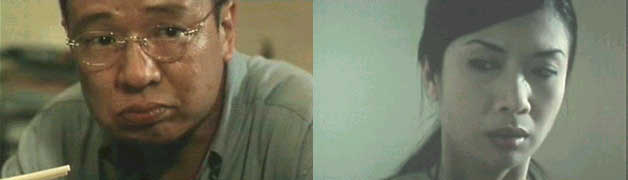
gem of a dramatic offering. However, it also is true of a homeless
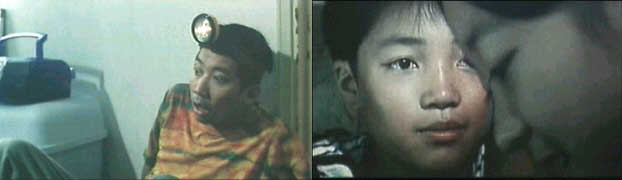
but camcorder-equipped burglar (Cheung Tat Ming in fine form) who found more
than he bargained for upon entering into the Cheungs' apartment (whose household
is headed by Hui Siu Hung's not particularly sensitive -- or sympathetic
-- character).
The heart of DIAMOND HILL's director -- who appears briefly on screen as
a mugger -- is clearly in the right place. Cheang Pou-Soi's technical
talents probably should also not be doubted. However, this is not to
say that his work is without problems. For one thing, his playing with
time, choice of music (whose score is credited to Tommy Wai) and (other)
stylistic experiments make Wong Kar Wai's efforts -- yes, really, even "Ashes
of Time"! -- look straightforward and staid. I also sincerely hope
that I am wrong in my identification of who is the father of May's baby.
This having been said, I would maintain as well that this boldly novel offering
-- which Grady also referred to as an "urban gothic" -- is one more Hong
Kong movie that can be proudly flourished at detractors of that cinematic
world, who think that all it has ever produced are "chopsocky flicks" and
(other) 100% conventional commercial-oriented output.
My rating for the film: 6.5