Alan & Eric: Between
Hello and Goodbye
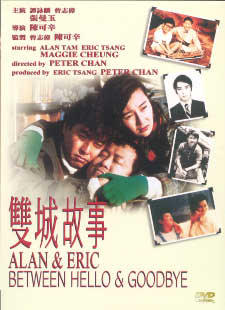
Reviewed by YTSL
In 1991, the United Filmmakers Organization was
co-founded by Peter Chan, Eric Tsang, Lee Chi Ngai and Jacob Cheung.
In the same year, three of these individuals were involved in making a movie
that can be retrospectively regarded as a prototypical U.F.O. dramatic offering.
Five years prior to that, the man who had been production manager and assistant
director for three Jackie Chan films -- but has mainly made his name by directing
and producing non-action movies like “He’s a Woman, She’s a Man” and “Comrades,
Almost a Love Story” -- had a job in distribution and sales for Alan &
Eric, a production company named for singer-actor Alan Tam and Renaissance
man Eric Tsang (See Fredric Dannen’s “Hong Kong Babylon”, 1997:63-65).
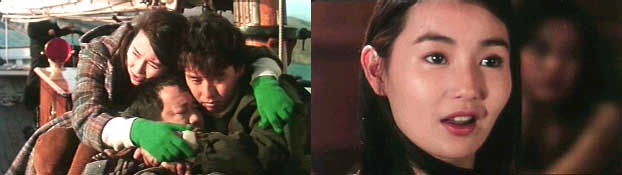
It thus seems rather appropriate that Peter Chan’s directorial debut work
would be entitled ALAN AND ERIC: BETWEEN HELLO AND GOODBYE as well as star
Alan Tam (as a waiter turned chicken farmer turned Cantopop star named Alan
Tam!) and Eric Tsang (giving a HKFA Best Actor performance as a chicken farmer
turned fisherman(!) named Eric Tsang), plus have Lee Chi Ngai as the co-scriptwriter
-- along with a guest appearance-making Barry Wong (as a bar-owner named
Barry) -- of this Peter Chan-Eric Tsang co-production. Given that the
UCLA educated auteur has been labeled “the region’s most Americanised film-maker”
(In Miles Wood’s “Cine East”, 1998:9), it also makes some sense that this
maudlin melodrama -- whose focus is on the up-down, hot-cold friendship between
two individuals with antithetical personalities -- would be perceived to
have been inspired by the tear-jerking Hollywood “chick flick” that was “Beaches”.
In actuality though, I don’t see this at times charming -- but nonetheless
shallow and uneven (plus rough at the edges) -- offering having that much
in common with the 1989 weepie that starred Bette Midler and Barbara Hershey.

Instead, my stronger sense is that quite a few of the thematic strands and
plot devices that appear in this unfortunately at times too immature feeling
movie are ones that Peter Chan would return to use to better effect in his
more polished UFO works. E.g., the love triangle that tested the friendships
of Alan, Eric and an artistic lass named Olive Cheung (played by a Maggie
Cheung who was alternating between being a cute gal and serious actress at
this point in her career) looked in some ways to presage that between “He’s
a Woman, She’s a Man”’s main trio. Relatedly, the sentiment expressed
by a wistful Olive at one point in the film -- re her ideal love being someone
that combined the more attractive attributes of her two favorite men -- is
similar to one that would be uttered by Wing re Sam and Fan-Fan in “Who’s
the Woman, Who’s the Man?”. Additionally, there were moments in ALAN
AND ERIC: BETWEEN HELLO AND GOODBYE that caused me to feel that Mr. Tsang
and Ms. Cheung were effectively rehearsing to play the roles that they ended
up essaying five years later in the also transnational “Comrades, Almost
a Love Story”.
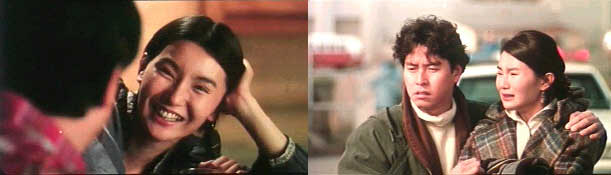
For the most part though, while the individual chemistry between those two
talents was already there (as was that between them and Alan Tam), the overall
mix and formula still did not feel quite right in ALAN AND ERIC: BETWEEN
HELLO AND GOODBYE. One contributing factor that I can think of was
the surprising lack of a specific localizing sense that this nostalgia tinged
production’s proceedings did largely unfold in that part of the world whose
Chinese name translates into English as “Fragrant Harbor”. Somewhat
unusually for a Hong Kong movie, there seemed to be more flavor in the portions
of the work that were filmed in San Francisco and less readily identifiable
parts of the U.S. Although this by itself is not a bad thing, the problem
is that the bulk of this offering -- including those scenes which feature
a fortune-telling, Cantonese-speaking “Yank” (played by Paul Fonoroff) along
with a Chinese man named Pierre (played by Blackie Ko) -- does (presumably)
take place elsewhere than North America (even while it does begin and end
in the Bay Area). Alternatively put: This generally too shallow
effort surely would have benefited from being more grounded as well as possessing
a greater contextualizing depth.

My rating for the film: 6.