Love au Zen
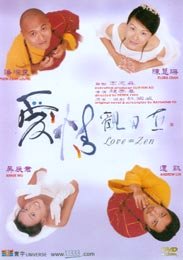
Director: Derek Chiu
Year: 2001
Rating: 5.5
Director Derek Chiu
has risen quickly in the ranks of Hong Kong directors with his critically
praised Sealed with a Kiss (1999) and Comeuppance (2000), but his recent
film, Love au Zen (2001), mildly disappoints in comparison. While both of
his previous films had a lyrical element to them, they also had an edge that
created an emotional impact. Love au Zen is lyrical with moments of charm
but it has no edge to it at all, no emotional resonance and in the end one
feels very little for the characters or for the outcome of the film.
As one might expect from a screenplay that
is based on a play from the same author, Raymond To, it is quite literate
and at times fairly wordy – but it rarely grabbed my attention. Part of this
might be blamed on the actors who never really inhabit their characters with
any energy or depth. Though the four main characters are on screen for much
of the film, I never get any sense of who they are beyond what we see and
hear – they are simply the creations of their dialogue and little seems to
come from within.
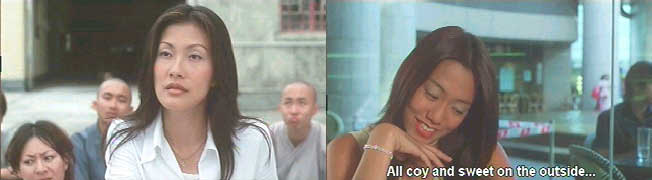
The film is interesting in the manner that it contemplates the conflict between
love and a state of inner harmony. In a sense, Chiu almost concludes that
the two are very much at odds with one another. Into his scenario he introduces
two couples that he uses to explore these issues. One couple is Andrew Lin
and Annie Wu who seem to have nothing really in common but are following
in a shallow manner society's expectations of marriage. The other couple
is Poon Chan Leung and Flora Chan – a more cerebral pair who after five years
of being together are beginning to question where their relationship is going
– if anywhere.
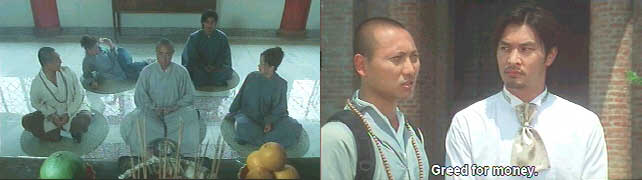
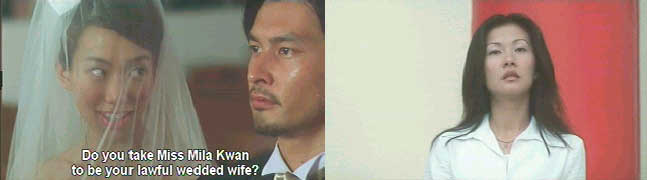
A few days prior to Lin and Wu getting married, Poon, the best man, disappears
leaving his girlfriend, Flora, at her wits end. It turns out that he has
temporarily joined a Buddhist monastery on Lantau Island in order to get
a better understanding of who he is and where he wants to go in his life
– and whether this includes Flora. He makes it to the wedding though – but
Andrew hesitates for five seconds before his “I do” and this causes the spoiled
and temperamental Annie to call the whole thing off. In an amusing follow-up,
the two fathers stand up and tell Andrew that he should rejoice that he will
not have to live with a shrew as they have done!
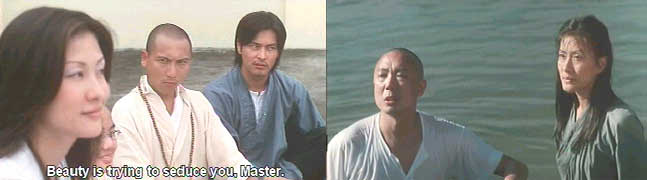
Poon convinces Andrew to return with him to the monastery to receive guidance
from his Master, Ko Hon Man, an old classmate who has turned to a life of
abstinence. The performance from Ko is the best thing about the film and
he often reminded me of a young smiling Wu Ma. Soon the two women also find
themselves enrolling at the monastery for reflection as well and the two
couples slowly try and work out their issues and come to some better understanding
of what they need and want from life – though the resolutions are not necessarily
what one might expect.
It is difficult to understand why this film left so little impression on
me. The production values are excellent, the story has a different feel to
it than most Hong Kong films, the locales are lovely, the script is clever
at times – but I simply never found the foursome all that engaging as they
blandly go about their lives.