Soul
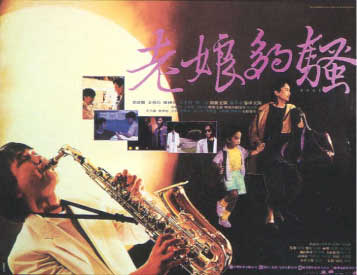
Reviewed by YTSL
This 1986 Hsu Feng and John Shum co-production
opens with a woman (Deannie Yip’s main character is variously known as Mrs.
Lee, Yip Cheung and Girl Girl) and a man (David Chiang plays Detective Inspector
Lee Kai Yeung) having sex in between waking up and having breakfasts.
Before the film had reached its ten minute mark, he is seen falling to his
death from a high place in his home police station. In the ten minutes
that follows, she: Witnesses the death of a Taiwanese woman (who she
had been previously chatting with about good hairdressers and schools); belatedly
finds out that the Mandarin speaking female was her spouse’s mistress; also
learns -- from a grim-faced colleague of his -- about her late husband being
suspected of corruption; gets asked to take care of “the other woman”’s now
orphaned three and half year old son; goes home to find out that the Filipino
maid has absconded with her boyfriend (and trashed the place before doing
so); plus has to deal with the electricity supply to her living space suddenly
getting cut (due to the Filipino maid not having paid the bill, despite her
employer having thrice directed her to do so).

If nothing else, the first quarter of this work looked to be director Shu
Kei’s very accurate capturing on celluloid of a(n upper-)middle Hong Kong
married woman’s nightmare! Something else that I reckon that he effectively
accomplishes in the early section is the providing of viewers with an accurate
taste of the surprising and eventful nature of an offering which nonetheless
is actually neither very fast paced nor in possession of a storyline that’s
at all hard to follow. When it is taken as a whole, I do believe that
the movie’s scriptwriter as well as helmer was definitely successful in his
bid to make a multi-genre offering that turned out to be about equal parts
thriller, melodrama, comedy and women’s film plus was “structured...so people
could not tell what would happen next” (This and subsequent quotes were culled
from the SOUL portion of the Shu Kei interview in Miles Wood’s 1998 “Cine
East: Hong Kong Cinema Through the Looking Glass”).
Perhaps those who have viewed John Cassavete’s
“Gloria” will be more able to predict the path that this film -- which Shu
Kei stated he had been very much inspired by -- follows. Since I have
not done so, I can’t say whether it actually does. However, I find
it hard to believe that there actually exists another movie in which one
individual is killed by being hit on the head by a sausage and another dies
in part because of a champagne bucket’s worth of ice getting thrown on him
(And yes, I do actually think as well as sincerely hope that these events
-- along with a few others plus certain rich little details -- speak to SOUL’s
having a black comedic vein running through much of it)!

It also seems to be beyond doubt that Deannie Yip is as much the heart as
well as central figure of SOUL as Gena Rowlands was in the 1980 Hollywood
production. Shu Kei is on the record too as saying that -- in a manner
not unlike with “Hu-Du-Men” and Josephine Siao -- the major impetus for his
deciding to make this offering was because he had great admiration for this
veteran actress and wanted to work with her. Although she is not the
female who comes off as the most striking and glamorous looking of all who
appear in this Christopher Doyle lensed work (this honor falls instead to
Elaine Kam, who plays Girl Girl’s friend, Gi Gi), Ms. Yip’s certainly is
the film’s most interesting and complex as well as primary character.

The individual who probably gets the second largest amount of attention in
SOUL is Loong Loong -- the little kid who I initially wished that Girl Girl
would either lose or abandon but did come to appreciate the further along
into the film that I went. And while he initially appeared to be but
a lackey to Dennis Chan’s serious-looking but bumbling-acting Wai Wai, Jacky
Cheung (the name of a character as well as the actor who played him) did
turn out to have some depth and a nice side. However, I expected far
greater things of Boy Boy -- the saxophonist seen as Girl Girl’s soul-mate
-- and not just because he came in the form of the great Taiwanese director,
Hou Hsiao Hsien (Yes, really, re the director of such as “Dust in the Wind”,
“A City of Sadness”, “The Puppetmaster” and “Flowers of Shanghai” making
an appearance in a Hong Kong movie). Instead, his part in the production
seemed but an extended version of Manfred Wong and Alfred Cheung’s cameo
roles (as an insurance agent and ticket booth attendant, respectively).

Much as I appreciate what Shu Kei tried to do with SOUL (i.e., react against
overly formulaic filmmaking), I can see why the film flopped at the local
box office. Especially when compared with “Peking Opera Blues”, “100
Ways to Murder Your Wife” and “Passion” (three other works released in 1986
that are creative in their own ways plus were bigger commercial and/or critical
hits), it could have been more tightly edited and not so loosely structured.
There also is a restrained feel to the production that makes it so that its
viewers are likely to chuckle rather than laugh at some of its proceedings
and wryly or wanly smile rather than feel truly saddened about certain other
occurrences that take place over the course of it. Still, my sense
is that upon viewing this early cinematic offering of his, some more people
will add themselves to the list of Hong Kong film fans who wish that the
individual who I’ve actually seen manning the cash register of his book cum
video store would spend more time and effort making -- rather than reviewing
and selling home video copies of -- movies.
My rating for this film: 7.