Headlines
Reviewed by YTSL
Most overseas Hong Kong film fans only know about
the HKSAR’s Chinese language newspapers by way of the entertainment reports
that Sanney Leung and Jerry Chan translate into English and post on their
websites for our benefit. Reading their (in)famous references to “two
points”, “flower vase roles” and “jade babes”, the sense one can get is of
the territory’s reporters generally belonging much more to the ranks of the
“stalkerazzi” and “gutter press” than that of respectable broadsheets.
This negative gossip-mongering image of those who work in the news(paper)
industry is not helped by there being few – let alone particularly positive
– depictions of journalists in Hong Kong movies (unlike with, say, police
officers, Triad members, mothers and even bakers as well as chefs).

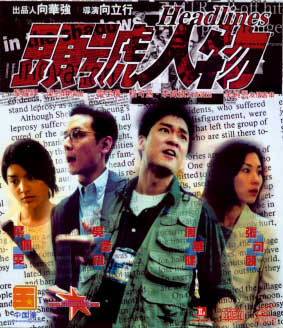
Despite its lead trio consisting of a very clean cut looking individual (in
the form of Daniel Wu), an established Cantopop star (though it will be granted
that Emil Chow doesn’t have the “pretty boy” looks of many of his contemporaries,
let alone the representatives of the newer generation that has recently come
along to challenge the established Sky Kings) and a TV actress with a considerable
fan base (in the person of Maggie Cheung Ho Yee), HEADLINES is far from the
cinematic equivalent of an expensively put together glossy magazine.
Instead, it is one China Star Entertainment Group and One Hundred Years of
Film Company co-production which surely was more modestly budgeted and no
frills styled than those which come under such as the Milkyway Image aegis.
Indeed, that whose other producers are the lesser known Sundy and Nam Yin
Production Companies seems to have a consciously “ordinary folks” focus as
well as straightforward presentation mode which successfully conveys the
sense that the persons who are shown going about their usually unglamorous
business and lives in the movie aren’t too different from their real life
counterparts.

With assertions like “We are a news agency. We don’t educate”, HEADLINES
doesn’t initially look like it will be a film that’s going to show the better
side of those whose job is to provide people day in and out with readable
information about their world. Indeed, as we follow such as a rookie
intern -- who has just returned from the U.S., and is prone to spout out
English phrases a la Michael Fitzgerald Wong – named Peter Wong going about
his assigned business, we see him rather painfully learning that there’s
more dirt, sweat and blood involved in the task of “follow(ing) the truth
to find the lies” than his college professors divulged. As a worldly
scribe cum photographer who goes by the nickname of Sorrow points out pretty
early on, among the arguably lesser concerns that need to also be taken into
account by those who hope to survive in this highly competitive business
are those of deadlines, sales, and headlines (attractive ones of which can
make a mediocre article look good, unattractive ones of which can make a
great article look bad). Especially as Ross Clarkson’s camera trails
and chronicles a dogged journo like Joey’s attempt to develop an interesting
story out of a small detail which had not caught the eye of less observant
others, we also get shown how those who are expected to produce at least
three articles a week for the Hong Kong Daily News – and presumably other
newspapers like it – have to be willing to lie as well as venture into the
underbelly of society to get what they want and need.
Almost invariably though, the further along we
go into that whose (longer) Chinese title translates into English as “People
of the HEADLINES”, the more it becomes apparent that things are never as
black and white as they might first seem. As Daniel Wu’s Peter Wong
character discovers, even the easiest of assignments – in this case, the
supposedly routine investigation of a relatively minor car accident – can
bring on unanticipated complications (and even a physical assault on his
person). Ditto re his effort to do good as well as do a good reporting
job. In the case of Emil Chow’s Sorrow character, ethical dilemmas
come about when, in the course of covering a jewelry show, he learns more
about one of its models (the Puerto Rican identified as Nancy Sing), one
of the organizers (a Mr. Ricky Chan) and the senior police officer in charge
of its security (Officer Mak is played by Wayne Lai) than he probably retrospectively
would have liked to have done.

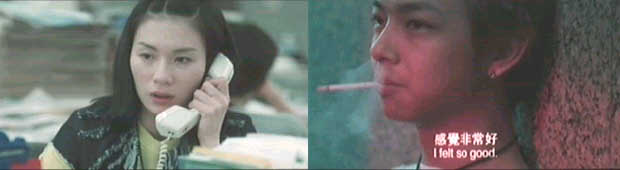
Meanwhile, the predicament that comes along for Maggie Cheung Ho Yee’s Joey
character is less the product of her electing to masquerade as a social worker
to the expelled schoolboy who she tracked down by going to his grandmother’s
dwellings and far more a result of her taking to him as a person (rather
than just as the source of an interesting story about the Triad presence
in Hong Kong’s schools and among the local youth). Lest Joey’s emotional
attachment to Ho Wai Keung be stereotypically perceived by some as that which
was inevitable, given her female nature, here’s pointing out that:
Peter also obviously cares more for the focus of his first newspaper article(s)
– a plucky orphan lass named Yuen Chi Wai (played by Grace Yip) and her two
younger brothers – than he is professionally obliged to; and Sorrow is unlike
another reporter portrayed by Simon Loui in worrying about how his reporting
will impact the innocent loved ones of those whose guilt probably do deserve
to be revealed for all the world to see.
Those who conclude, upon reading this (far into the) review, that HEADLINES
is not a film that puts an accent on the sensationalistic are correct in
their surmization. One would be wrong, however, to consequently believe
that it is a boring cinematic piece. Although not greatly memorable
as a whole, the generally workmanlike effort still most definitely had some
startling moments that caused this (re)viewer to alternately gasp or almost
forget to breathe upon encountering them while taking in this Leo Heung helmed
offering.
My rating for the film: 6.