From the Queen to the Chief
Executive
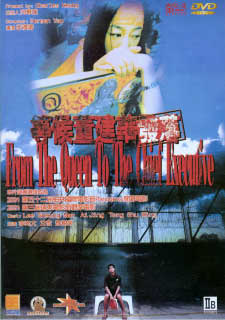
Reviewed by YTSL
The existence of this 2001 Herman Yau helmed effort
first came to my attention when I read about the socio-political drama’s
having been yanked out of its Hong Kong International Film Festival opening
slot (in favor of Yon Fan’s undoubtedly more visually lush and less controversial
“The Peony Pavilion”). After viewing this well made – and, more importantly,
genuinely moving – work, the fact of the action having arisen from a bureaucratic
technicality (with the authorities objecting to its already having had its
international premiere elsewhere in the world) seems rather ironic; what
with this very personal feeling offering being one which seeks to focus attention
on the sorry plight of seventeen juvenile offenders who had been sentenced
under a problematic ruling that caused them to be “detained at Her Majesty’s
pleasure” (i.e., for an indefinite period of time) and continue to be victims
of ill thought-out legal regulations in post Handover Hong Kong.
The makers of FROM THE QUEEN TO THE CHIEF EXECUTIVE
take the stance that “Juvenile offenders are not trash”, “Human rights are
not meant to be stepped on” and “Prisoners are humans too”. Some people
might hold such opinions to be rather self-evident but there are others who
do not. Among the latter group are those who believe that only “animals”
commit the more heinous crimes of murder and gang rape that certain of this
film’s incarcerated juvenile offenders were found guilty of having been involved
in carrying out. There also are those who share the expressed sentiment
of one of the prison guards in this movie that not much mercy ought be tendered
to the jailed individuals who haven’t spared sufficient amounts of thought
for the families of their victims as well as felt real remorse for having
committed the criminal acts that caused them to land in their trying situation.
Whatever their reason for having the viewpoint on this matter that they do,
it is illuminating to (additionally) learn that: Despite evidence for
1 in 4 Hong Kongers apparently being and/or related to convicts and/or ex-cons,
an estimated 60% of the East Asian territory’s populace are in favor of there
being a death penalty; and that in lieu of such not currently existing in
the HKSAR’s legal books, the most damning sentence there probably entails
being “detained at the Chief Executive’s discretion”.
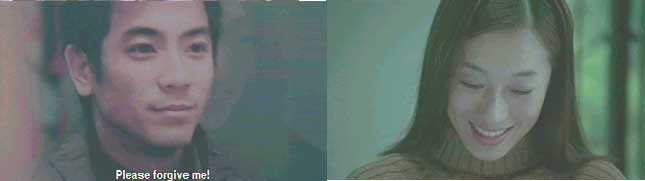
In electing to make a case for why “We object to endless imprisonment”, Herman
Yau and co. were therefore swimming against the tide of popular local opinion.
To their credit, they -- who include scriptwriter Elsa Chan, executive producer
Nam Yin and presenter (i.e., producer?) Charles Heung -- didn’t try to bring
people over to their point of view by going for the easy option of focusing
FROM THE QUEEN TO THE CHIEF EXECUTIVE on a wrongly incarcerated innocent
and/or entirely saintly activists. Instead, the film’s three all-too-human
major characters – two of which are based on real life persons -- are:
A youth who was involved in the perpetuating of a particularly brutal as
well as infamous set of crimes (David Lee gives a sensitive portrayal of
Cheung Yau Ming, AKA prisoner #67544); someone whose childhood experiences
-- some of which took place in “wooden shack district”, post her arrival
from Mainland China – are the sort that often lead to people being unhappy
for all of their life (Ai-jing deserves to be commended for her mature performance
as Cheung Yue Ling); and an idealistic activist, liable to neglect his family
in favor of stubbornly taking up unpopular causes as well as seeing to mundane
welfare matters (Stephen Tang is very convincing as Councillor Leung Chung
Ken).
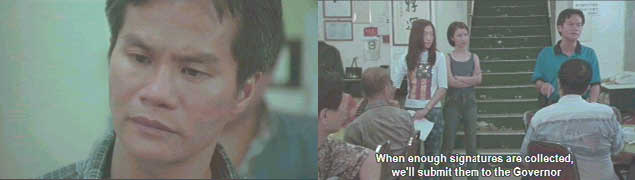
Cheung Yue Ling first learns of the existence of Cheung Yau Ming after he
bests her in a writing competition. Curious as to what this fellow
would be like in person upon learning that he was a Shek Pik Prison inmate,
she goes and pays him a jail visit. Although he – who had (already)
been incarcerated for twelve years at that point in time -- had not had much
practice talking to a female, conversation is easy between the two Open University
students until she asks him how long more he will be a convict. Unable
to provide a concrete answer, he initially does not give any answer.
Only later, does he tell her – in a letter -- of his – and twenty-two others
– being in a purgatory-type limbo situation. After doing some independent
research on the matter, Yue Ling goes to Councillor Leung Chung Ken and makes
him aware of the particular plight of the juvenile offenders “detained at
Her Majesty’s pleasure” (along with the human rights violation that arose
from the existing bureaucratic legal system making it illegal for them to
appeal against not having fixed term sentences).
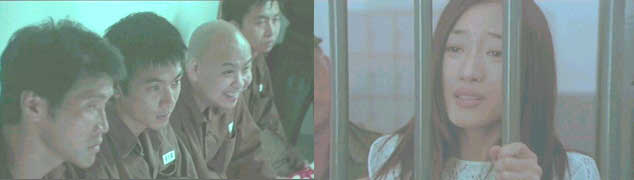
With only six months remaining of the existence of the legislative body of
which he is a member (due to its being due to be abolished and replaced by
another upon Hong Kong’s ceasing to be a British Crown Colony), Councillor
Leung realizes that there is not much time left for him to be able to act
to remedy the uncertain situation of the detainees. Enlisting the aid
of the prisoners’ families, he goes and publicly campaigns for the length
of the youths’ prison terms to be specified by Governor Chris Patten (the
Queen’s chief decision-maker in Hong Kong). Over the course of doing
so, Councillor Leung is made aware – by his staff members (none of whom are
particularly enthused about his deciding to champion this particular cause
bar for his new assistant, Yue Ling), wife, child, constituents and fellow
councillors – that this particular cause is not one that many people feel
sympathy for. It doesn’t help that that instead of looking at the juvenile
inmates and thinking that “there but for the grace of God go I” (the way
that Yue Ling does), a large number of their fellow humans are more likely
to think that a minimum of twenty years of jail time may already be much
better than the committers of (often deadly) violence deserve.
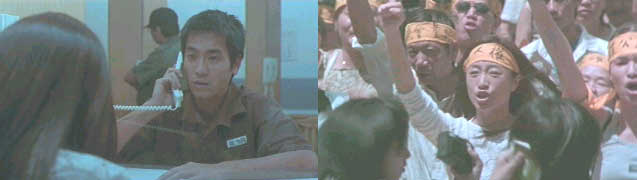
Prior to viewing FROM THE QUEEN TO THE CHIEF EXECUTIVE, I did not know one
thing about the specific situation that this film’s cast and crew look to
have considered their duty to cast light on. Neither did I possess
any knowledge of the bloody events that really did take place on Braemar
Hill back in 1985 (that this piece of investigative cinema did not shirk
from detailing). Herman Yau and co.’s achievement lies not only in
making this (re)viewer aware of them but also caring much about the people
whose lives they impact. Unless they are terribly uncaring of others,
I have little doubt that others who do decide to check out this admirably
humane as well as generally praiseworthy offering will be similarly impacted.
My rating for this film: 9.
I just want to add a second very strong recommendation
for this film. Hong Kong film is not particularly well known for delving into
social and political issues, but this small budgeted but powerful film shows
no hesitation and a great deal of heart in taking on an issue that certainly
is not an easy one to come to grips with. The film approaches it in a restrained,
near documentary fashion, but still manages to create empathy for all the
characters and generates a massive emotional punch by the end. It is as of
this writing (9/01) my favorite HK film of the year.
My rating for this film: 8.5