Little Cheung
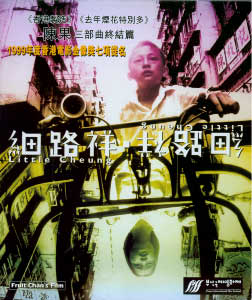
Reviewed by YTSL
Although Fruit Chan had previously directed two
films (“Finale in Blood” and Five Lonely Hearts”), he really rose to fame
with that which is known as the Handover or Reunification Trilogy. These
three works -- released in consecutive years from 1997 to 1999 -- for which
he is the scriptwriter as well as helmer share a preoccupation with the return
of Hong Kong to China. They also possess a generally “realist” -- some
might say downbeat -- tone that, nevertheless, leaves room for their auteur
to embark on certain seemingly intuitive flights of fancy (which actually
can put a damper on things even while they make matters seem more surreal
than hyper-realistic) midway through them.
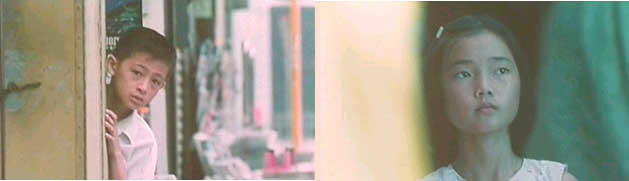
One such plot development -- or, as this (re)viewer is inclined to see it,
defining act which precipitated a too abrupt and unneccessary change in the
movie’s overall mood and direction -- led to the title character, a boy of
only nine years named LITTLE CHEUNG, defiantly singing out lines -- from
old songs associated with Tang Wing Cheung AKA “Brother Cheung” (the Chinese
Opera and old movie star who this Doris Yang and Ueda Makoto co-production
is dedicated to) -- like “My heart is broken, my luck ran out” and “Only
god knows my true pain”. I get the feeling that it will appall some
people to learn that at the time that he (who is portrayed by an incredibly
able young boy named Yiu Yuet Ming) was doing so, the film’s protagonist
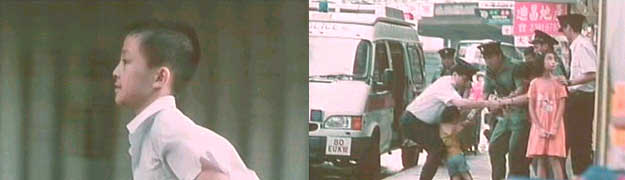
was standing naked from the waist down, out in the open air -- on the side
of a public street outside of his father’s teahouse -- and in the rain; having
been placed in that situation by the older man (Mr. Gin is played by Gary
Lai) as punishment for having carried out an earlier act of rebellion.
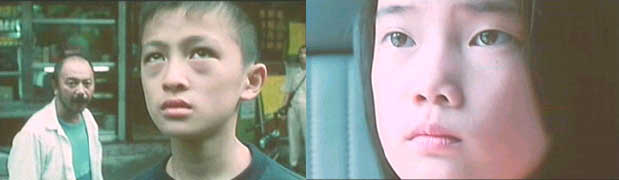
A fair amount of sensitive viewers probably will be displeased too by LITTLE
CHEUNG not only being a (part-time) child laborer for his father but being
quite the exploitative little capitalist himself: Not only given to
asserting -- as he did early in the film -- that “I have known from an early
age that money is a dream and...also a future” but also on the look out to
hire an assistant delivery person to ease his work burden. In a different
kind of cinematic offering, the fact of this individual coming in the form
of a girl who’s about the same age as the boy would probably be emphasized
over the fact that she (who is essayed by Mak Wai Fan) is an illegal immigrant
who (also) spends part of her days washing dishes for another eating establishment.
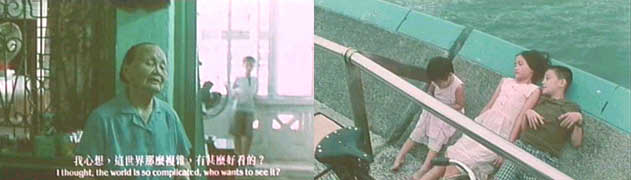
In this hardly cutesy effort (despite its having not just one but three child
actors -- Fan has a little sister named Man, who comes in the form of Mak
Suet Man), all those aspects of her identity are important and have a role
in determining how Fan’s fate gets played out in the movie.
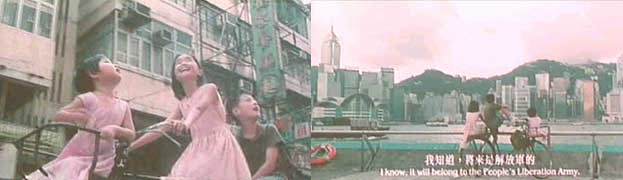
Throw a frequently put-upon Filipino maid (Armi Andres is Armi), a literally
toothless grandmother (portrayed by Chu Sun Yau), a seemingly mahjong addicted
mother (Mrs. Gin is portrayed by Chun Kwok Hei), a petty gangster (the actor
who plays David is credited only as Robby), his elderly father (Mr. Hoi is
essayed by Heung Hoi), a prostitute who looks to have a heart of gold and
other assorted Yim Kee tea-house clients and neighbors -- including a couple
of aged coffin-makers -- into the equation and LITTLE CHEUNG can seem to
promise a wallow in depression and not much more. However, and much
to his credit, what Fruit Chan successfully and generally fashioned out of
this collection of Mongkok-Yau Ma Tei area characters (all of whom were absolutely
convincingly played by non profesional actors) was something that’s more
akin to a love letter to Hong Kong and the inhabitants of those admittedly
unglamorous sections of it that -- for all of its warts and problems -- is
much more of a close-knit urban village than an impersonal and truly uncaring
concrete jungle type of world.
Although LITTLE CHEUNG doesn’t hold together in my mind and memory as well
as “Made in Hong Kong”, it does not meander -- and therefore threaten to
bore, at least in sections -- the way that “The Longest Summer” did.
This equally dramatic and political work also may be the one that has some
of the best and undoubtedly hard-to-forget moments and images of this set
of very interesting films. These range from the gag-inducing (including
that which involves a used tampon dropped at least one floor down into someone’s
drink as well as what is passed off as a special tea and/or lemonade!) to
the poignant and nostalgic (namely that brought about by a grandson having
the kind of loving relationship with his grandmother that he’s not able to
have with his parents and his grandmother unfortunately doesn’t have with
her son) all the way to the celebratory (notably that in which a gathering
sings out that “I am blessed every day of my life”).
If only LITTLE CHEUNG had ended on that note and with that scene. This
regret notwithstanding, the fact remains that for much -- maybe more than
three quarters even -- of this close to two hour long movie, I did think
that Fruit Chan -- with the help of cinematographer Lam Wah-Chuen -- had
painted a portrait of Hong Kong that had really captured many of the things
that were special and to be valued about those of the territory’s folks who
might be described as more salt than scum of the earth. In any case,
a measure of how much I still do like this sincere feeling effort -- despite
its not having the conclusion I wished it had had -- is that I find myself
very much looking forward to checking out the Fruit Chan offering that followed
it (“Durian Durian” is said to be this one’s companion piece as well as part
of a new movie trilogy -- this time involving prostitutes).
My rating for the film: 8.