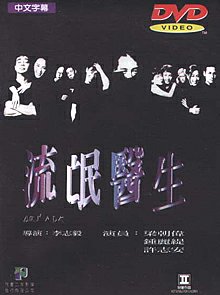
Dr. Mack
Reviewed by YTSL
In his review of “Lost and Found” (that can be
found on his “A Chinese Cinema Page”), Shelly Kraicer wrote that “the screenplay...is
smart, precise, fresh, and has a "written", thoughtful feel to it, for a
popular HK movie -- one could almost believe that it had been composed in
its entirely, and then polished, ahead of time, before the actual shooting
(not typical HK practice).” Here’s giving advance warning that those
who expect this to also be the case with regards to an earlier effort --
released just one year before that magical film -- which also has the versatile
as well as multi-talented Lee Chi Ngai as its scriptwriter, director and
producer as well as is an(other) United Filmmakers Organization (U.F.O.)
work will only meet with disappointment.
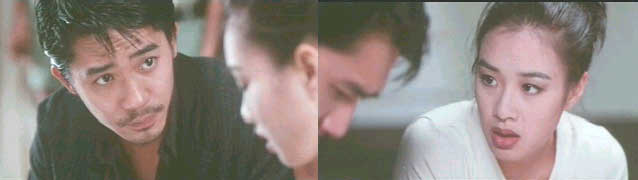
One likely reason for this being so is that that which goes by the English
titles of “Mack the Knife” as well as DR. MACK is just too full of subplots
involving a whole host of potentially interesting but generally too underdeveloped
characters (among whom are a socially awkward undercover policeman played
by Lau Ching Wan, an idealistic young doctor essayed by Andy Hui, a no less
idealistic schoolgirl who comes in the form of long-legged Gigi Leung, a
cancer patient portrayed by Hilary Tsui, an unexpectedly intellectual --
and stereotypically kind-hearted -- prostitute portrayed by Eileen Tung plus
an eccentric medical school professor played by Richard Ng). When one
adds in cameo-like appearances by Hong Kong film critic, Law Kar (as Gigi
Leung’s character’s father), as well as Law Kar Ying (as a dedicated Christian
preacher), Jordan Chan (as a celebrity singer who graces one of the movie’s
Evangelical type events) and Lawrence Ng (whose most notable contribution
to the work involves his getting slapped by Christy Chung while urinating
in a public men’s room!), some idea ought to be gained re how overcrowded
this effort can seem to be.
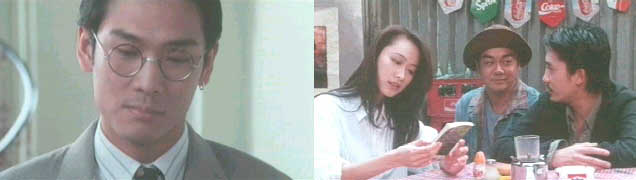
And all this before my making any mention of the film’s protagonist (The
scruffy but nonetheless agreeable looking individual whose Chinese name of
Lau Man apparently can be translated as “Delinquent Doctor” -- and got somewhat
anglicized into Lau Mack -- comes in the form of Tony Leung Chiu Wai).
Ditto re DR. MACK’s medical school buddy turned less than scrupulous arch-rival
(Dr. Jaw is played by a convincingly slimy Alex To), and the third party
in what turns out to be a love triangle (Christy Chung would not have been
my first choice to portray a classy as well as physically attractive psychiatrist
named Jamie) as well as a clash of divergent personal style and medical ethics
that could be said to be the central subject of the movie, if it had a single
real center (rather than a decentered feel to it).
Still, this is not to say that this 1995 “feel good”, even if not quite (completely
successfully) “touchy feely”, offering has nothing (thematic) in common with
the 1996 effort that (also) depicts individuals from different walks of life
-- and in different stages of health -- coming together and finding community,
friendship and love. Indeed, certain elements which I noticed over
the course of my viewing DR. MACK got me wondering whether the messier feeling
-- but still rather enjoyable, especially when expectations have been sufficiently
lowered, plus quite heartwarming in parts -- movie hadn’t effectively served
as a “dry run” of sorts for that which centers on a young woman who had lost
hope and the young man who sought to help her regain it.
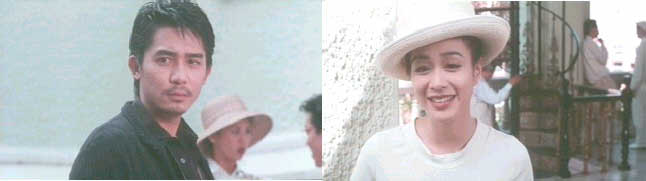
For example, it surely wasn’t coincidental that both these romantic(ized)
dramas have as their main male characters physically unassuming -- yet immensely
charming -- do-gooders who seem to have found their calling and place in
the world on the fringes of Hong Kong society. Then there’s the fact
of both films featuring a young female character who hails from a privileged
background getting inspired to assist the male protagonist in carrying out
his entirely admirable enterprise (This (re)viewer was somewhat disappointed
to find that Gigi Leung’s May has a smaller part to play in proceedings than
Kelly Chan’s “Lost and Found” character, however). Something else that
is of note is how, despite the specter of death looming over some individuals
in -- and sections of -- the works, the movies actually do seek to impart
messages that are largely life-affirming as well as positive.
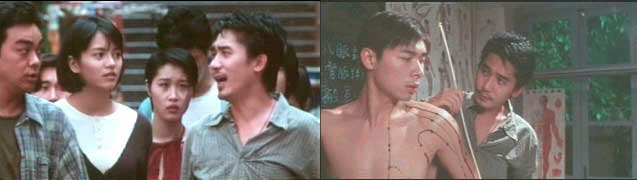
Upon learning that DR. MACK is a Chinese New Year cinematic offering, it
makes sense that Lee Chi Ngai and co. seemed to have sought for their work
-- one which apparently has been adapted from a Japanese manga (“Dr. Kumahige”,
by Sho Fumimura and Takumi Nagayasu) -- to impart a sense of good will and
cheer to its audience and the world in general. How ironic it is then
that a movie that is infused with such sentiments, plus contains such lines
as “we are all human”, has been castigated -- by at least a couple of HKMDB
reviewers -- for containing some racist remarks. At the risk of myself
being accused of (cultural) insensitivity, I feel obliged to suggest that
a mountain has been made out of a molehill with regard to this particular
matter. In any event, the bulk of my dissatisfaction with this effort
had less to do with it being Politically Incorrect and more to do with my
finding its plot(ting) to be less streamlined and “deep” than it probably
ought to have been.
My rating for the film: 6.5