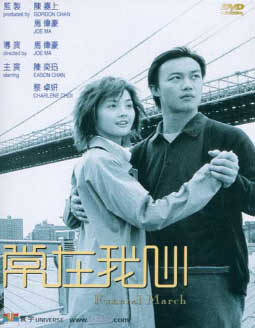
Funeral March
Reviewed by YTSL
There are logical reasons, I reckon, for thinking
that it would constitute a “kiss of death” for cinematic works to have at
least one of their protagonists spend significant periods of their on-screen
time being seriously -- or even fatally -- ill. When looking at the
box office performance of more than one Hong Kong offering that fits this
description though, it makes quite a bit of sense why “disease films” continue
to be produced in the HKSAR; and to the credit of those who come out with
these efforts, thus far it does seem to be so that each and every entry in
this -- perhaps paradoxically -- often life-affirming sub-genre that I’ve
checked out has been endowed with a certain amount of distinctive elements
as well as quality attributes.
In the case of the Joe Ma and Gordon Chan co-produced FUNERAL MARCH, what
particularly stood out for this (re)viewer was how much there appeared to
be an overall sense of admirable restraint to it (This especially in comparison
to the hyper-melodramatic “Forever and Ever”, the other 2001 movie I viewed
which featured a leading character whose young life gets prematurely cut
short). Although this impression of coolness is conveyed in large part
by way of this surficially bleak film’s understated color template and ace
cinematographer Ko Chiu-Lam’s other visual choices, it also comes through
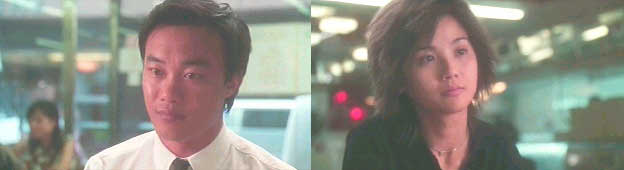
in the measured approach to death and life of a key personality -- Duan (well
essayed by Eason Chan), a funeral director who is much more conscientious
when going about his duties than might be expected of someone who came into
his line of work by way of it being a family business (plus has religious
beliefs that differ from many of his clients).

FUNERAL MARCH’s main story starts with a young woman named Yee approaching
Duan and telling him that she is dying of intestinal cancer and wants to
hire him to see to her funeral arrangements. After she (who is portrayed
by Charlene Choi) agrees to adhere to his stipulated conditions for doing
so (which include her not being allowed to attempt to take her own life and
taking certain actions that ought to prolong her time on earth), he learns
that the tasks he’s getting asked to execute include accompanying her on
a visit to New York (where, he subsequently learns, her mother -- who died
six years earlier by way of an act which people remain unsure was either
a suicide or genuine accident -- is buried and her (ex-)boyfriend goes to
school).

Even though Duan and Yee are accompanied on their New York trip by two others
(The dutiful Elsa -- played by Sheila Chan -- looks to be her wealthy father’s
lawyer while a quiet man who doesn’t say much at any time in the film appears
to be the family chauffeur), the two lonely individuals get ample opportunities
to go from being undertaker and client to something more. While this
sort of social development is clearly what Yee -- whose relationship with
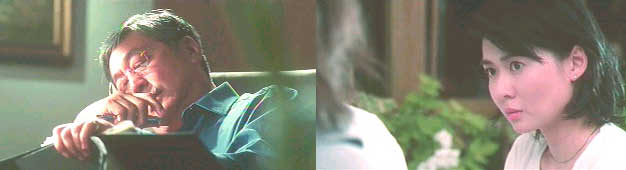
her father (The often worried looking Mr. Wong comes in the form of Kenneth
Tsang) has been strained by his having a new significant other (The actually
not at all evil acting Patsy is essayed by Pauline Yam) -- wants (even if
she may not have been consciously looking for this to happen), Duan -- who
has not had a girlfriend since breaking up with Jane (The charismatic Candy
Lo, making a cameo appearance) -- is shown being less comfortable about the
direction that this particular relationship looks to be heading.

It is to the credit of FUNERAL MARCH’s scriptwriters (director cum co-producer
Joe Ma along with Chan Gam Kuen and Chan Ling Sun) that more than just a
single acceptable reason is furnished as to why the apparently ever-rational
Duan would hesitate to cultivate more than a professional connection with
Yee. Still, the fact of the matter is that this movie -- whose Chinese
title translates into English as “Always In My Heart” -- would have been
a really short one if its (main) characters were shown being able to completely
follow the dictates of their brains rather than hearts. And as it turned
out (by way of at least one major plot twist that I found to be disappointingly
clunkier than the rest of the otherwise pretty smoothly moving work), the
film actually went on for several minutes longer than the (first) point at
which I really thought that it was going to conclude!
Even while it makes some sense that FUNERAL MARCH turned out to possess the
extended final sections that it does, I have to admit that they actually
ended up taking away something (meaningful) from the movie for me.
Similarly, while Lowell Lo’s instrumental musical score may have been an
added attempt to make this dramatic offering classier than if it had been
more run-of-the-mill Cantopop infused, I often found the highlighted music
to be more overpowering and noticeable than it probably should have been.
Consequently, this by no means unwatchable effort is one that ultimately
cannot maintain -- even while parts of it did approach -- the lofty standards
set earlier by the truly spirit-soaring likes of “C’est la Vie, Mon Cheri”
(1993) and “Lost and Found” (1996).
My rating for this film: 7.