Midnight Fly
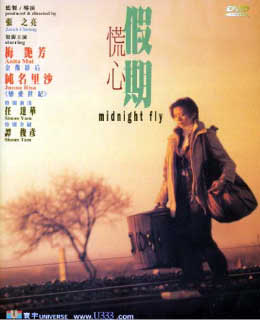
Reviewed by YTSL
There are a handful of Hong Kong auteurs whose
sterling reputations this (re)viewer has difficulty understanding their having
apparently earned. When I have mentioned this to admirers of their
works, the usual suggestion that I am provided with, other than of my being
out of my mind..., is that I just haven’t seen their best -- and, perhaps
not coincidentally, usually earlier -- efforts. For example, this 2001
melodramatic “art house” type offering’s director cum producer -- whose less
high brow movie from that year, “Never Say Goodbye”, had caused me to seriously
wonder whether I ought to continue checking out any more entries in his filmography
-- looks to have had been established as a film-maker to respect and name
to look out for with two 1992 offerings: “Lover’s Tear”, and the HKFA
award winning -- including for Best Picture as well as Best Director -- “Cageman”.
On the other hand, the eight efforts which Jacob Cheung has at least co-helmed
since then (six of which I’ve seen to date) have been a pretty mixed bag
in terms of quality; with the presence of charismatic performers like Michael
Hui and Josephine Siao Fong Fong saving some of them (e.g., “Always On My
Mind”) but others (e.g., “The Returning”) not having benefited much from
having cast members who included Tony Leung Chiu-Wai, Wu Chien Lien and Sandra
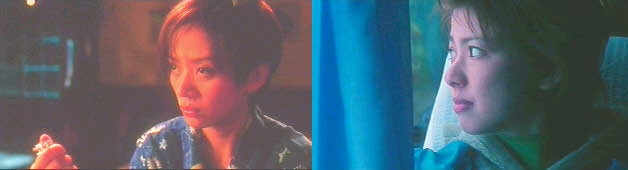
Ng. And even while I do think that MIDNIGHT FLY’s leading actresses
and supporting actors played their parts well, that which stars Anita Mui
(as Michele, a woman who is in her sixth unhappy year of marriage to Simon
Yam’s Tong) and Junna Risa (as Miki, a “Midnight Fly” perfume wearing younger
woman who wished that she were married rather than in the kind of problematic
relationship that she is with a married man) is one more cinematic offering
from the sometime United Filmmakers Organization (U.F.O.) partner that I
didn’t feel was particularly compelling or moving and consequently also thought
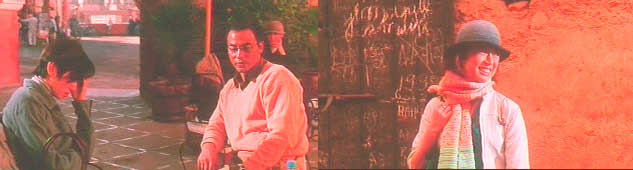
was rather disappointing (even while undoubtedly admirably lensed by Wong
Ping Hung, who made very good use of the production’s photogenic French and
Moroccan settings).
This having been said, I feel obliged to point out that MIDNIGHT FLY appears
to actually not be without its share of female and male fans (who, perhaps
not coincidentally, perceive it to be both a more convincing tale of female
friendship and generally well-made “chick flick” than yours truly).
Also, from one of them (The Illuminated Lantern’s Peter Nepstad) has come
what I reckon is the inspired suggestion -- if you are going to view the
effort on DVD -- to apply the option of removing the English subtitles that
otherwise will be on screen during those substantial segments of a work --
whose opening scene takes place in Paris and subsequent ones all take place
in locales that are far away from the HKSAR, yet apparently aren’t necessarily
ones where Cantonese speakers -- like Shaun Tam’s Mike character -- are impossible
to find...) -- in which English is the language being (often awkwardly as
well as hesitantly) utilized (by such as a hyper cheery French tour guide
but also Anita Mui’s downbeat Hong Konger character and her newly found Japanese
friend). This way, the movie’s viewer will be spared having to see
those subtitles that are particularly distracting on account on whole phrases
and sentences making their appearances before an individual can be heard
uttering the end bits of them.
Another plus that may come from doing so is that MIDNIGHT FLY might then
come across as less repetitive and resultingly heavy-handed in its presentation
of the often moralizing -- not just moralistic -- messages that looked to
me to have been peppered throughout a workmanlike piece with an overly predictable
story arch that its director is on the record as stating that he wanted to
be thought-provoking and cause people to ponder such questions as: “Why do
we have so much regrets in life?”; “Why have we become so heartless?”; and
“Why do we always consider something as either right or wrong?” (See <http://filmcritics.org.hk/ciajun.html>).
At the very least, this may prevent it seeming to be all too jarringly obvious
that one of this mono-tonally, though far from visually, somber film’s main
plot-lines involves its protagonist learning -- by way of her forming a relationship
with the appealing looking plus acting fellow female she met on a bus tour
of Provence, then went with on a visit to Morocco (the North African country
where Michele and her now often distant doctor husband had honeymooned) that
was to turn into the archetypal hellish trip to a very foreign land -- that
“sorry” is a word best uttered by strangers rather than good friends or supposed
intimates.
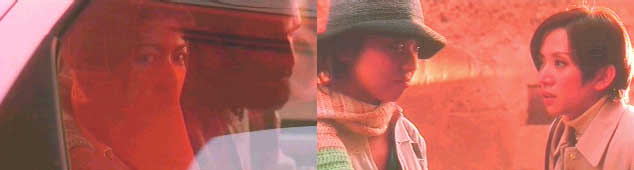
Another preachy point that Jacob Cheung was apparently majorly intent on
hammering home in MIDNIGHT FLY is that which relates to the value and sanctity
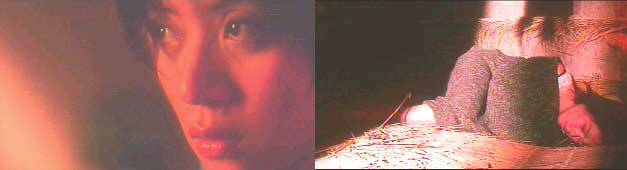
of life. This can be seen in such as a disturbing Moroccan country-market
scene involving dying and dead donkeys along with those in which humans are
the visual as well as actual primary focus, and was something which he seemed
to have taken pains to communicate in a Hong Kong Film Critics Society organized
forum in which he participated. Yet, IMHO, this is the precise idea
that got negated by the director-producer’s choice of ending for this effort
-- one which, it ought to bear noting, actually significantly differs from
that which he has revealed was contained in Tang Tsz Chun’s original script.
Thus, in contrast to those who believe that the movie started off slowly
but then got better the further along it went, its conclusion is where I
consider this well-meaning but often too trying work’s nadir to lie.
My rating of the film: 5.5