A Moment of Romance III
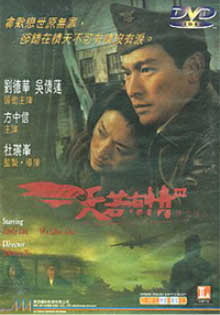
Reviewed by YTSL
The 1996 entry of a trio of works that bear the
same title and have Wu Chien-Lien as the lead actress -- but have her playing
different characters in each of them and have had her appearing on different
sides of a “hailing from the right versus wrong side of the tracks” romantic
equation -- appears to be the least popular among Hong Kong film fans as
well as have come under the heaviest criticism by internet and other
movie reviewers. I thus was rather surprised to learn (via the HKMDB)
that the old-fashioned as well as melodramatic feeling presentation whose
Chinese title translates into English as “As If Heaven Has Love III: Flames
of War Beauty” -- and was directed, not just produced, by Johnnie To -- actually
outperformed its Benny Chan directed 1990 and 1993 predecessors at the local
box office.

For the record: The almost overpoweringly orchestral music-filled A MOMENT
OF ROMANCE III grossed about HK$1.5 million more than the generally more
modest effort which saw the first pairing of Andy Lau and the then cinematic
debut-making actress whose is known to Cantonese speakers as Ng Sing-Lin;
and raked in some HK$5.5 million in excess of that which teamed up Wu Chien
Lien with Aaron Kwok. After viewing it, I strongly suspect that this
period offering that’s set in rural as well as urban portions of China that
are at war with the Japanese -- and which really does look visually sumptuous,
no doubt due in large part to its cinematographer being the masterful Poon
Hang Sang as well as because it does boast a couple of physically attractive
stars plus places them amidst some very photogenic locales and sets -- also
cost a fair bit more than the earlier AMOR works; and not only because of
its main male character’s preferred modes of transportation being planes
as well as a jeep and a chauffeur-driven limousine rather than motorbikes
or mass transit.
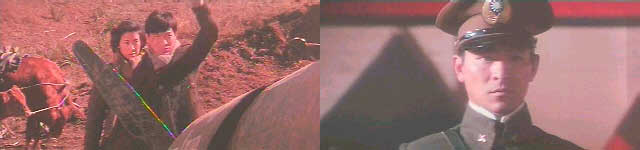
A MOMENT OF ROMANCE III’s main (love) story effectively and rather inauspiciously
begins on a rainy day in 1938, with a wounded Chinese Air Force Lieutenant
Lau Tin Wai (who gets played by Andy Lau in dashing mode) crashing his bullet-riddled
plane into a corn-field and narrowly avoiding smashing into an eighteen year
old local female who had just finished praying to the gods to bring the potentially
harvest-ruining heavy downpour to a halt. What with the sun having
come out soon after the military pilot’s sudden arrival into her very remote
neck of the woods, Ting Siu Wo (who is portrayed by the sufficiently young-looking
as well as perennially sweet-faced Wu Chien-Lien) sees the nearly as quickly
convalescent Tin Wai as having had something to do with the miraculous-appearing
change in the weather, and consequently undertakes to make him feel welcome
and comfortable during what amounts to an enforced stay in the area for him
(until he gets his plane back in fly-able condition plus manages to (re-)establish
contact with some others who are actively engaged in the war effort).

Despite the patriotic Tin Wai clearly hankering to get back to fighting the
good fight against the Japanese invaders of his beloved motherland, he ends
up being unable to help but enjoy the latest situation he found himself in
and bathe in the warmth of the sun plus the warm affection that is showered
on him by Siu Wo and, to be fair, pretty much all of the other residents
of Double Mountain Village. Before too long however, with such as the
return of a group of men who had temporarily ventured outside of their home
territory to look for work and such, his rural idyll gets interrupted and
then brought to a close. One reason for this is that Tin Wai is recognized
by them to be a scion of a very wealthy, high class family (in whose presence
it is felt that people ought to stand on ceremony). Another spanner
thrown in the works -- and specifically into Tin Wai and Siu Wo’s hitherto
innocently friendly but increasingly close relationship -- is that one of
the recent male returnees to the community happens to be not only the son
of the village headman but also the individual who the now obviously grown-up
Siu Wo was designated from childhood to marry.
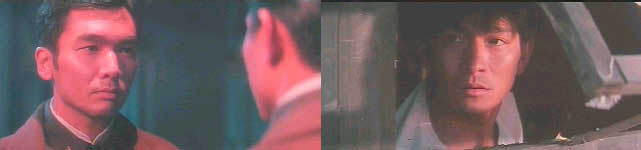
A series of other events soon contribute to Tin Wai being at least briefly
designated as persona non grata in the previously welcoming village (and
thereby complicating A MOMENT OF ROMANCE III’s otherwise pretty straightforward
as well as simple plot). Although this state of affairs actually only
ended up strengthening the emotional bonds between Tin Wai and Siu Wo, this
unlikely pairing -- of rich urban fly-boy and illiterate as well as poor
peasant female -- are then compelled to part when he gets successfully contacted
by other Chinese air force personnel and ordered to return to his squadron’s
Wushan base. Some short hours after Tin Wai’s looking to have permanently
departed from her community and life though, Siu Wo ends up making tracks
of her own to the far away big city that happens to be Tin Wai’s hometown.
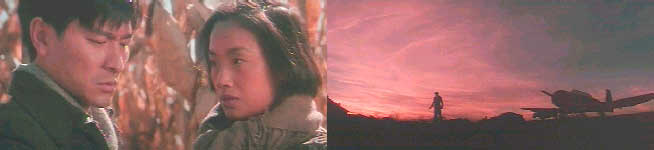
In Wushan, Siu Wo not only successfully re-encounters Tin Wai but also meets
-- in varying circumstances -- a prostitute cum apparently archetypal “air
force pilot’s woman”, other members of Tin Wai’s not particularly respected
-- as it turned out -- squadron (whose oft brooding captain is played by
the ever hunky Alex Fong), and his strong-minded societal pillar of a widowed
mother -- and receives a mixture of receptions (ranging from surprisingly
positive to expectedly negative) from them. All in all, the arguably
too nice-for-her-own-good young woman appears to rather disconcertingly and
discomfortingly find that there really isn’t that much time and opportunity
in that city for romance or, seemingly, even genuine love of more than one’s
country...Or/but does she really? Suffice to say at this point that
I wouldn’t rule out it being so that the manner in which A MOMENT OF ROMANCE
III concludes might well have had a significant role in this watchable --
but not all that special, really -- effort enjoying greater commercial success
than the two previous offerings with which it significantly differs in more
than just temporal and geographic settings.
My rating for the film: 6.