Hollywood, Hong Kong
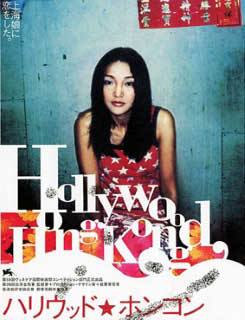
Reviewed by YTSL
Before anything else, here’s confirming that a
scene in this Fruit Chan, Christine Ravet, Doris Yang, Kei Haruna and Sylvain
Bursztejn co-produced work does takes place in the U.S.A. and where the famous
“Hollywood” sign is indeed clearly visible. For the most part though,
the Hollywood that plays a larger part in the second of director cum scriptwriter
Chan’s “Prostitute Trilogy” -- whose first installment was the Mongkok-,
Shenzhen- and Manchuria- based “Durian, Durian” -- actually is the up market
Hollywood Plaza (shopping mall and set of apartment blocks) which abuts the
now torn down shanty town known as Tai Hom Village in the apparent “land
of contrasts” that is/was the Diamond Hill section of Hong Kong (For the
record: This area also was the setting for -- and gave its name to -- a low
key 2000 Soi Cheang movie with its share of admirers).
Early in this lively offering (which is replete with the kind of black comedic
absurdist -- more so than plain fantastical -- elements that looks to have
become a Fruit Chan film trademark), its physically attractive lead female
character of HOLLYWOOD, HONG KONG tells one of her frankly not particularly
visually palatable Tai Hom Village clients that she lives in one of the luxury,
high rise apartments that overlooks -- but can seem like a wondrous world
that is far removed from -- his squalid living space. Seeing that the
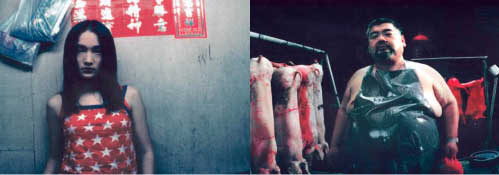
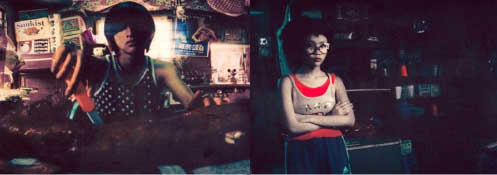
coquettish lass (intriguingly portrayed by Zhou Xun) who goes by the internet
handle of “Shanghai Angel” -- and whose meat- (as opposed to cyber-)space
name is variously given as Tung Tung, Fong Fong plus at least something else
-- is a Mainland Chinese prostitute who really doesn’t appear all that fussy
re which men she is prepared to “serve”, one can’t blame the squatter lad
-- a tattooed pimp named Keung whose offer to manage her the independent
minded sex worker had quickly rejected and sexual prowess she had also gently
mocked -- for being quietly disbelieving regarding her statement.
However, as she -- who I will refer to as Tung Tung from here on -- later
demonstrates, this seeming improbability truly is an at least temporary reality.
Ditto re there actually being a genuine possibility of the enigmatic young
woman really not being turned off by obese persons in the way that many look-ist
HKSAR residents appear to be, and to such an extent that this aversion was
rumored to have played a big part in creating difficulties in finding HOLLYWOOD,
HONG KONG -- a novelly imaginative, to say the least, effort whose maker
seems to positively revel in revealing the physical similarities and other
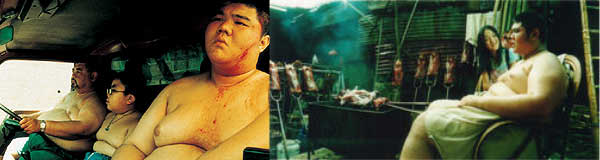
links that exist between such as a prized sow named Ma Ma (who must be the
first pig to be accorded an acting credit in a Hong Kong movie) and the three
sizable members of the all male Chu family who make a living from hawking
barbecued pork -- a willing local distributor.
Still, this is not to say that Tung Tung is a completely saintly individual.
In fact, the film’s master auteur has been quoted as saying that she “is
the incarnation of both the angel and the devil” (See p. 87 of the “HOLLYWOOD,
HONG KONG: Fruit Chan’s Heaven and Hell” chapter of the 2001-2002 HKIFF “Hong
Kong Panorama”). Accordingly, even while they did get to derive some
pleasure from their brief acquaintance with her, the likes of Boss Chu (who
Glen Chin -- one of the commendably interesting production’s two professional
thespians -- adeptly portrayed) -- and his teenage son (who is appropriately
labeled Fatty and reputedly played by a real life pig butcher cum barbecue
pork purveyor) probably would have foregone all of the earth(l)y delights
she had made available to them for a time if they had known at the start
what would be the trappings that would come with the at least outwardly delightful
package of womanhood who initially looked to have so fortuitously entered
their lives by way of an innocent befriending of her by the young Ah Sai
(Boss Chu’s quite cute as well as chunky second son’s moniker translates
into English as Tiny).
Even though the ramshackle hut dwelling males of HOLLYWOOD, HONG KONG almost
invariably are the losers of encounters with others, it could be argued that
they often got what they deserved on account of their being too prone to
project fantasies onto such as the allegorical tale’s main female character
(and driving force). At the same time, this is not to say that Fruit
Chan’s stance is all that strongly condemnatory of the sort of persons that
many in quite a few and different ways more fortunate folks would not want
to associate with (or even know exist). Instead, despite its director,
scriptwriter cum co-producer having talked of this work of his possessing
an apparently cautionary or maybe just unsentimentally matter-of-fact central
theme of “running out of stream, or promising more than one can deliver”
(See p. 88 of the 2001-2002 “Hong Kong Panorama”), this surely pretty unique
dramatic offering appears to be much less of a scathing indictment of a post-Handover
Hong Kong that the critically acclaimed film maker has done his bit to give
the impression has been infiltrated by Mainland Chinese prostitutes galore
-- or woeful general tragedy -- than some might be inclined to expect that
it would be.

Maybe it is because -- in Fruit Chan’s own words -- “I [increasingly] am
more concerned about evoking the local people’s sentiments, than taking any
political stance” (Ibid). Even if so, I think a contributing factor
is that of the remarkable visioned man -- together with his regular cinematographer
(O Sing Pui) and art director (Oliver Wong) -- having the ability to spot
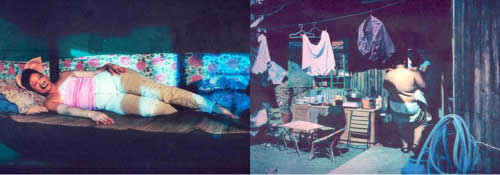
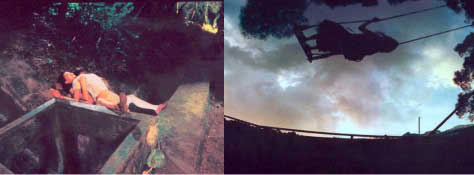
and draw attention to some downright transcendent sights (e.g., of Tung Tung
ecstatically -- and apparently purely plus innocently -- enjoying the feeling
of moving closer and closer to the heavens by way of a fellow human being’s
sweaty efforts and a home-made swing) plus colorful personalities who can
be found amidst the most mundane or not at all obviously satisfaction yielding
of surroundings, circumstances and happenings. Whatever the reason(s),
this often warmly generous -- though far from rose-tinged -- perspective
of uninhibitedly flawed plus lower class humanity is what makes the substantial
HOLLYWOOD, HONG KONG seem much more like the cinematic equivalent of immensely
delectable meat, as opposed to poisonous substance, for me.
My rating for the film: 8.