The Day the Sun Turned Cold
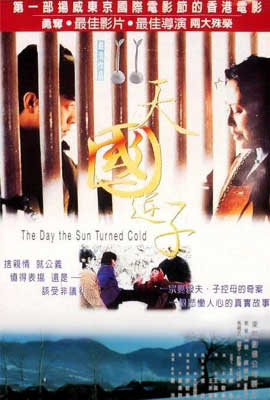
Reviewed by YTSL
Early on in this 1994 film that Yim Ho directed,
wrote the script for and co-produced (along with Wong Hing Dung and Wong Sik
Ban), a twenty-four year old man is heard to assert the following about his
mother: “I don’t hate her. She’s a good woman. I love her a lot”.
Although he sounded sincere when issuing these statements, it’s very difficult
to take him at his word. This is because of it being so that pretty
much the very first things that this recently demobbed soldier turned welder
is shown doing in this chill-inducing offering is going to a police station
to, seemingly out of the blue, accuse the woman who had raised -- and, according
to her (then) husband, spoilt -- him of having committed a murder -- a crime
whose penalty (as pointed out by the already hard pressed police captain
played by Li Hu) in Communist ruled China, the country where this story is
set, is death by way of a firing squad -- that few other people look to have
suspected her of enacting.
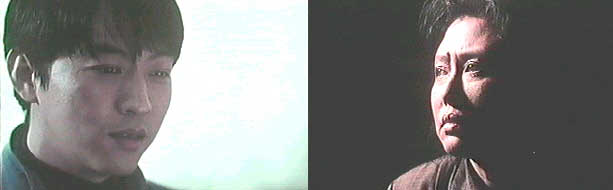
When the point is reached in THE DAY THE SUN TURNED COLD that this not very
sympathetic fellow -- who argues that he did what he did because his conscience
forced him to but gets very negatively described anyways in this 1994 effort’s
Chinese title (which translates into English as “Traitorous Prince”) -- actually
finally tells the woman he has essentially betrayed “Ma. I’ve informed
on you”, this (re)viewer’s sympathies were squarely with the accused murderess
as opposed to the self-righteous individual who had instigated a criminal
investigation against her. Similarly, I wasn’t going to argue against
this former bean curd maker and seller as well as wife of a school principal’s
bitter suggestion of it being so, at least in this particular instance, that:
“Raise a son, and you’ve brought up resentment”.
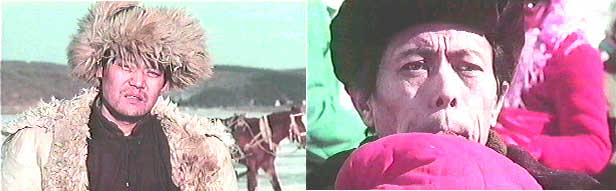
All this is not to say though that there’s no foundation whatsoever for the
case that ended up being built against the accused woman. What muddies
the waters morally, even if not legally, though is that: For one thing, she
-- whose maiden name is Pu Feng Ying (and who gets portrayed by the highly
respected Mainland Chinese actress, Siqin Gaowa) -- was being reported, then
investigated, for a very serious crime that occurred ten long years ago (in
1980, since the flashback as well as snow filled THE DAY THE SUN TURNED COLD’s
“present day” is 1990); and, for another, the man (Guan Shichang is essayed
by Ma Jing Wu) that the twice married woman gets charged with of having fatally
poisoned turns out to have been her first husband (and father of her first
three children, the eldest of whom is her accuser).
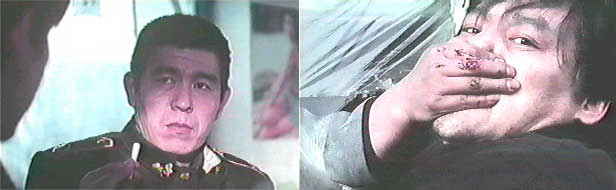
In view of the childhood experiences that THE DAY THE SUN TURNED COLD’s audience
get shown being undergone by the generally taciturn Guan Jian (who is played
as an adult by Taiwanese actor Tuo Zhong Hua and as a fourteen year old child
by Shu Ziong), I would have thought that he would have been far more inclined
to take the side of his caring mother than less warm father. After
all, this Northern Chinese villager -- who unquestionably had had a hard
life -- it is who was prepared to do such as take a beating for him (as well
as labor in far from ideal conditions to put food in his stomach, shoes on
his feet and a smile on his face) while the older and more educated parent
it was whose method of punishing his hooky playing son involved spanking
him with a substantial as well as hard looking piece of wood.
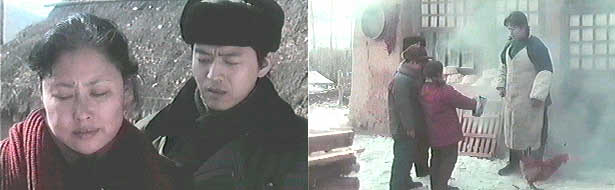
In the process of presenting this fact based story (THE DAY THE SUN TURNED
COLD is apparently based on a real life criminal investigation) though, Yim
Ho seems to be insinuating that -- for worse rather than better -- certain
post 1949 (Mainland) Chinese practices have (overly) encouraged state interference
into family matters and also that traditional Chinese culture has taught
people to be loyal to those who they share the same surname (and line of
descent) with above others (including mothers or step-parents, however (more)
kindly and loving they may be). Hence this unsavory tale -- in which
a wood cutter named Lin Dagui (and portrayed by Wu Aizi) also has a part
to play -- coming across as actually having rather logically progressed and
reached the denouement and conclusion that it does.
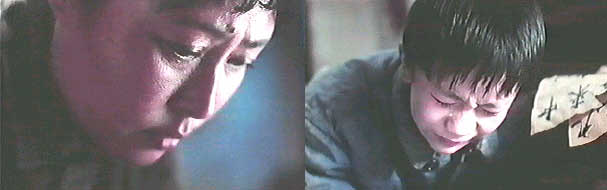
THE DAY THE SUN TURNED COLD is an international award winner (including for
Best Film and Director at the 1994 Tokyo International Film Festival) as
well as possibly Yim Ho’s most widely distributed Hong Kong film (E.g., it
is the only one of them that’s available to rent at my local (non-Chinatown)
video store). While there’s no doubting the pedigree of a dramatic
work for which Ann Hui served as executive produce, planner and also costume
designer, I will admit that I found this impressively lensed (by Hau Wing)
effort difficult to like or even sincerely admire. This is not least
since it is as wintry cold plus didn’t (seem to try to) move me as much as
“Red Dust” -- my favorite movie of the art house (leaning) auteur’s mere
three that I’ve thus far checked out, and with which this offering looks
to have shared a couple of locations -- was blood red warm plus successfully
appealed to my heart as well as mind.
My rating for this film: 7.