Women's Prison
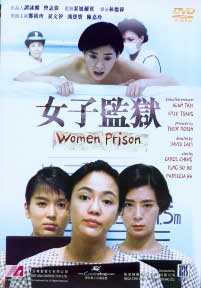
Reviewed by YTSL
Unlike those movies that are filled with hopping
vampires and flying “jiang hu” representatives, women-in-prison films are
not unique to Hong Kong cinema. Like with certain prostitute dramas
from this East Asian territory -- notably the 1992 edition of “Girls with
Tomorrow” that was co-directed by Wong Chi and David Lam, and also Lawrence
Ah Mon’s “Queen of Temple Street” -- however, the few Jade Theatre “females
behind bars” efforts that I’ve thus far viewed seem to contain certain elements
that I find uncommonly effective at tugging at my heart strings and making
me come to have empathetic feelings for those of its main characters who
I’d normally expect to not have all that much sympathy for. Also like
with the better “call girl” offerings that I’ve checked out, these films
look to be good showcases of those actresses who prominently feature in them
(e.g., Carrie Ng, Season Ma and Meg Lam in “The First Time is the Last Time”
and the stars of this work that came out one year before the Raymond Leung
helmed prison drama that also benefited from having a strong supporting performance
from Andy Lau).
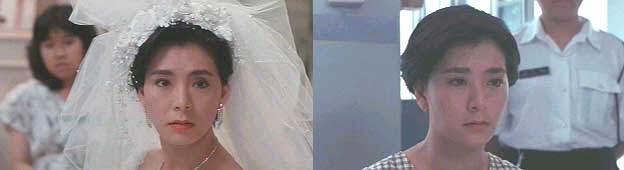
In point of fact, I would go so far as to suggest that such as WOMEN’S PRISON
are likely to rise or fall on the abilities of those entrusted with investing
an essential modicum of humanity into archetypal characters that might otherwise
too clearly come across as being way too tiredly stereotypical in nature.
In which case, a fair amount of kudos ought to go to whoever was responsible
for ensuring that this Alan (Tam) & Eric (Tsang) production has Pat Ha
in the lead role of Kelly Ho Ka Wai -- a thirty year old individual who this
David Lam helmed offering’s viewers first see attractively attired in Western
styled bridal wear on what was supposed to be her wedding day but spends
much of the rest of the traumatic incident filled work in drab prison garb
(and being known to other uniformed women as inmate number 6180 as well as
by her personal name(s)) -- as well as the particular actress who I’m coming
to greatly admire after seeing her in such varied fare as “On the Run”, “Vengeance
is Mine”, “An Amorous Woman of the Tang Dynasty”, “Princess D” and now this
film too.

After being sentenced to 18 months in jail for bashing the head of one of
two loan sharks who had pursued her intended (Wayne Lau -- who comes in the
form of Simon Yam -- had sought to make some money from gambling but ended
up only incurring significant debts) all the way from Macau and manhandled
her mother, Kelly (as she is identified in the English subtitles but is clearly
being referred to as Ka Wai on the Cantonese audio track) finds herself in
a WOMEN’S PRISON where she’s told that “it’s not jail here but hell” and
the maxim that “life is not easy” rings all too true. One major reason
for the prevailing conditions being so difficult stems from the institution’s
permanent promotion- cum cushy life-seeking nominal head having opted to
delegate a lot of her work and authority to -- plus close her eyes to the
less savory actions of -- another prison officer (portrayed with apparent
relish by Ha Chi Chun) who not only seems to delight in inflicting pain and
hardship on the prisoners in her official capacity as a Physical Education
trainer but also playing favorites among the inmates (and, accordingly, deciding
on the bully known as “Fatty” as well as prisoner number 1012 -- who is played
by Liu Fan -- as the person to do much of her dirty work).
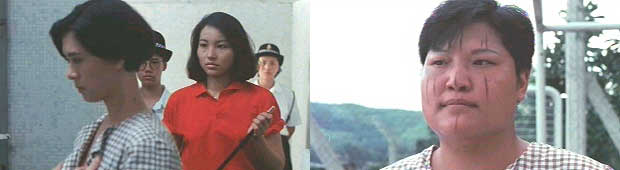
Being the inexperienced jailbird that she is, Kelly soon finds herself on
the bad side of the prison’s weak chief warden, her riding-crop-always-at-the-ready
(de facto) lieutenant and the overbearing Fatty (with whom she finds
herself being locked up in the same space at night as well as serving on
the same work detail during much of the day). Among other things, this
means that she gets subjected to more than her fair share of humiliations
(notably a “body searching” that must have been a true trial for Pat Ha,
not just her convict character, to be a party to enacting) as well as frustrations
(Some of which boiled over and precipitated an escape attempt in the back
of a garbage truck -- which might have been successful if not for Rocky,
the young son of an unhappy “lifer” referred to as Jean -- as well as number
958 -- in the English subtitles and Kam on the Cantonese audio track (who
is sensitively portrayed by Petrina Fung Bobo) having tagged along without
her, or his mother’s, permission -- as well as the still unmarried woman’s
seeking to abort the baby that she was found to be carrying).
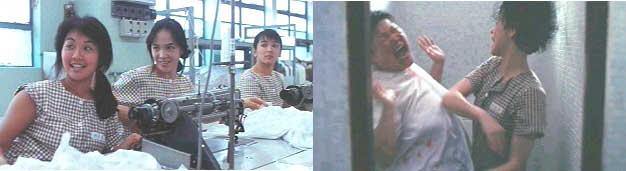
If truth be told, the undoubted heroine of WOMEN’S PRISON never was going
to get into these mean personalities’ good books (not least because she possessed
a strong sense of justice and could see that this trio -- even the two who
were officially on the correct side of the law -- were particularly apt to
violate it). However, certain events -- that often involved more than
just the two of them -- did at least manage to turn the ever capable Carol
Cheng’s rough, tough “Big Sis” Lynn (AKA inmate number 950) character from
a(nother) cheesed off potential enemy into a trusted friend. Even while
this relationship does bring along its particular troubles, it is one that
could be said to play a part in giving the upright Kelly some heartening
cause to believe that good can be found in seemingly unlikely places and
people, including the system itself -- which actually does get depicted in
this Nam Yin scripted effort as one that is not beyond repair -- and within
the ranks of those who are paid to maintain order in that which are, after
all, hardly supposed to be lawless institutions (One of whom is portrayed
by Maria Cordero, whose powerful musical contributions to this emotion impacting
offering it would be remiss of me to not mention).
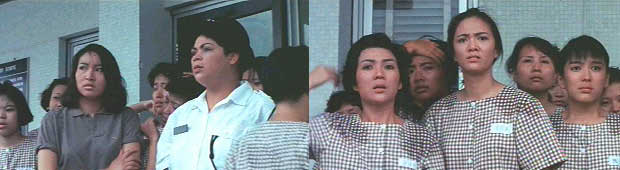
Consequently, for all of the travails and torments that she -- whose status
as a rare convict who is an “educated woman” ended up bringing more trouble
upon her than she probably thought as well as wished would be the case --
and many of her fellow prison inmates (including a particular unfortunate
played by Charine Chan) are seen undergoing over the course of the movie,
WOMEN’S PRISON is not as thoroughly depressing as its trailer made it look
like it would be. Although there are those who might disagree, it is
this (re)viewer’s honest opinion that the sincere feeling film’s nursing
of a hopeful message and postscript -- amidst some truly trying situations
and desperate events (at least one of which seriously got my adrenaline pumping)
-- is what makes this female-centric (melo)drama a compelling work that some
may not just want to check out once but, rather, might deem to be the kind
of offering that is worthy of at least one revisit somewhere down the home
video viewing road.
My rating for the film: 9.