Lan Yu
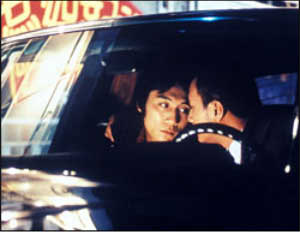
Reviewed by YTSL
There is a large number of Hong Kong movies about
which I have been unable to unearth little useful information. This
is far from the case with regards to this 2001 Stanley Kwan directorial offering
which garnered a Golden Horse Best Actor award for Liu Ye (who portrayed
this dramatic work’s titular character), and a nomination for its other main
actor (Hu Jun, whose essaying of Chen Handong I personally found more impressive).
Considering how illuminating are the materials I have managed to come by
about that which looks to provide ample plus concrete proof of auteur Kwan
(and scriptwriter Jimmy Ngai’s) return to form after the multi-lingual transnational
disaster that was “The Island Tales”, it seems a pity to not play a part
in making them (more) accessible to interested parties. Accordingly,
I have decided that my review of this Yi Feng and Zhou Bin co-production
should largely comprise certain cobbled together quotes from a couple of
especially helpful sources: Namely, the official website; along with the
relevant sections of the 26th Hong Kong International Film Festival’s “Hong
Kong Panorama” 2001-2002.
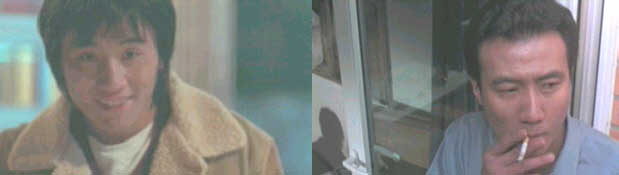
For example, I think that (potential) viewers of this compelling romantic
effort -- that I found to be aesthetically spare, appealingly tender
and appropriately bitter-sweet -- will find it helpful to learn that: “The
novel upon which LAN YU is based was published on the internet. The
first of three installments appeared in 1996. Each installment was given
a different title; the final, unifying title for the ten-chapter work was
Beijing Gushi (Beijing Story). The author adopted the pseudonym 'Beijing
Tongzhi' - literally 'Beijing Comrade', but the word Tongzhi, the traditional
form of greeting between communists, has latterly picked up the slang meaning
of 'gay'.”
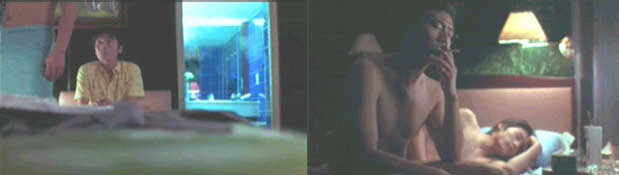
Ditto re Stanley Kwan having opined that: “The original author may not be
too satisfied with what I've done in the film; the author uses the central
relationship to reflect ten years of changes in society and social attitudes.
If a mainland [Chinese] director had made the film, probably that social
dimension would have survived quite strongly. Unfortunately, though,
I'm a Hong Kong director, and the social observation isn't what I responded
to in the material. I responded to the elements, which meant something
to me personally, and so I made the film as a relatively straightforward
gay love story” (From an 18 April 2001 interview by Tony Rayns -- who, besides
being an international film festival programmer and film critic, also was
LAN YU’s English subtitler).
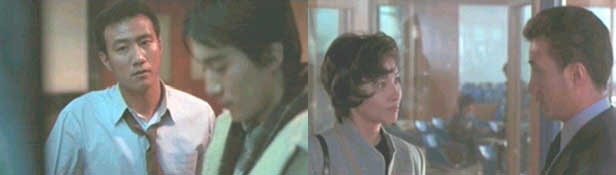
The art house darling -- who publicly disclosed his homosexuality in the
highly recommended 1996 documentary that he made for the British Film Institute,
whose title is “Yang +/- Yin: Gender in Chinese Cinema” -- is also on the
record as stating that: “When I first read the original novel, I didn’t have
much feeling about it and had no intentions to adapt it for the screen.
However, my boyfriend found something interesting in it and said, “Don’t
you think it is our story?” The way that Chen Handong treats Lan Yu,
or vice versa, is just like the twelve-year relationship between my boyfriend
and myself. I can see our relationship from the story -- it’s that
simple, nothing else” (In HKIFF, 2002:64).
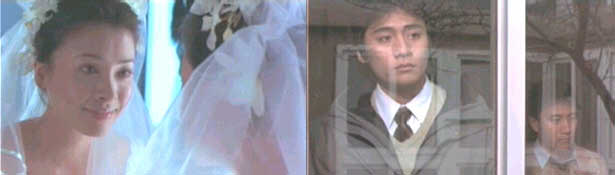
While we’re on the subject of “simplicity” (as well as personal feelings),
one of the most revealing of Stanley Kwan’s statements -- as far as I was
concerned -- is it being so that: “While “The Island Tales” complicated simple
matters, this time I just let my feelings go” (In HKIFF, 2002:64).
Elaborating on his decision to go for a streamlined approach, Stanley Kwan
further vouchsafed that: “In my last film “The Island Tales”, I made simple
things too complicated. And so this time I've tried to make complicated
things less complicated, or simple things even simpler.” To this end,
the decision was made to substantially pare down the part of Su Jin, the
actress whose supporting role in this work was that of the woman who was
-- for a short while -- the wife of one of LAN YU’s two main characters,
“as well as some buildup to the scene on the evening of June 4 (1989)” (A
date that many Chinese people -- whether they be denizens of the People’s
Republic or not -- feel like they will never be able to forget, and probably
would catch even the most subtle of references to).
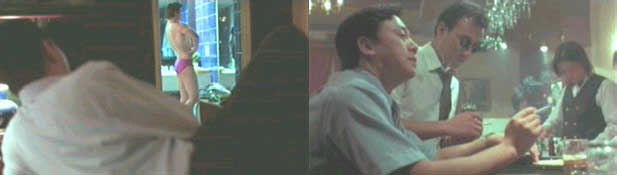
Another set of Stanley Kwan’s comments that I feel are worth highlighting
are those which have this respected helmer -- whose critically acclaimed
works include “Rouge”, “Centre-Stage” (AKA “Actress”) and “Hold You Tight”
-- emphasizing that: “Although I'm gay, I'm not particularly eager to deal
with 'gay issues' in the films I make.” Also, that: “My next two projects
have nothing to do with homosexuality” (In HKIFF, 2002:64); and for it to
be so that “Maybe I have done something for the gay movement, but that’s
not my priority. I do what I want to do first” (Ibid). Taken
outside of their home socio-cultural context, these not entirely uncontroversial
statements may come across as a case of “he doth protest too much”.
Hence my thinking that it’d be best for them to be accompanied by the following
pronouncements by a HKSAR film critic: To wit, “There’s an openness about
Hong Kong directors handling gay topics: tell a “love story,” and not a “gay
love story,” A gay relationship is just like a straight relationship.
No need to afford it any special status . . . In the final analysis [then],
this is a story about finding the one true love in your life. [In conclusion,]
LAN YU tells a universal truth about love. It is not a gay love story.
It is a love story” (Bono Lee, in HKIFF, 2002:67).
My rating for this film: 8.