The Other 1/2 & The Other
1/2
Reviewed by YTSL
In the U.S.A., there’s such as Kathleen Kennedy
and Frank Marshall as well as Regina Prince and Reginald Bythewood.
In Iran, Mohsen Makhmalbaf and Marziah Meshkini (whose daughter, to boot,
is Samira Makhmalbaf). In Hong Kong, there’s Tsui Hark and Nansun Shi
and, until they permanently migrated to Australia, Clara Law and Eddie Fong.
Film-makers who, in the words of the last named -- an individual who has
worked with his wife, Clara Law, on all of her directorial efforts as well
as been the director in his own right of such as “An Amorous Woman of the
Tang Dynasty” and “Private Eye Blues” -- appear to have decided that “it’s
better to have two people struggling together, rather than one” (As quoted
in Fredric Dannen and Barry Long’s “Hong Kong Babylon”, 1997:110).
And “struggle” is what Clara Law appears to believe that she has had to do
for much of her career -- in large part because of her having the kind of
serious plus artistic sensibilities that can seem anathema to the government
subsidy free cinema of the territory that this Macau-born, London-trained
helmer of films has been associated with for much of her professional life.
For example, it took her a total of two years to get her first Hong Kong
movie project off the ground. And even then, this involved her scriptwriter
-- Eddie Fong -- having to work for free, at least until their envisioned
product became a cinematic reality, as well as agree to serve as its associate
producer (and, in the process, promise to ensure that this rather modest
seeming effort would be one that was done “in a commercial way” (See Miles
Wood’s “Cine East: Hong Kong Cinema Through The Looking Glass”, 1998:72-73)).
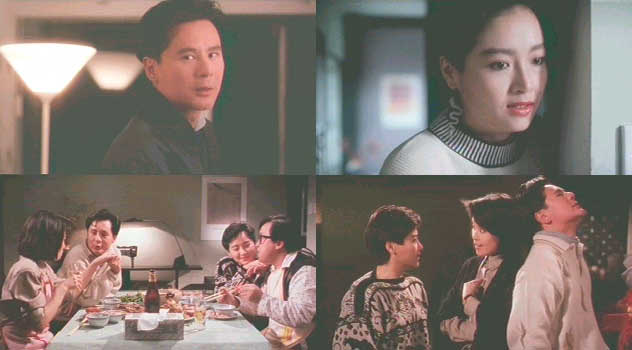
Considering that THE OTHER ½ & THE OTHER ½ only played
for 9 days in Hong Kong cinemas, raked in a total of HK$4,404,392 during
its short run and came in 88th in the 1988 local box office rankings, it’s
not a movie that can be accurately described as having been a smash hit.
In all probability, matters were not helped by this small-scale Teddy Robin
Kwan production -- that centers on the personal relationship between a man
and a women who are both one (other) half of a married pair of “flying immigrants”
(i.e., people seeking to secure residential privileges elsewhere besides
Hong Kong, preferably before the 1997 Handover came along) -- being unable
to boast of possessing star names along the lines of Joan Chen and Joey Wong
among its actually satisfactorily competent cast.
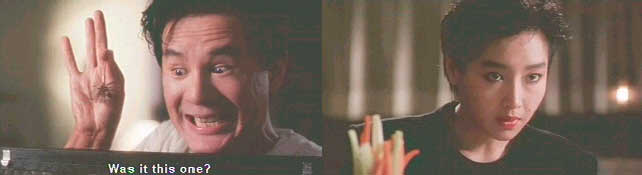
At the same time, however, I -- who have also viewed later Clara Law efforts
like “Temptation of a Monk” and “The Goddess of 1967” -- strongly suspect
that this uneven, comedy infused drama is one of the more consciously monetary
profit oriented plus generally accessible of this auteur’s efforts, and --
if truth be told -- suffers somewhat from being so. Put another way:
On the basis of this Jingle Ma lensed work, it would seem that Ms. Law is
weakest at handling that which might be described as Hong Kong cinema’s more
characteristic -- and often positive -- elements, including sudden plus quick
changes in emotion and farcical comedy that borders on being utterly slapstick
in nature. Alternatively, she does excel at investing a whole lot of
realistic feeling along with sincerity into THE OTHER ½ & THE
OTHER ½’s more ardent plus serious sections. Towards this end,
she undoubtedly benefited from having the principal performers to work with
that she did.
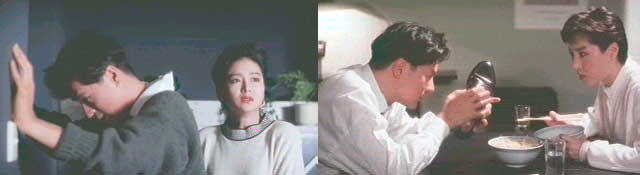
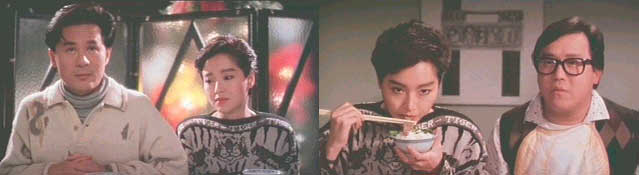
More specifically, the romantic chemistry and tension exhibited in many of
their scenes together by THE OTHER ½ & THE OTHER ½’s leading
man, Kam Kok Leung (who may be best known as the director of such as the
luminescent “Wonder Women” and as the terrorist in Purple Storm but here
portrays a not very happy married man named Sam Cheung), and the alluring
Tien Niu (whose role is that of a free spirit, named June Lee, who guiltily
discovers that she is happier when not in the company of her husband of three
years than she probably should be) could be said to rival that of Maggie
Cheung and Leon Lai’s in “Comrades, Almost a Love Story”. In addition,
such as their kissing scenes look vastly more comfortable and “natural” than
those enacted by the likes of Brigitte Lin and Chow Yun-Fat’s more inhibited
as well as tortured “Dream Lovers”, and consequently seemed much less of
an intrusion of two people’s private interactions than a celebratory declaration
of the joy they can derive from the company of each other.
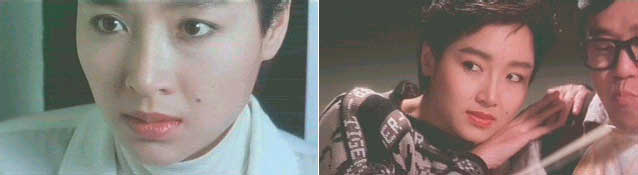
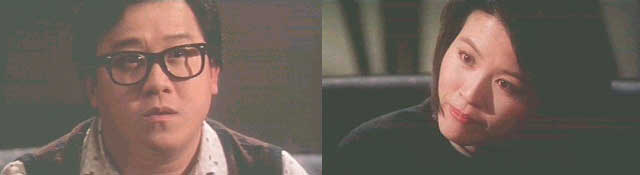
Although their parts in the production are far smaller than those of those
who essayed their spouses, Cora Miao and Eric Tsang also contributed quite
a bit to making this offering and its problem posing story as interesting
as it turned out to be. If nothing else, this supporting actress --
who in real life is Mrs. Wayne Wang -- gave a sufficiently convincing performance
as the type of female character who this (re)viewer could see being both
a good but also annoying wife. Similarly, Eric Tsang was effective
in the short time that he appeared on screen in this work as the kind of
husband who could be loving yet also prove to be insufficiently exciting
as well as empathetic in the eyes of someone like June Lee (and consequently
come across as less attractive to her than -- even while being just as “good”
a human being as -- the lodger who she came to know as a friend and, then
additionally, lover). In so doing, her Connie and his Tak made it more
understandable why their spouses might go astray but also provided reasons
as to why they should try to make efforts to not abandon their marriages,
and -- in the process -- helped to ensure that the major life decisions that
THE OTHER ½ & THE OTHER ½ came to be confronted with were
not ones that were necessarily easy to reach and effect.
My rating for this film: 6.5