Lover's Tears

Reviewed by YTSL
For those who continue to think that Hong Kong
cinema consists almost entirely of cultish action flicks and exploitation
efforts, this 1996 Lee Kwok Lap offering -- that Paul Fonoroff described as
“a traditional tear jerker with a strong sense of traditional family values”
in his “At the Hong Kong Movies” book of reviews (1998:557) -- may come as
a shock to the system, should they ever check it out. Since this high-minded
David Chiang and Yang Yat Ming co-production is not an art-house type work
(as well as the kind of film for which Hong Kong is (in)famous) though, the
likelihood that they will come by a copy of it is very slim. IMHO,
this is probably for the best since I can’t imagine this dramatic effort
-- whose fictitious tale is presumably intended to be an inspirational one
(a la the fact-based “Forever and Ever” and “Time 4 Hope”), and disaster
impending arc is effectively foretold upon its main man’s making the fate-tempting
assertion that “I have to feed a family. How can I have an accident?”
-- holding all that much interest for other than fans of its male and female
leads.

Although Derek Yee has first billing in LOVER’S TEARS, the veteran but still
quite boyish looking actor-director-producer-cinematographer actually has
much less time on screen than the younger and more inexperienced -- though
not necessarily less capable or charismatic -- Carmen Lee (whose Lau Heung
Ching character is a primary school teacher loved by two men as well as adored
by her young charges). Additionally, his character (an architect named
Kam Ming-Sang, who comes across as a commendably good -- almost to the point
of unbelievably saintly -- man) spends more than half of the film lying atop
a hospital bed and in a coma. Indeed, if not for her sizable role requiring
that she be considerably de-glammed for much of it, this hardly low budget
feeling offering would come across as the sort of effort that was designed
to make its principal actress -- who appears to be one of a score of her
generation’s promising young things to have somehow never managed to capture
a sufficient number of Hong Kong movie goers’ hearts -- into a major star.
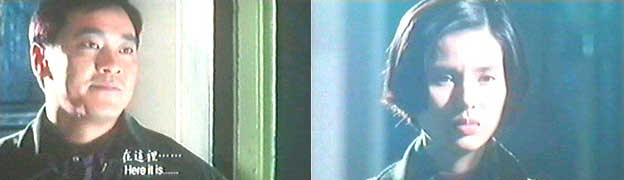
By this, I mean that the quite watchable Carmen Lee’s character looks to
be the designated heart and soul of LOVER’S TEARS. While Ching took
the thoroughly admirable man she married, Ming-Sang, to be her rock and inspiration,
viewers of this Ella Chan scripted effort are clearly meant to particularly
respect as well as care most for the woman who is pregnant at the time that
an unfortunate incident causes her husband -- and father of another two children
(named Chi Wai and Chi Chung) -- to no longer be able to actively be by her
side plus provide for his family. And although some other adult characters
also do fairly prominently figure in the story, for one reason or another,
all of them end up not being there for their friend or daughter -- and Ming-Sang
and her children -- as much as the film’s viewers, especially those who are
familiar with tight knit Asian families, might expect them to be.

Perhaps the actions of Ching’s parents (who elect to visit their son in Canada
at a time that I thought that they would want to stay close to their lost
acting plus looking daughter) and her best friend (Pauline Suen plays Kam
Hing, who announces her intentions to go off to the U.S. to marry someone)
is meant to say quite a bit about the events of LOVER’S TEARS taking place
-- like with the filming of the movie itself -- just a jittery year or so
prior to the Handover of Hong Kong to (Mainland) China by Britain.
In this context, it’s rather interesting to see that the individual (named
Lam Long and portrayed by Tok Chung Hwa) who blamed himself for Ming-Sang’s
ending up in the bad condition that he did chose a harsh appearing part of
“the Motherland” as the place to exile himself before returning to his home
territory to help out a family that he found to be in quite a bit of need.

Why that little group’s situation gets as dire as it does is something (else)
that this (re)viewer has to admit to not quite understanding. While
financial difficulties can be expected to ensue when a young family’s professional
class main breadwinner becomes indisposed -- and in serious need of medical
care -- for a significant period of time, Ching and her (step-)children’s
descent from living in a mansion like residence to a one room shanty seems
far too rapid to be all that believable. So much is this so that, and
at the risk of being labeled as someone with a heart of stone, the primary
emotions that the unfortunately insufficiently involving LOVER’S TEARS ended
up evoking in me actually were perplexity -- re the movie’s illogic (that
I am wont to suspect occurred as a result of its makers’ trying to make the
still too mundane work’s protagonist’s situation appear more dire than reality
would have dictated that it be) -- and indifference (rather than sympathy
or such like).

My rating for this film: 5.5