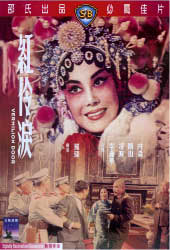
Vermilion Door
Reviewed by YTSL
For many Western Hong Kong movie fans, the Shaw
Brothers name is one that they solely equate with old school kung fu flicks.
Since the start in December 2002 of the home video onslaught that is Celestial
Pictures’ re-releasing of the decades worth of offerings which are collectively
known as the Shaw Brothers library though, those with Region 3 DVD and/or
VCD playing abilities have been able to see for themselves that the former
film-making powerhouse produced so much more besides the directorial efforts
of such as Chang Cheh and Lau Kar Leung. And already, there are some
individuals who have discovered that they may actually prefer some of this
legendary studio’s non-action productions to its more internationally famous
martial arts efforts.
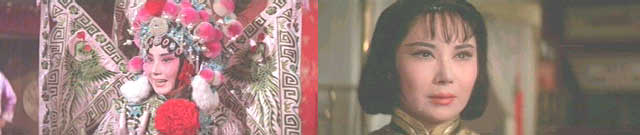
After beholding an at times absolutely visually stunning work -- not least
because of its having well-designed plus sumptuous sets -- like VERMILION
DOOR, it’s not difficult to see why this could and would be the case; and
even for those who, unlike the 1965 film’s original target audience, are
not familiar with its decades old plus oft told melodramatic story of --
as outlined on the new re-release’s DVD cover -- “[t]he tragic love triangle
of early 20th century Peking Opera star Chiu Hai-tang, his beautiful stage
partner, and the warlord who forces himself between them”. For one
thing, this tale is one that is centered on the kind of subject matter (namely,
the love which a mother and father have for a child -- and vice versa --
along with the sort that is more romantic plus carnal in nature) that is
for the ages even while some of its espoused value systems can latterly seem
dated. For another, this Lo Jun directed cum scripted effort also certainly
possesses -- as trumpeted in the movie’s original trailer -- an “outstanding
cast”.
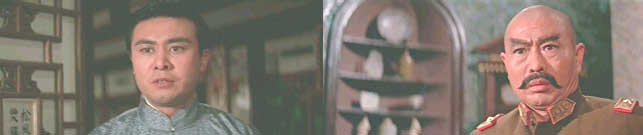
This (re)viewer had previously seen the first-billed Li Li-Hua in King Hu’s
“The Fate of Lee Khan”. Although that was a few years ago, I still
had little difficulty recognizing this respected actress -- whose Luo Xiangyi
character’s first appearance in VERMILION DOOR is as the legendary Peking
Opera woman warrior, Mu Guiying -- on account of her having a very
distinctive looking plus expressive pair of eyes. Similarly, it was
not difficult for me to understand how it could be that the famous Peking
Opera performer she portrayed in this certified weepie could be so passionately
coveted by a powerful general as well as deeply loved by her surprisingly
-- given my previous knowledge of this traditional Chinese performing art
(by way of such as “Peking Opera Blues” and “Painted Faces”) -- male co-star.
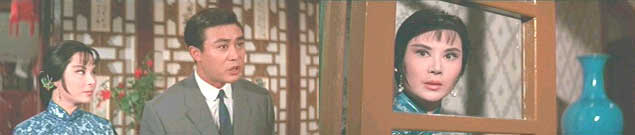
Early on in VERMILION DOOR, a noble military man -- who often gets referred
to as 7th Lord as well as by his name of Ruan Bofan -- discloses to his sadly
ignoble 3rd Uncle cum fellow senior military officer, Ruan Shaowen, that
Xiangyi “has already been spoken for”. In the same conversation, the
younger personage also reveals that her betrothed is his best friend, Chiu
(AKA Qui) Hai-tang: the Peking Opera actor (who comes in the at least initially
handsome form of Kwan Shan (AKA father of Rosamund!)) whose real name of
Wu Yuqi is seldom used -- including by Xiangyi (who, instead, tends to address
him as “tak keh” (i.e., elder brother)) -- and who this other smitten individual
had seen sharing the limelight with the object of his affection a few hours
previously.
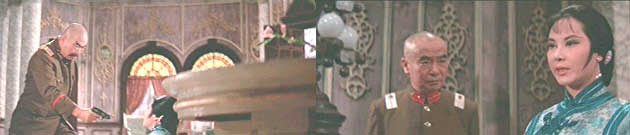
Unfortunately for all concerned however, General Ruan Shaowen (who is played
by Ching Miao) is undeterred by the relaying of these pieces of information
from his pursuit of Xiangyi. In fact, he -- who happens to also be
the appointed Chief Guardian of Rehe County -- ends up effectively using
them to at least temporarily break up the engaged couple. More specifically,
he managed to effect a nefarious plan that involved the individual I shall
henceforth solely refer to as Hai-tang getting arrested and tortured post
being accused of working for the regime’s revolutionary enemy, and had a
desperate Xiangyi agreeing to be his concubine in return for Hai-tang’s release
from custody and freedom from further physical punishment.
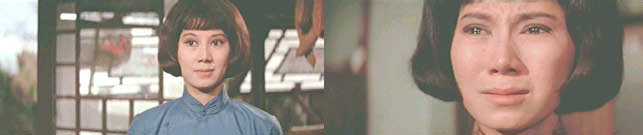
As can be seen by Xiangyi and Hai-tang ending up having a daughter together,
General Ruan turned out to be unsuccessful in his bid to make Xiangyi his
and his alone forever. In an effort to ensure that this review has
fewer spoilers than VERMILION DOOR’s original trailer, I will only disclose
here that seventeen years after the birth of their child, she (who is named
Mei Bao and essayed as a young woman by the wonderfully luminous Ivy Ling
Po) only knows one parent despite the other also still being alive and wishing
that all three of them could be happy together. As we enter the final
stretch of the emotional plus eventful offering, such as misplaced pride
as well as an unhappy man continue to threaten to stand in the way of the
kind of conclusion to the film that many of its viewers will have been rooting
for. And while today’s audience members probably will not shed many
tears when taking in this -- if truth be told -- sometimes far too overwrought
work, I can imagine the older ones having done so in as great quantities
as the classic production’s main characters (who clearly include the second-billed,
even if late stage appearing, Ivy Ling Po’s).
My rating for this film: 7.5