Golden Chicken
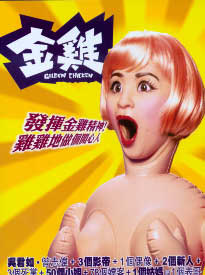
Director: Samson Chiu
Year: 2002
Rating: 8.0
One late evening
in an ATM booth Kam (Sandra Ng) gets accidentally locked in with a thief
(Eric Tsang) who has been driven to the edge of desperation due to the bad
economic times that have hit Hong Kong square in the face like a sucker punch.
In an attempt to calm him down, give him hope and get them through the long
night, Kam acts as a modern day Scherazade and relates to him the story of
her life. In the episodic narration of her story and profession (prostitution),
she also incorporates the ups and downs of an ever-changing Hong Kong. To
some degree Kam is symbolic of this gritty resilient city that has learned
to adapt to events such as the stock market crashes, Tiananmen Square, emigration
and the Handover with stoic resolve.
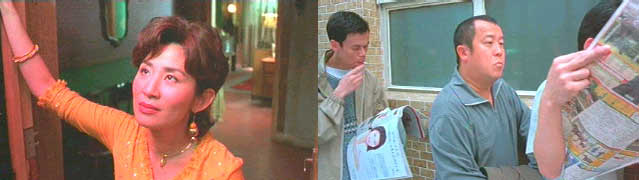
Beginning with the entry into her profession at the young age of fifteen,
Kam strings together various small interludes in her life that are by turn
comical, wistful, hopeful and touching. It all adds up to a bittersweet portrait
of someone getting through life as best as they can. In the background of
her story always lies the character of Hong Kong – the tawdry massage parlors,
the steaming hot pots, the rainy days, the constant chattering, the late
night drinking games, the breathing of a city finding its way through two
decades of change. From 1979 to the new millennium we witness Kam go from
a pimply-faced “chick” to "Golden Chicken" status with an ever-thickening
layer of rouge applied as she gets older. She begins in the “fish ball girl
joints” where men grope women’s breasts in the shadows and later moves on
to the glitzy years in an upscale hostess bar to the slow decline in a chicken’s
professional career – to low rent massage parlors and finally to an apartment
solo-bordello operation.
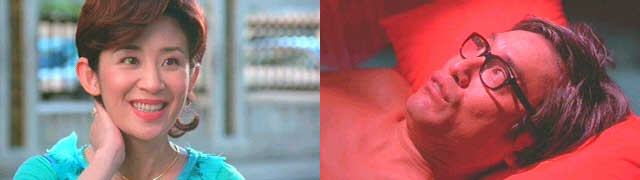
This aspect of her life is never judged harshly – it’s simply life and you
make the best of it. As she tells Eric “What is tragic about it? I’ve met
a lot of interesting people and sure had a lot of fun”. What really has a
poignant yearning sadness to it that slowly grows during the narration is
simply the inevitable passing of time – of friends made and friends lost,
of youth fading into middle age, of birth and death, of a city of hope slowly
changing to one of despair – of times that can never be recaptured except
in your memories. By the end we feel as if we have gone on a journey with
this woman to the mid-point of her life – optimistic to the end and a never
say die glint in her eye. The almost Christmas like payoff miracle to this
fairy tale has a wonderfully sweet and sentimental ring to it.
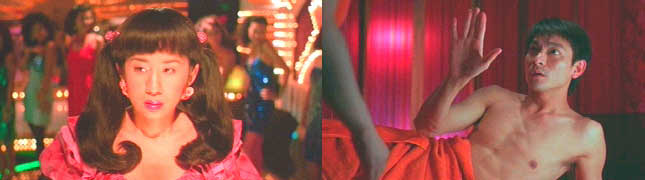
It is hard to imagine any actress in Hong Kong being able to do this role
but Sandra Ng – she is simply wonderful here as she goes back and forth between
humor and pathos and again establishes herself as perhaps the finest actress
in that film industry. Admittedly she isn’t particularly convincing at fifteen,
but she plays those scenes broadly – but as she ages she gains a sense of
world-weary dignity that hangs on her like a badge of honor. The comical
bits are easy for Sandra – she has done them in a hundred movies – but it
is in the quieter reflective scenes where we can see straight into her heart
that pull us into her life and make us care about her.
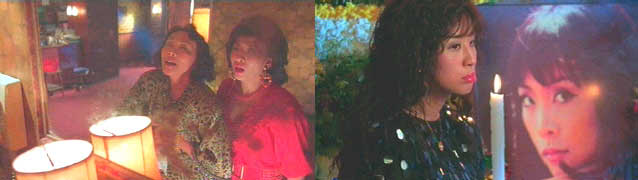
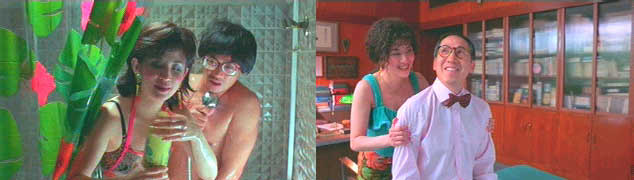
The film has a number of enjoyable cameos – Andy Lau as himself, Tony Leung
Ka-fai in an almost unrecognizable role as a horny bucktoothed professor,
Eason Chan as a client with peculiar tastes, Alfred Cheung as her doctor,
Chapman To as one of her bosses – we also get to see a very young Chow Yun
Fat, Maggie Cheung and Tony Leung Chiu-wai on the TV playing in the background.
Starring as Kam’s Aunt who teaches her how to properly use her diaphragm
to moan convincingly is Irene Tsui who also played the Aunt in Comrades a
Love Story and was a beautiful actress in Hollywood earlier in her career.
This is a good film – I had been expecting it to be more of a comedy but
though it has amusing aspects, it is really a thoughtful character study
of a very ordinary person in perhaps a not very ordinary profession. There
is no real plot per se and there is no focused drama – just points along
the way that explain who you are. In a similar way to Just One Look, the
film seems to look back longingly at a Hong Kong in the past – these are
films that almost appear to be saying “lets celebrate what Hong Kong used
to be – lets look back before we go forward” and in a society that has always
been on the run, these moments of nostalgic reflection and celebration make
one sense that we are catching HK at a turning point in it’s always changing
life.