GeGe
Reviewed by YTSL
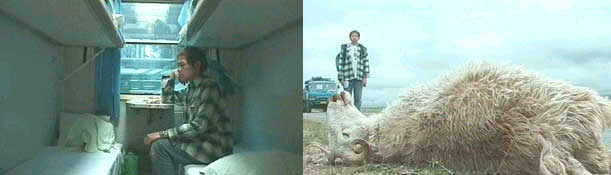
This dramatic offering takes its title from the
Mandarin word for older brother, and sends a youthful Hong Kong man journeying
to a remote Mainland Chinese province in search of his itinerant elder male
sibling. At Ma-Duo, a dusty “stopover place” that reminded me of a
few places I’ve been to in East Africa (as opposed to any I’ve seen in an
East Asian film -- but has a school named after Sir Run Run Shaw), the apparently
by now seasoned traveler shows strangers a photograph, one of whose three
figures is his elder brother. By way of actions more than words, it
gets revealed that this older member of his family “disappeared when [he]
was young” but regularly informed those at home of his whereabouts by way
of postcards mailed from all over China. However, three years ago and
for reasons (yet) unknown, after sending a postcard from that Northern Chinese
town, no more was heard from him...
GEGE looks to have been given a premiere screening at the 2001 Hong Kong
International Film Festival. Although this joint production of the
Hong Kong Arts Development Council, X'ian Film Studio and RTHK was a FIPRESCI
award winner at that well attended event along with “My Life as McDull”,
its very existence continues to remain far from well known. Some additional
acclaim (including at the Venice, Bratislava and Fribourg international film
festivals) may have helped the 85 minute length effort get a Fall 2002 theatrical
run at the Broadway Cinematheque plus a DVD release. However, even
with Andy Lau -- the Cantopop singer-actor who also had a hand in producing
Fruit Chan’s “Made in Hong Kong” -- being listed as its “film consultant/advisor”,
it does not appear to have found much of a “regular” audience.
The most cursory of glances at GEGE should yield several reasons why this
is so. For one thing, this reflective plus “indie” feeling work --
whose debutante director plus scriptwriter, Mak Yan-Yan, was a screenplay
assistant on “In the Mood for Love” and appears to share Wong Kar Wai’s eye
for detail -- is truly light on dialogue. Indeed, it’s really only
at an advanced stage in this apparent semi-documentary that a relatively
lengthy speech is heard being made. Furthermore, so unused remained
this (re)viewer to the voices of the predominantly Mandarin language film’s
cast members that she’s actually uncertain re who it was who proclaimed that
“I know each and everyone of us will travel on life’s journey, and there’s
no turning back”, then “I see and can only say, I wish you well, a good journey,
take care” (even while recognizing that those sentiments are key to (understanding)
this offering together with more than one of its main characters).
GEGE probably also lost out at the box office as a consequence of it appearing
to be a star-less vehicle. Still, while it’s true enough that its rather
average looking lead actor doesn’t seem all that charismatic, this actually
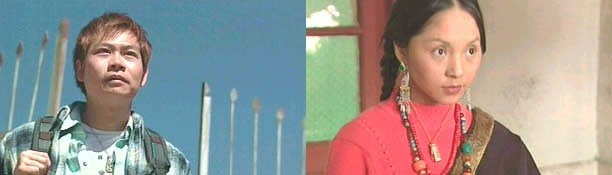
ended up being to the film’s benefit (since Stanley Tam Kwok Ming comes across
as an individual who, like his traveler character, wouldn’t require deluxe
level hotel accommodation or transportation when visiting a foreign territory).
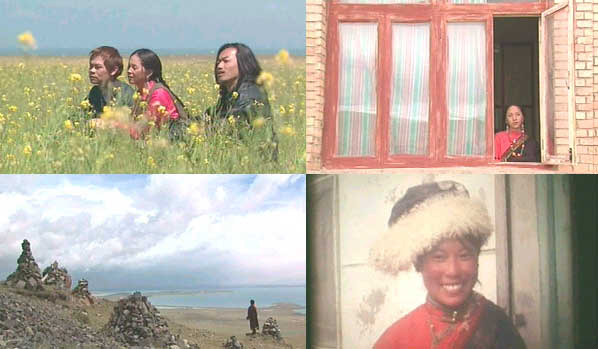
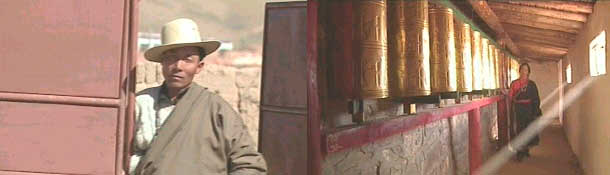
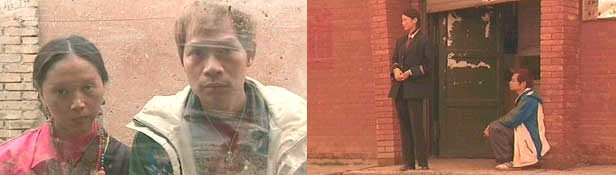
Similarly, one cannot put it past Jin Cai-Hsia being a real life equivalent
of the fetchingly traditional costumed native of Qing Hai province plus ethnic
minority in her own country that she essayed in the shot entirely on location
-- and mainly outdoors -- (by Siuki Yip and Eric Lau) work. Ditto with
regards to there being some of Cai Tao in the generally scruffy looking plus
leather jacketed photographer -- who turned out to have Beijing roots --
he portrayed.
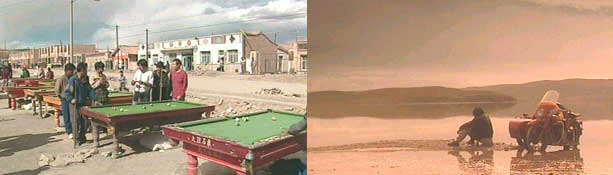
In point of fact, one of GEGE’s strong suits is the feeling of authenticity
that courses through much of it. Despite its having been shot using
the much maligned medium known as digital video, this admirably unjudgmental
feeling -- and, consequently, perspective enlarging -- work also can boast
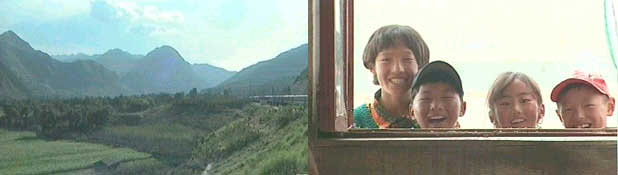
of having some striking images along with photogenic and uncommon scenery
(notably a beautiful lake into which three men, including this film’s protagonist,
skinny-dipped) plus interesting human subjects (including tent-dwellers,
Muslim skull capped elders and immensely rosy cheeked children who, nevertheless,
are recognizably East Asian). And even while its main musician makes
major use of an incorrectly tuned guitar, the work’s deceptively amateurish
as well as arguably tuneless sounding soundtrack turns out to not only be
distinctive but helpful at scene setting plus mood establishing too.
Lest it seem like I can see no wrong with GEGE, however, here’s pointing
out that I wish that it was more dynamically paced. No doubt, its surprisingly
sure handed first time director had her reasons for having it be the way
it is. As things stand, however, my mind was apt to wander for a bit
while viewing certain portions of this at times perhaps too understated work.
Additionally, although I don’t mind the even toned offering having as simple
and thin a general plot as it does, I really would have preferred for its
story to have come to a clearer and more decisive close than it ended up
doing.
My rating for this film: 7.