Turn Left Turn Right
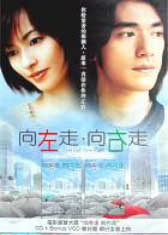
Reviewed by YTSL
This romantic movie that reunited the “Tempting
Heart” pair of Takeshi Kaneshiro and Gigi Leung -- and has them essaying a
couple of lonesome Taipei residents that fate seems uncertain whether to
permanently keep apart or bring together -- is one that I ended up checking
out twice in as many weeks. My first viewing of the highly anticipated
Warner Brothers (U.S.A.)-Raintree Pictures (Singapore)-Milkyway Image (Hong
Kong) co-production took place in a large theatre that was the most packed
I’ve seen a cinema in Penang, Malaysia (where I presently reside), in years.
Almost needless to say, the Hong Kong movie booster part of me was very happy
to see such a large -- plus largely appreciative -- audience for this Johnnie
To and Wai Ka Fai co-helmed offering.
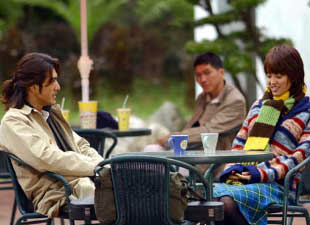
Alternatively, I couldn’t help but feel pretty unhappy, not to mention be
distracted, upon being “treated” to an as impossible to ignore as it was
inane running commentary of this not especially complexly plotted film by
two drooling Takeshi fans sitting directly behind my mother and me.
As such, my decision to view TURN LEFT TURN RIGHT a second time stemmed less
from my having unmitigatedly fallen for the screen adaptation of a popular
illustrated storybook (by Taiwan’s Jimmy Liao) -- whose cinematography (that’s
courtesy of regular Milkyway Image cameraman, Cheng Siu Keung) I did at least
already appreciate the first time around, and most definitely is one that
can be said to gain much from being projected onto a big screen -- and more
from wishing to check it out in better circumstances.
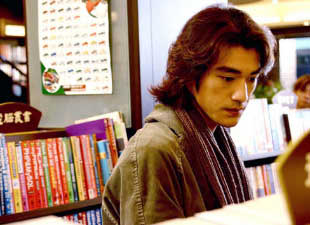
Post managing to do so, it’s with no small amount of relief that I also feel
able to report that the second time around, the music which I had previously
dismissed as disappointingly unmemorable turned out to not seem as much of
a weak component of TURN LEFT TURN RIGHT as deemed before. What with
this 2003 offering’s male protagonist being a violinist with classical musician
dreams and lead actress also having been the singer of the two main songs
that appear in the version of this movie that’s primarily in Cantonese --
but also contains snippets of German, Polish, Mandarin and English -- plus
one other for its Mandarin language equivalent, it should be clear that this
favorable finding is less insignificant a matter than it otherwise may have
been. More generally, and maybe even more saliently plus unexpectedly,
there’s my feeling upon repeat viewing that that which I could never consider
to be all that “deep” a work did not suffer from being seen twice (and within
a short period of time at that).
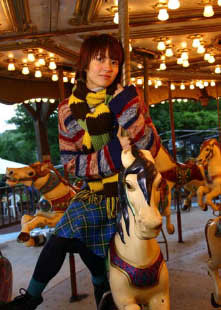
Indeed, it ended up appearing to make some kind of cosmic sense that I would
end up getting a double dose of a film in which much is made of parallel
behavior that can play out as much like psychic repetition as the unknowing
mirroring by one of another’s movements. So much is this so that I
am seriously tempted to urge others -- particularly those who are apt to
dismiss this pleasantly atmospheric offering as insubstantial and consequently
unpleasing fluff after viewing it just once -- to check out twice for good
effect the surely hard to dislike effort whose: high strung main female character
(named as Eve Choi or Yi in assorted reviews and synopses but solely by her
old school number of 784533 by her soul mate) was wont to TURN LEFT upon
exiting her apartment block; and sensitive male equivalent (similarly identified
as John Liu or Hong by various written sources but known only as 763092 by
his beloved “shadow”) was equally liable to TURN RIGHT upon exiting from
his neighboring multi-storey residence.
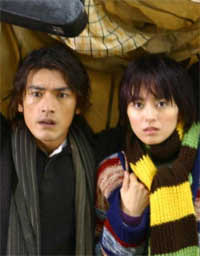
For those who are wondering: An overactive imagination -- fueled by late
nights working on translating a German horror novel (as opposed to the Polish
poems that she loved more) -- was what caused the apparently Sammi Cheng
channeling Gigi Leung’s scatterbrained as well as multi-lingual character
to make more of a kite trapped up in a tree than she should, and consequently
seek to actively avoid passing by that which was located to the right of
her abode. Meanwhile, angel-faced Takeshi Kaneshiro’s shy plus talented
artiste character took to habitually walking in the opposite direction in
a bid to steer clear of a lecherous stalker (who professed to know where
he lived and sought to lie in wait for him at a particular nearby street
corner). Thus it was that the protagonists of the (now) understandably
entitled TURN LEFT TURN RIGHT came to not cross paths for a longer time than
one would expect to be the case for two people whose living quarters turned
out to really abut each other’s.
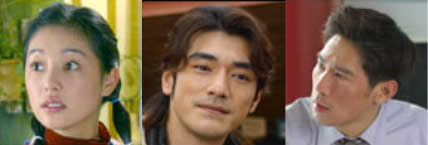
The irony of this all is made even more clear by a school days flashback
sequence in this Category I offering. To hammer things home plus complicate
matters as well as for (further) comic relief, TURN LEFT TURN RIGHT’s quartet
of scriptwriters (Wai Ka-Fai, Yau Nai Hoi, Au Kin Yee and Yip Tin Shing)
wove two additional push-pull pairs of characters into this affecting love
story. The main duo’s elderly landlord and equally seasoned landlady
actually don’t occupy all that much screen time. In contrast, Singaporean
actor Edmund Chen’s rambunctious Dr. Hu and Taiwanese actress Terri Kwan
Wing’s outspoken food delivery girl, Joan, threatened to steal the show from
the ultimately maybe too “safe” movie’s two protagonists even while their
bids to win the quieter personalities’ affections never ever truly had a
chance of succeeding.
My rating for this film: 7.5