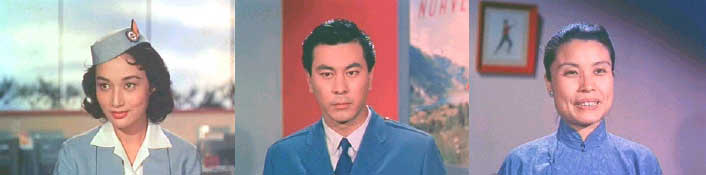
Air Hostess
Director: Evan Yang
Year: 1959
Rating: 8.0
By the second half
of the 1950’s a strong middle class was beginning to emerge in Hong Kong
with money in their pockets that allowed them to begin buying consumer goods
that had been out of their reach not too long before and to go on holidays
to other parts of the world. Many of the Cathay films inhabit this middle
class world in which modernization is being introduced. Our Dream Car is
about a young couple purchasing their first automobile, in Our Sister Hedy
many of the conversations are crowded around the telephone, a new refrigerator
takes center stage in The Greatest Civil War on Earth and here the ease
and comfort of international air travel is an indication of a changing Hong
Kong.
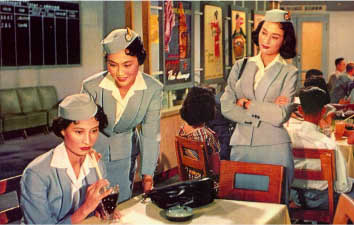
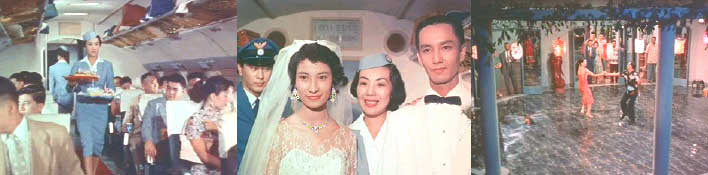
One of the biggest symbols of this entry into the modern age was the air
hostess – immaculately tailored in their shape fitting jackets and skirts
with a cap perched jauntily at an angle on their head. It was a new age and
they romantically represented a yearning to go beyond the city walls of Hong
Kong – to discover a world that most had seen only on movie screens. Of course,
the film company (called MP&GI at this time) also had ties to an airline
(Malaysian Airline) company partly owned by its founder Loke Wan Tho – and
this film often feels like an advertisement to travel and see the world. It
is a calling to become part of the global experience. Ironically, Loke was
to die in an airline crash in 1964.
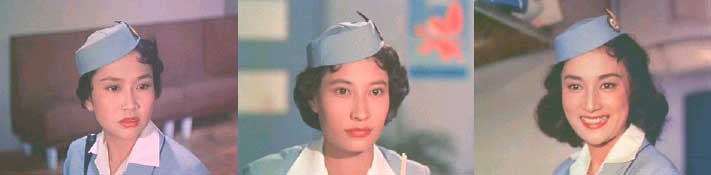
For some of us, this film was a lovely trip back in time – when the planes
were propeller driven and you stared out of the window with fascination at
the whirling blades, when you had to walk across the tarmac and board the
planes by movable stairs, when the hostesses were young and stunning, when
you received silverware to eat with, when passengers wore formal attire, when
you felt like you were on an adventure – that a plane was a magical carpet
ride to somewhere new and exciting. At least that is how I fondly and admittedly
vaguely recall it. I remember as a child flying with my parents from New
York to Calcutta – a forty-hour trip in those days with berths to sleep in
and cheerful hostesses doing their best to keep the food coming. Now of course
it’s all speed and economy – get you there fast and leave the comfort behind*
– perhaps unavoidable in these times when people feel they have to be connected
to something or someone every minute of every day. Still watching this film
brought back a flush of nostalgia when walking up those stairs and getting
the window seat was more exciting than anything in the world.
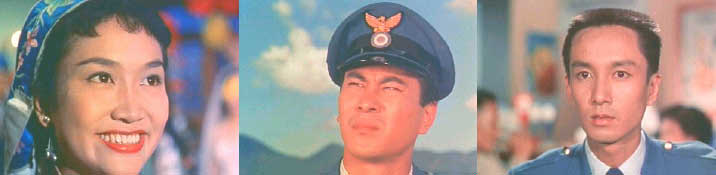
Another theme that runs through this film is the modern woman. Back in those
days there were certainly not a lot of opportunities for women to take on
positions of prestige and independence – and admittedly there is some truth
as one character states in the film that air hostesses are simply waitresses
in the sky – but they had a huge status in society (as Cathay hostesses still
do in HK where they are talked about by some friends in tones of awe and one
senses from a film like Chungking Express that they still represent something
romantic and sexy in the consciousness of people) and this was a career path
for some – as long as they didn’t get married! Most airlines in those days
(and until fairly recently I believe?) had a policy of only hiring single
women and if you married you had to leave the company – and this is the case
in this film. But a woman was making a statement by becoming an airline
hostess – that she was adventurous, modern, independent and that she wasn’t
simply marriage fodder – though of course many hostesses ended up meeting
the man they would marry on the job – either pilots or often wealthy passengers!
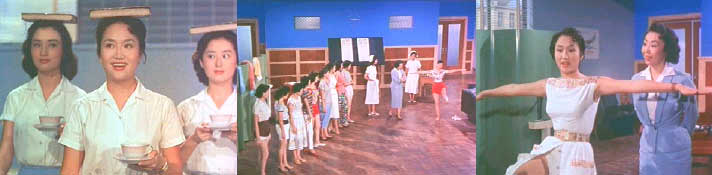
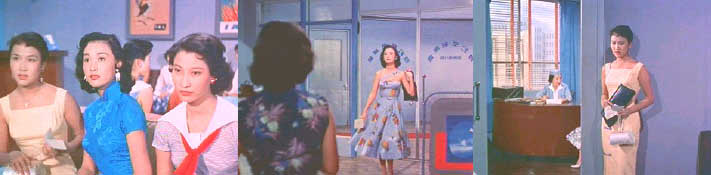
The film focuses on three single women who all join up for their own reasons
– Grace Chang wants to prove that she is not a “canary in a cage” – much to
the chagrin of her mother (an actress who also plays her mother in Mambo Girl)
who has a nice wealthy man ready to marry her, the shy Soo Fung joins basically
to be with her friend Grace and Julie Yeh Feng appears to be looking for
the glamour that this lifestyle presents. Once accepted they have to go through
a period of unusual training – how to deal with disorderly and irritating
passengers (though probably nothing like the fellow who defecated on the
serving cart a few years ago!), how to serve coffee while balancing a book
on their head (don’t try this at home), life jackets, announcements, the
proper smile and so forth.

All along the weak, the unfit, the wandering minds are being weeded out
and only the strong survive to service people like you and me. Grace is the
teachers pet – Ms. Kang – and often her character seems to be the character
from Mambo Girl a few years before – and as in that film everyone loves Grace
– and as in that film she stops from time to time to sing a song! Soo Fung
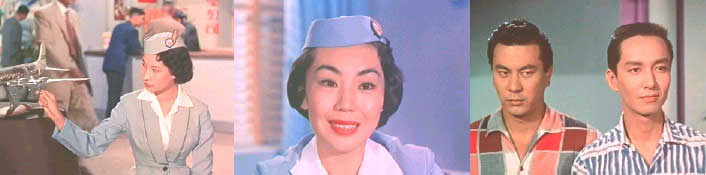
proves too shy to be a hostess in the sky and instead gets stuck behind the
counter. There is a touching little scene of her reaching out to a model
airplane and sadly twirling its propeller – and then the film dissolves to
the real thing that she can’t attain. Julie’s main problem is she has a body
that suggestively curls like smoke slowly crawling through a window
- or as Ms. Kang notes, she walks “like she is swinging a hula hoop”.
After this, the film basically turns into a travelogue as Grace travels
to Taipei, Singapore and Bangkok and walks about town. Seeing her tour the
grounds of the Grand Palace in Bangkok was a special pleasure – it looks
much the same as it does today but no people! She also has sparks fly between
her and a pilot played by a handsome Roy Chiao – of the romantic and fighting
kind. Soo Fung hooks up with Kelly Lai Chen while Julie stays footloose and
free. There isn’t a lot of drama in this film at all – and not much of a story
really – but it captures a wonderful mood and a different era beautifully
and somehow in its simplicity manages to be surprisingly touching. I went
on about Grace Chang in my review of Mambo Girl and I could do so again –
she is even more fabulous in color (the first color film from Cathay) as you
are blown away by her radiant smile and dancing eyes. She has an astonishing
ability to draw the viewer into her emotional orbit – when she smiles you
feel wonderful for her, when she is heartbroken you want to hurt the person
who caused her this pain.

Though the film is not really a musical in the sense that there are lavish
or unrealistic musical numbers – Grace does sing four songs – all quite lovely
(A Taiwan Tune, Fly Me to the Blue Sky, I Love Calypso and Bell Chimes at
the Temple) from composer Yao Min and lyricist Yi Wen (a.k.a. Evan Yang who
also directed this film as well as Mambo Girl). Yao Min was considered one
of the finest film song composers at the time and was involved in many of
the musicals for both Cathay and Shaw Brothers (Mambo Girl, Calendar Girl,
Les Belles). It is only in "I Love Calypso" – which is somewhat derivative
of “I Love Cha Cha” from Mambo Girl – in which Grace twirls about the dance
floor. According to The Cathay Story – the film and particularly the song
"A Taiwan Tune" came under heavy criticism by leftists for its portrayal of
a happy Taiwanese people and thus its implicit knock at Communist China.
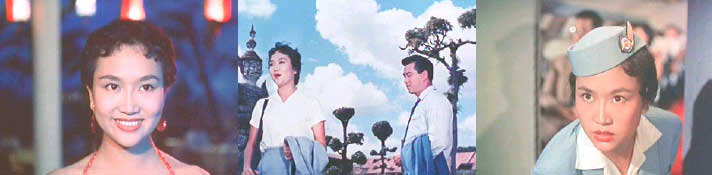
Perhaps the most marvelous thing about this 1959 film (besides Grace Chang’s
smile) is the wonderfully saturated Sirkian colors that make this look like
an old postcard at times. The film’s color scheme is constantly drenched in
various shades of blue that suggest flying in the sky and the flesh tones
are suffused with rich exaggeration – everything is so colorful and expressive.
The film just has retro-cool all around it - you almost expect Sinatra to
board the plane and break out into "Come fly with me. Lets fly, lets fly away"!

I have read complaints about the DVD and a radiation problem that had made
viewing it difficult – but I have to say that I did not notice it at all while
watching it – and only noticed it when I was capturing images a foot away
from my monitor. Also, I realized that this region 3 disc played fine on
my region 1 player when I put it in by mistake. There are clearly some little
bits missing from the DVD - a later reference to Grace almost quitting that
we missed earlier on, a couple of ugly edits that feel as if something
went amiss - and according to the book "Mandarin Films and Popular Songs"
(that shows a picture of the trainees in life jackets that the DVD does not
have) the length of the film is 105 minutes while the DVD runs 102 minutes.

* the above statements of the current situation
on airline travel are mainly directed at U.S and European carriers – flying
most Asian airlines – Singapore, Thai and Cathay in particular – are still
excellent experiences and the hostesses are still young and beautiful!