Sky of Love
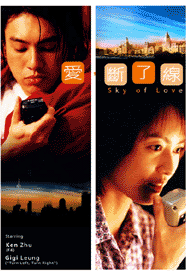
Reviewed by YTSL
This nostalgia tinged offering is one movie which
left me with a feeling of sadness post my viewing it -- though surely not
in the way that was intended by its makers. Alternatively put: Rather
than empathize with this beautifully lensed (by Mark Li Ping Bin) effort’s
pair of photogenic protagonists, I found myself sympathizing with the crew
and cast of “Ditto”, the 2000 South Korean film that this 2003 China Star
drama is a virtual carbon -- and, if I am not mistaken, completely uncredited
-- copy of and might well overshadow (due to its having bigger stars -- in
more than one market, including that of the three Chinas -- in Gigi Leung
and a member of popular boy-band, F4). Additionally, despite there
not being explicit acknowledgement of this, the sense I got from viewing
their patently unoriginal work was that producer Charles Heung and company
had decided that they needed to borrow ideas from a once indisputably lesser
national cinema.

Something else that irked me about THE SKY OF LOVE is that it -- or, at least,
the Cantonese language version of this ostensibly Hong Kong romance film
-- does not appear to have been in synch sound. Accordingly, it feels
like a throwback to an era in Hong Kong cinema that I had hoped was long
past (as far as medium as well as big budget movies were concerned).
Granted that the work’s female lead, the hardly stretched Gigi Leung, appears
to have dubbed herself. However, I strongly suspect that this was not
the case for her co-stars -- the great majority, if not all, of whom look
to have been -- probably as a concession to the Mainland Chinese market that
Hong Kong film folks are so hoping that they will be able to successfully
crack -- native Mandarin speakers from Mainland China (like Liu Zhi, who
had the part of a young (in 1981) man that more than one young female found
herself drawn to) or Taiwan (e.g., F4’s Ken Chu).

In what seems like yet another concession of this nature as well as in keeping
with an increasingly noticeable Hong Kong movie trend, SKY OF LOVE is not
set in the Fragrant Harbour but, instead, in Shanghai. Much more pertinently
for the story, its proceedings take place in both 1981 and 2003. Somewhat
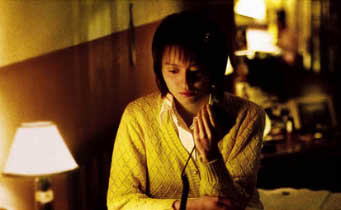
interestingly, although the 1981 milieu -- in which Gigi Leung’s character,
a soft-spoken university student by the name of Yan Xiao Jia, dwells for
the most part -- depicted in this effort is recognizably Communist Chinese,
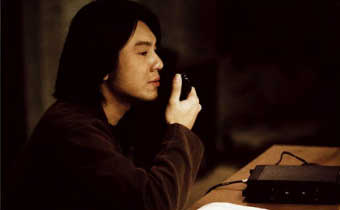
the contemporary space -- that’s inhabited in the film by Ken Chu’s petulant
character (Wen Jia Hui is a student at the same university as Xiao Jia, but
more than two decades later) -- could almost be any trendy, four seasons
possessing, internet-connected, Starbucks filled, etc. city on earth as well
as one as that definitely comes across as being in another world from that
which it actually had been at an early point in time.
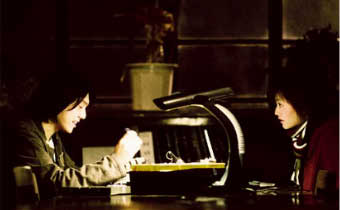
Thus, not only are SKY OF LOVE’s two short wave radio user protagonists a
study in contrast but so, too, are their spheres. Yet, as viewers of
the movie will discover, this pair of personalities turn out to be connected;
and less by a thread and more by such as two radiophones that -- inexplicably
as well as inextricably -- can be used even when not plugged into a socket
or may be objectively adjudged to not be in working order. Additionally,
the more that Xiao Jia and Jia Hui talk to each other, the more they share
confidences, talk about some of the most important people in their lives,
learn about one another, and find that they do have much in common.
Furthermore, in a plot twist that even those who have not viewed “Ditto”
should be able to spot from a mile away, this young woman and man find that
two people who are close to them also have ties, albeit of a different nature,
with them both.
All in all, one of SKY OF LOVE’s major weaknesses is its predictability.
Also disappointing, and this especially so if it is categorized as being
a primarily Hong Kong film, is its lacking “oomph” together with its possessing
the sort of plodding pace that I tend to associate more with efforts from
such as South Korea. Still, the most unforgivable of its makers’ “crimes”
as far as I’m concerned is that they spurned many an opportunity to contribute
their own -- or, at least, a Hong Kong style -- “spin” or bits to this not
particularly exciting movie that requires its viewers to be like the offering’s
protagonists in letting their heart rule their head in order for it to work
whatever magic it has on them.
My rating for this film: 4.
Note: Ditto was also remade into a Japanese film
called "Scent of Time" (2002).