The Floating Landscape
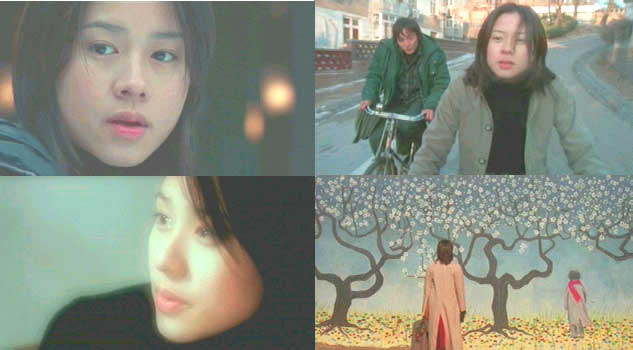
Director: Carol Lai
Year: 2003
Rating: 7.0
The good news is
that Ekin dies about 30-seconds into the film. The bad news is that since
this is film there are lots of opportunities for that all too often used
device, the flashback. It is not that I have flashback phobia, but its something
that has to be used carefully or it can feel almost manipulative. That was
my feeling here – there really seemed no point to the many short flashbacks
other than being able to have Ekin in the credits. I also tend not to like
flashbacks that are filmed in a different manner than the rest of the film
as if the past was in a different color than the present.
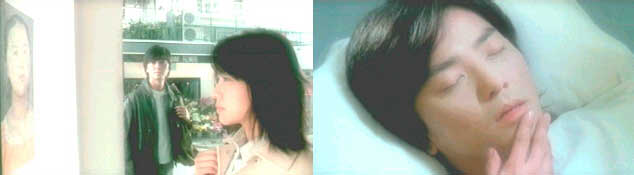
This can admittedly be utilized as a visual cue so that the viewer immediately
knows he has been thrown back to another time, but since we know Ekin is
dead my guess is that most people will realize that we are in flashback mode
when he shows up – but nevertheless the flashbacks are filmed in a washed
out otherworldly white that makes you think you are either in heaven or a
Seven-Eleven. There is actually one flashback in which Ekin looks a bit like
a frozen Popsicle in a Seven-Eleven as he lies there dead – some of his best
acting ever perhaps – and it struck me that as he has gotten older (and as
YTSL wrote me, beginning to resemble Gigi Leung) and taken on senior statesman
like status, he seems much more willing to die in his films and I think he
should be praised for this.

Other than this I have no major complaints about what I thought was a fairly
solid if rather glum drama. It is quite slow moving (as one should expect
in a film produced by Stanley Kwan) and I have to admit to looking at the
timer on a few occasions to see how far the film had gotten, but somehow
along the way almost without one noticing, it manages to pick up some emotional
weight and by the end I found myself rather moved. Director Carol Lai (Glass
Tears) once again brings her lovely eye for design, color and framing and
uses the cinematography to perfectly capture the inner desolate mood of the
film until the final colorful minutes when the tone of the film changes.
The film’s basic theme is about moving on with your life. Though the main
focus is on Karena Lam getting over the death of her boyfriend, Ekin, the
film also touches on a man still in love with his ex-wife and an elderly
woman who has lost her husband of many years. The message is simple enough
– go through your needed grief and pain but don’t get stuck in it like an
insect in sap.
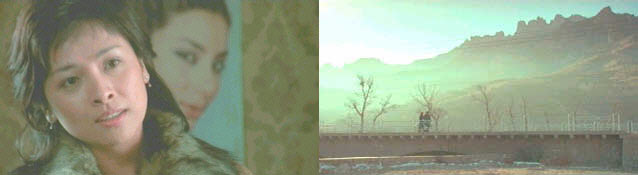
Right before dying Ekin sketches out a landscape of a tree set against the
background of a mountain and tells Karena that this image from his childhood
has been invading his thoughts but he can’t remember where it was. After
he goes to that special place where only Idols reside, a disconsolate suicidal
Karena feels the need to find the location of the sketch and to see it as
Ekin did. She travels to his hometown, Qingdao in China, and stays with one
of his relatives, Tung (Su Jin) and begins to look for the landscape. In
her search through the streets of this old town (hmmm – think mountain –
not many of those in the middle of a city), she strikes a friendship with
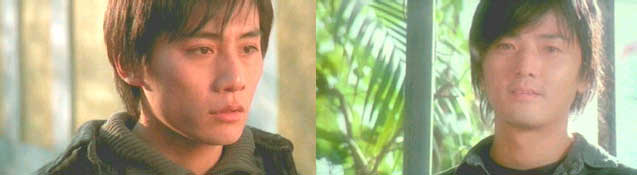
the young postman Lit (Liu Ye – Lan Yu) and as he tells her “who better than
a postman to find this place”. As this friendship deepens Lit worries that
she will never get over Ekin and Karena feels horrible guilt that she is
slowly beginning to forget her dead lover and care about another man. Once
she finds the spot though, she knows that it will be her time to leave and
not look back.

The film is based on the writings of Jimmy Liao who’s work was also the source
of the recent Turn Left, Turn Right starring Gigi Leung and Takeshi Kaneshiro
and like that one it is a quasi-romance in which the characters almost don’t
connect and fate has to come in and lend a hand. It is a darker and more
morose work than TLTR was though with little humor. In fact when Karena breaks
into an ear-to-ear smile at one point it is as if the sun finally came out.
This is a splendid performance from her – her best yet - never allowing herself
to spill over into melodrama or hysterics; all her emotions are contained
and yet very visible and painful to the touch – very much following through
on the promise she showed in July Rhapsody and Inner Senses but I felt was
missing in Tiramisu, Heroic Duo and Truth or Dare. She also sings the theme
song which I thought sounded very good.
My rating for this film: 7.0