Hong Kong Rhapsody
Director: Inoue Umetsugu
Year: 1968
Rating: 8.0
The fact of the matter
is that if you don’t have a fondness for musicals, the chances are you aren’t
going to enjoy the Hong Kong musical any more than you did Hollywood musicals.
Probably less actually as in some ways Hong Kong musicals are clearly inferior
to the ones pumped out by the big Hollywood machine in the heyday of musicals
from the 1930’s through the 1950’s. This genre from both film industries share
a lot of the same traits – they abound with color (post black and white of
course), they are generally sentimental and romantic with an anticipated happy
ending, plots are often the merest of structures to throw musical numbers
around and people break out in song and dance whenever the notion strikes
them whether it’s while hanging the laundry in “Hong Kong Nocturne” or in
the school gymnasium in “Mambo Girl”. I know a lot of people just don’t enjoy
the whole thing. The other day when I picked up a new musical, my Chinatown
DVD supplier told me that he was so happy to see me because he only gets
two copies of these types of films – one for me and one for some guy who
is buying them for his elderly mother!
What can I say, I happen to really enjoy film musicals and have ever since
I saw a late night showing of “Top Hat” many years ago and was awed by the
dancing of Fred Astaire. I still feel awe whenever I watch one of his films.
That musicals have become an extinct genre almost everywhere except in India
strikes me as a great shame. A well choreographed dance number is just as
intricate and astonishing as a well choreographed fight – perhaps more so
because while the camera and editing can often help you look good in action
scenes, in dancing you are out there naked for the world to judge. So even
though the dance choreography in the Hong Kong films I have seen so far are
not up to the standards of those from Hollywood, I have still really enjoyed
them so far – the sweet comedy, the melodrama, the actors and the spectacle
have won me over. So take my raves with a huge pinch of salt because I have
often wished that real life was a musical and that on the way to work in
the morning people on the subways would periodically break out in song and
dance with the person sitting next to them – but that kind of thing only
happens in musicals – and that’s why I love them. Get prepared for a rave.
A year after “Hong Kong Nocturne”, Inoue Umetsugu once again painted the
screen in Hong Kong Rhapsody with gorgeous saturated spectacle in this effervescently
giddy musical that begins as screwball comedy and morphs into a touching
and sentimental romance. Like Nocturne there are lush musical sequences around
every corner that tickle your eyeballs with delight and send a rush of warm
nostalgia down your backside. Umetsugu was invited by the Shaw Brothers along
with a number of other Japanese directors to bring a larger degree of technical
sophistication to their films. While most of these directors seemed to have
a made a few films and then returned to Japan, Umetsugu stuck around for
some six years and seventeen films before doing so. I am not sure if all
of these films are musicals, but it seems the majority of them are and it
is on them that much of his Hong Kong reputation rests.
Here is what little information I have been able to run down on this director.
He was born in Kyoto in 1923. After graduating in 1949 he obtained a job
as an assistant director with Toho and in 1952 he stepped up to director.
He soon gained a reputation as a very efficient director who brought his
films in on time and could direct in many different genres. At some point
he left Toho and was directing for Nikkatsu by the end of the decade.
For Nikkatsu he made a number of action films starring two of Japan’s biggest
action stars of the time, Akagi Keiichiro and Ishihara Yujiro. Some of these
were “A Storming Drummer” that a website compares to Elvis's "Jailhouse Rock
in overdrive”, “Storming Brotherhood” and “Sun in the Crowd”. By the early
60’s Nikkatsu was turning much more towards the “pinku eiga” (soft-core)
film genre and perhaps for that reason Umetsugu next turned up at Toei where
he directed three yakazu films as part of an “Underworld” trilogy. Around
the same time in the early to mid sixties he also apparently directed a samurai
film for Daiei, “Third Shadow”, which starred Raizo Ichikawa and the film
that “Hong Kong Nocturne” was based on called “Odoritai Yoru” for Shochiku.
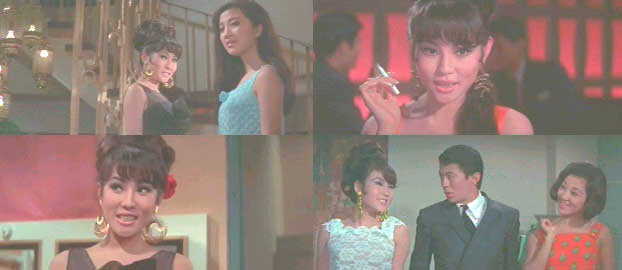
Cheng Pei-pei says that when he came over to make “Nocturne”, he set all
three of the female stars down and made them watch this film to get an idea
of how to play their characters since he was unable to express it in Chinese!
With all these works for different studios one would have to guess that Umetsugu
had become more of a contract director than a studio one. This was to change
with his years at Shaws. In all he made over fifty films and is still apparently
living in Japan (if anyone has more information on this director, please
send it in and if you know of the availability of any of his Japanese films
on DVD I would love to know).
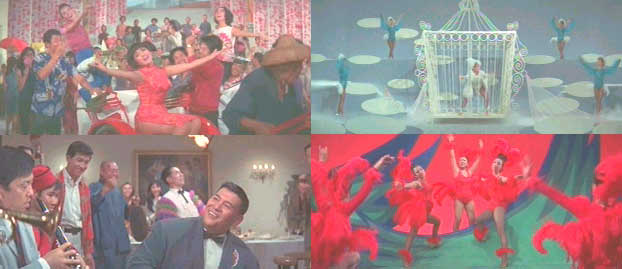
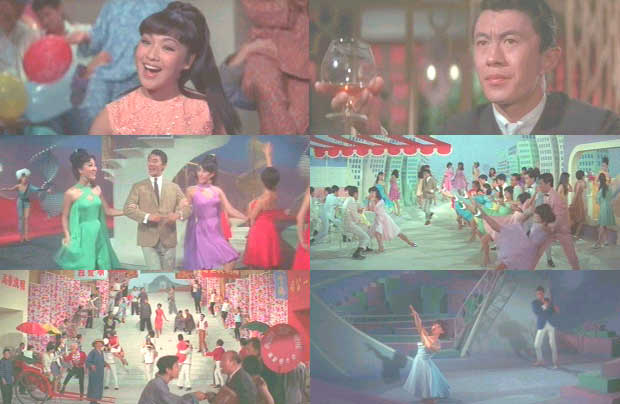
The plot of Hong Kong Rapsody is a simple one, but you have to picture it
in blazing color, populated by a myriad of interesting characters and immersed
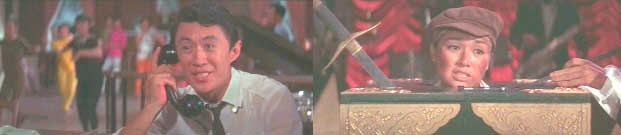
in stylish song and dance. Peter Chen is a nightclub magician and a bit of
a playboy heel who seems to be a younger version of the father from “Hong
Kong Nocturne”. He is juggling two vamps that come in the delicious forms
of Angela Yu Chien and Helen Ma and has managed to leech money from each.
He is wont to sing to himself “As a lady-killer you are hard to beat”! One
evening a parting gift from a dead magician friend appears at his door –
his vagabond smudged “son” that he appoints Peter to be the guardian of.
Later that same evening he has to pull one of his best disappearing trick
yet when Angela and Helen along with a few toughs come looking to collect
the money he “borrowed” from them. With the boy trailing behind him they
find a fabulous home whose owners seem to be away on a trip.
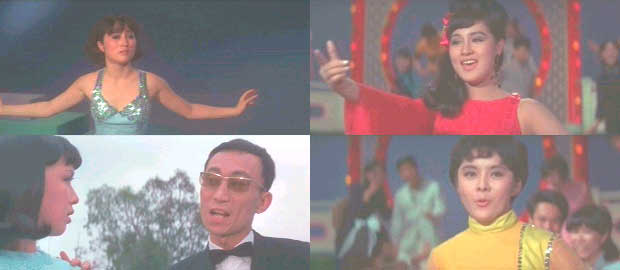
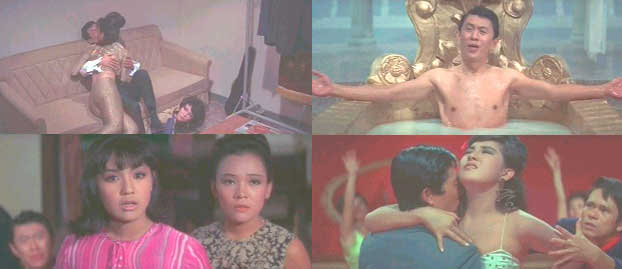
Chen soon discovers upon barging into the bathroom that underneath the dirt
and baggy clothes is the more than adorable Li Ching – a 20-year old girl
verging on womanhood. It turns out that the next day is Li’s birthday and
they decide to throw a party and invite all of their down on their luck entertainer
friends over for the festivities – a smorgasbord of dancing and singing occurs
that is simply a terrific scene. The niece (Allyson Chang Yen) of the home’s
owner shows up with her entourage, but instead of getting upset over these
trespassers she and her friends join the party and are soon blowing some
mighty horns – what do you know – they are all aspiring singers and dancers
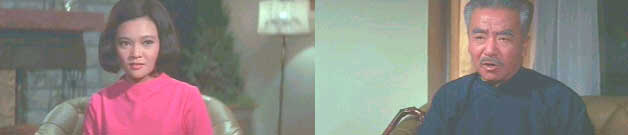
and want to put on a show! Sure enough, the elderly owner (Yeung Chi Hing)
shows up and has a good time until his rapacious nephew (Wei Ping Ao) puts
an end to the lovely evening.
Love is soon simmering between Peter and
Li Ching, but they don’t tell each other and Peter realizes that his reputation
as a playboy is hurting her image and potential singing career – so he leaves
her and accepts an invitation from old man Yeung to put her up as she reminds
Yeung of his dead daughter. The kids all decide to put on a show and though
there are many complications, the show must go on. And what a show it is
– with huge sets, an army of dancers and singers, ornate décor splashing
in color and some solid songs. My favorite section – the final 30-minutes
is nearly a non-stop number with some dramatic off stage happenings breaking
in from time to time – is the three color section which features guest stars
Lily Ho, Chin Ping and Margaret Hsing Hui. It is great fun and in particular
Chin Ping has a lovely graceful number that shows her in good form. Jing
Ting provides the vocals for Li Ching.
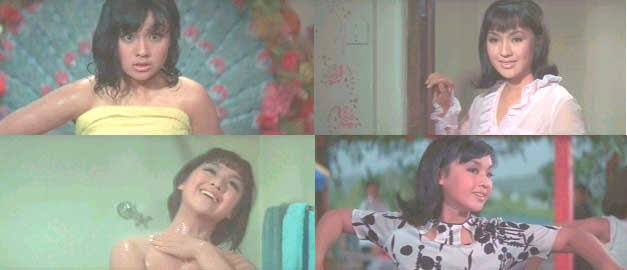
Li Ching is an extremely appealing cutie pie – small in stature and a bit
pudgy by most dancer standards but with a face that is like warm pie. Interestingly,
though she portrays this very innocent girl, the studio also seemed to be
trying to sell her sex appeal as she appears in towels a few times, a negligee
and in the shower (no nudity). Born in Shanghai in 1948 she joined Shaw at
the ripe old age of fifteen in 1963. She soon received some good roles and
won the Best Actress Award at the 12th Asian Film Festival for “The Mermaid”
and acquired the nickname “Baby Queen”. It fits her well. Like so many actresses
at the time, after this film she was pushed into martial arts films and was
in a few well-known ones – “Have Sword, Will Travel”, “The New One Armed
Swordsman” and “The Fourteen Amazons”. By the mid 70’s her career seemed
on the decline as she made appearances in films like “Sexy Girls of Denmark”
and “Sexy Playboys”. Later in the decade though she came back with roles
in “Clans of Intrigue” and “Dream of the Red Chamber”. The last role she
has credited in the HKMDB is a 1995 film called “Hope”.