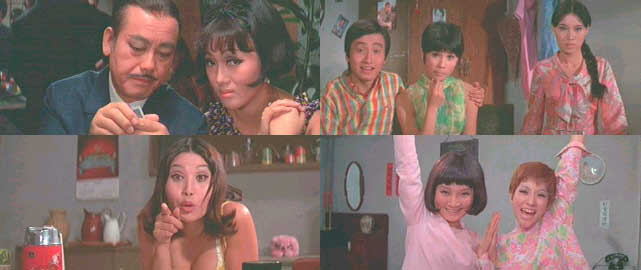
Apartment for Ladies
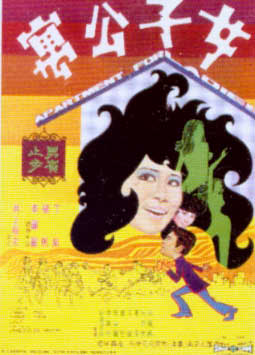
Director: Inoue Umetsugu
Year: 1970
Rating: 6.0
This intriguing title
certainly hints at a possible eye raising exploration of the seamy side of
Hong Kong, but this idea evaporates as soon as you realize that the director
is Inoue Umetsugu. Umetsugu could certainly be romantically flirtatious in
his films, but he was not one for crawling through the gutter looking for
shards of broken glass and sexual gratification. One can’t even begin
to think of this Japanese director taking on the material of some of the
more sexually provocative films that Shaw was beginning to churn out by the
early 1970’s. If he had somehow ended up behind the camera for such as “The
House of Bamboo Dolls”, he would no doubt still have managed to get in a
few musical numbers – perhaps the scene in which the female Japanese security
officer uses a wooden implement to pleasure one of the female prisoners would
have made for a great song, moan and dance sequence!
In nearly all of his Hong Kong films, Umetsugu clearly preferred dealing
with actresses and his stories nearly always seem to circle around female
characters whether they are the three sisters of “Hong Kong Nocturne”, the
three friends in “The Millionaire Chase” or the lady thieves in “The Venus
Tear Diamond”. Men on the other hand often get short shrift – generally kept
on the sidelines as one-dimensional romantic figures and usually played by
non-threatening affable male actors like Peter Chen, Ling Yun and Chin Feng.
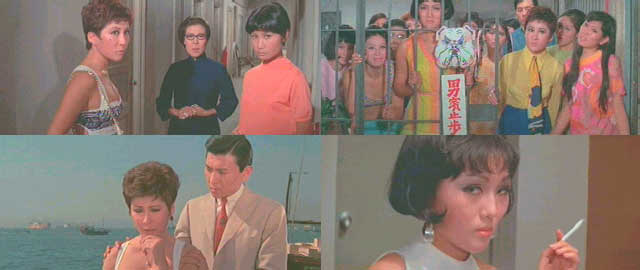
The women sparkle in his films, the men take up space. In this film Umetsugu
uses another male in this same mold and pits him against an entire apartment
of young attractive women – needless to say he barely registers. In fact
there is a real message within the film of female solidarity and sisterhood
as this group of women put aside their communal differences and support each
other when male nastiness rears its ugly head.
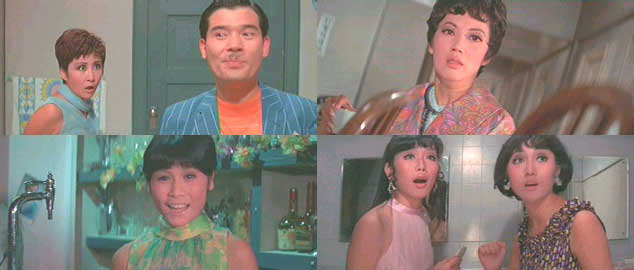
Suk Man (Betty Ting Pei) arrives in Hong Kong from Taiwan to look for her
sister who she hasn’t heard from in months. She and her sister had a singing
act (The Canary Sisters!) back in Taiwan, but the sister had been persuaded
by a man to come to Hong Kong and attempt to make it as a solo singer.
It turns out the address she has is a phony one, but she is helped out by
Wang (Yang Fang) who tells her that the apartment house he lives in has one
apartment that only rents to females and that there should be an occupancy
available for her. The landlady Mrs. Chan (Ouyang Shafei) runs it with an
iron hand and allows no men to even enter – and even checks out the curvy
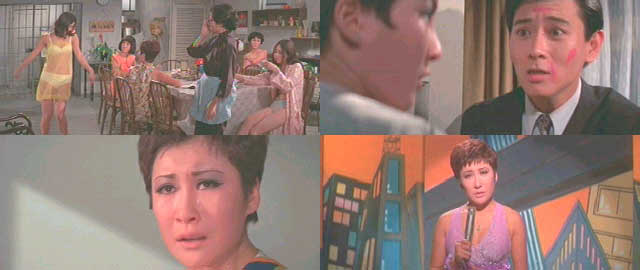
Suk Man to make sure she isn’t a man in disguise! There are a number of other
women living in the apartment – all with varied backgrounds and ways of making
money from working in a beauty salon, a jewelry shop, a message parlor, a
nightclub singer, a stripper, a late night secretary – i.e. female companion
- and a maraca player who has ambitions to take over the singing spot.
Over the film’s running time a number of sub-plots emerge – the singer Lulu
(Ha Ping) has found herself suddenly thrown into middle age like an old tire
toss and the nightclub owner George (Lee Pang-fei) has lost interest in her
and is eyeing up the much younger maraca player Betty (Guo Man-na) instead,
Lulu’s daughter (Lily Li) is keeping her innocent romance with Mrs. Chan’s
son (Barry Chan) a secret, Betty and another tenant Ding (Ou Yen-ching) are
playing a con game on a wealthy gentleman to allow George to win at cards
– but the main story is Suk Man’s search for her missing sister. Her only
lead seems to be a song Wang was playing that was a favorite of her sister's
and this leads her to various dead ends – and it seems likely her sister
may have run into one as well – if so she wants her revenge. She also finds
time to be romanced by the easygoing charms of Wang.
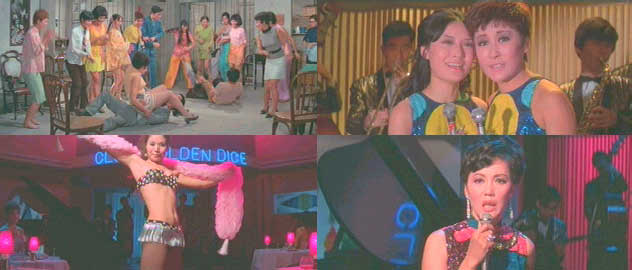
Most of this plays out fairly lightly with a number of songs interspersed
– a nice mix of drama, comedy and music that takes an old fashioned turn
deep into soapy melodrama in the final fifteen minutes. It is more satisfying
than it may sound – though somewhat lackluster for Umetsugu – the film feels
quite staged and perhaps its origin is theatrical - but the small stories
somehow begin to take on emotional ballast and the sense of community and
caring for your neighbor may seem clichéd and out of date but it still
feels good.
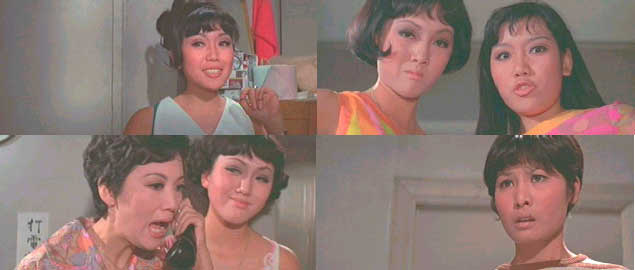
There are no major stars in the film – instead it primarily relies on a cast
of young unknowns – most of whom stayed that way! Umetsugu often used
young actresses at the beginning of their careers - Betty Ting Pei had appeared
in his film “The Millionaire Chase” the previous year, but at this point
she was a long way from getting into her more risqué films and it
wasn’t until 1973 that she gained her real fame when Bruce Lee died in her
apartment and rumors began of an affair between the two of them. She was
later to marry actor Charles Heung. Lily Li was also near the beginning of
her career and had yet to develop a reputation as an action female kung fu
star and is just quite adorable here. Another young attractive actress is
Ou Yen-ching who had been in a number of high profile Cantonese films, but
after switching over to Mandarin films never really had much of a career
- one of her roles was as Ti Lung's wife in "Vengeance". It is always interesting
to see Ha Ping in some of these earlier films after so many years of seeing
her as a much older character actress in the 1980s and 90s. She had been
an actress since her teenage years in the 1950’s and has a huge filmography
over five decades. She only joined up with the Shaw Brothers in 1970 and
was to stay with them for fourteen years. She has a good role here as the
aging singer who turns to drink as a last refuge of dealing with the sad
creep of the years.