A Place to Call Home
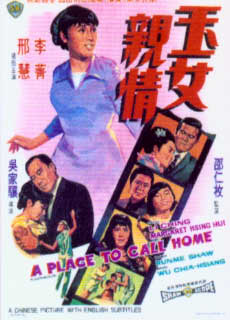
Director: Wu Chia-hsiang
Year: 1970
Rating: 6.0
By the time of this
film in 1969, the Shaw Brothers ruled the cinema screens throughout Hong
Kong, Taiwan and Southeast Asia and their main Mandarin competitor Cathay
films was only a faint echo of its former glory. The two production houses
had battled it out for years, but in the end the Shaw’s larger budgets and
scope of variety allowed them to eventually marginalize Cathay. In particular,
the immense popularity of the martial arts films propelled Shaw forward while
Cathay stayed with their dramas, musicals and comedies until it was too late
to compete with Shaw. The one genre though that Shaw never was able to emulate
as well as Cathay was the simple family drama. This was Cathay’s bread and
butter and they perfected these small emotional hearth and home dramas in
such fare as Mambo Girl, Our Sister Hedy and The Greatest Civil War on Earth.
Interestingly, in this film Shaw seems to take a step back in time and attempts
to make this type of film with a plot very reminiscent of the Cathay classic
Mambo Girl with Grace Chang.
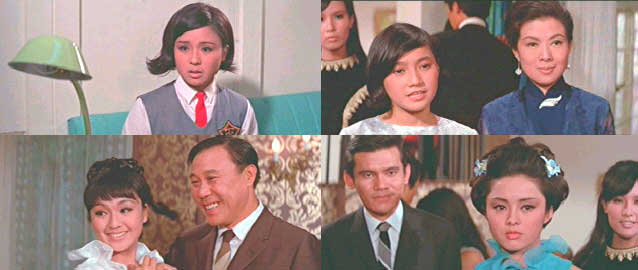
In fact for close to two thirds of the film, it follows in the footsteps
of Mambo Girl like a shadow to good effect and it is only when it decides
to add some lurid melodrama of its own that it goes off track and loses the
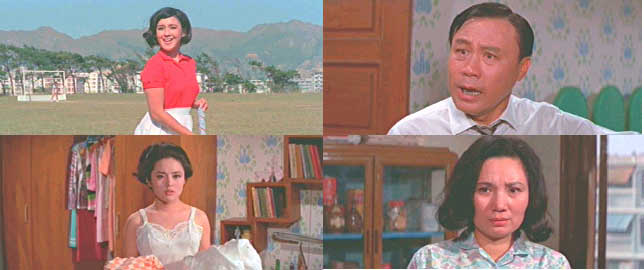
emotional build up. Like Grace in Mambo Girl, Li Ching is the most popular
girl in school – the star of her field hockey team and able to knock out
a song whenever her friend (Irene Chan) requests. Her family is a close one
with her loving father (Yan Jun), her protective mother (Ouyang Shafei) and
her two younger sisters. All seems bliss, until her middle sister (Margaret
Hsing Hui) becomes jealous of Li’s boyfriend and has her feelings hurt in
a misunderstanding and then overhears that Li was adopted when she was a
baby. In a moment of pique Margaret spills this out to Li and Li’s whole
world comes crashing down on her.
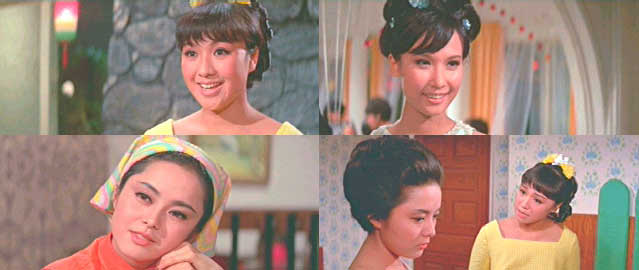
Feeling like a charity case, she is determined to track down her birth mother
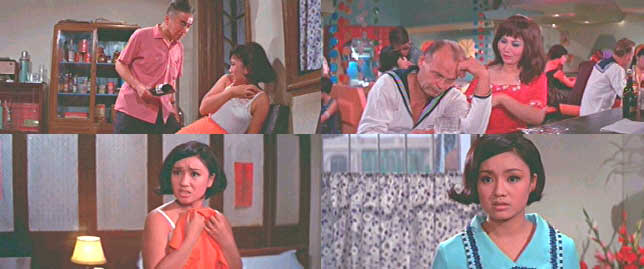
and with her father’s help she is able to. Her birth mother (Go Bo Shu/Kao
Pao-shu) it turns out lives in rather squalid surroundings and is now married
to Yeung Chi-hung, an unemployed fellow of uncertain morals. Even so Li decides
to move in with her mother and leave her other family behind with promises
to visit on occasion. One look at that apartment and I would have scooted
back to my nice middle class existence so fast I would have left my shoes
behind. Soon though her “uncle” is looking at her in a lecherous way and
has plans to use her to help pay his debts and mom is making money by having
foreign sailors buy her drinks in a bar. The film completely misses out at
this point by making Li somewhat unsympathetic and by a lackluster and lame
conclusion unlike Mambo Girl that ends on a note of absolute emotional and
musical perfection.
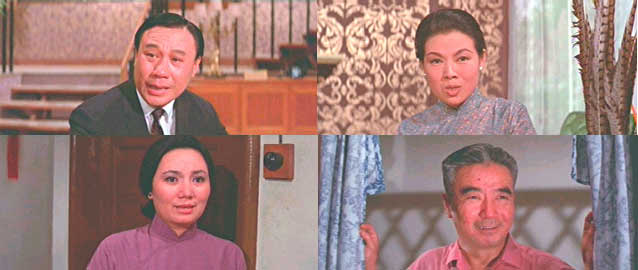
One of the enjoyable aspects of the film are the four older “character” actors
who play the adults. Between them there is a lot of film history and hundreds
of movies. Ouyang began acting in the late 1930s in Shanghai and by the age
of 19 she was being feted as one of the great actresses and beauties of her
time. By the early 1950s she had moved to Hong Kong where she again took
up acting and starred in many films. By the next decade she had moved into
character roles – often playing older mothers though she was only in her
early forties herself!
Go Bo Shu is another interesting case. Born in 1932 she had worked as a reporter
and acted in a theatrical troupe that toured around Asia before she was twenty.
In 1951 she married Chiang Nan (who later acted for the Shaw Brothers) and
moved to Hong Kong where she acted in both film and radio. In 1958 she joined
the Shaw Brothers and was an often-used character actor for the next decade.
Though only in her thirties she often portrayed women who were middle aged
such as in The Love Parade and The Dancing Millionairess. She also became
interested in working behind the camera and helped out in the dubbing department
and as an assistant director. In 1971 she finally had her opportunity to
direct and her debut film was Lady with a Sword starring Lily Ho. Not too
long afterwards she left Shaw and formed her own production company in which
she produced, directed and acted. These are difficult to locate now but have
interesting titles such as The Cannibals and Female Fugitive.
The father in this film also has quite the long resume. Yan Jun (Yien Chuen/Yen
Chun) was born in 1917 in Beijing and after moving to Shanghai in 1938 he
entered into the acting profession. He soon gained a reputation as being
adept at playing both good and bad guys. Like so many others, he moved to
Hong Kong after the Civil War in 1949 and worked for a number of different
companies and was in a few classic films such as A Strange Woman with Bai
Guang, Modern Red Chamber Dream with Li Lihua and Ouyang Shafei, The Flower
Street with Zhou Xuan, The Little Phoenix with Li Lihua and The Blood-Stained
Begonia with Bai Guang. He also began directing in 1951 and has films like
Singing Under the Moon, The Orphan Girl, The Grand Substitution, Moonlight
Serenade, That Fiery Girl and The Bride Napping to his credit. During the
fifties he formed his own production company and entered into a partnership
with Cathay films. In 1959 he married the legendary actress, Li Lihua but
after he was diagnosed with a heart ailment in 1972 he retired from the business
and they both emigrated to the United States in 1973. He died in 1980.
Information on actors gathered from various sources:
Monographs of Hong Kong Film Veterans, The Cathay Story, Hong Kong - The
Extra Dimension, the DVD biographies and this site dedicated to
Li Lihua.