Happily Ever After
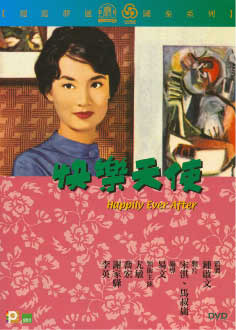
Director: Evan Yang
Year: 1960
Rating: 6.0
With a title like
this film has, there isn’t too much doubt where the story is headed, but
in those innocent days of the early 60’s most films were expected to have
happy endings and if they didn’t there would be riots in the streets. There
were of course the occasional melodramas that left you feeling blue, but
not in the field of romantic dramedies like this 1960 effort. Unless it was
an enormous co-incidence, the film appears to be based on a 1941 American
film called “It Started with Eve” that starred Deanna Durbin and Robert Cummings
and is a lot of fun. In fact, if anyone out there has a soft spot for old
fashioned films with songs as I do, I heartily recommend the “Deanna Durbin
Sweetheart Pack” that contains six of her films for around $25. I breezed
through all of them a few months ago.
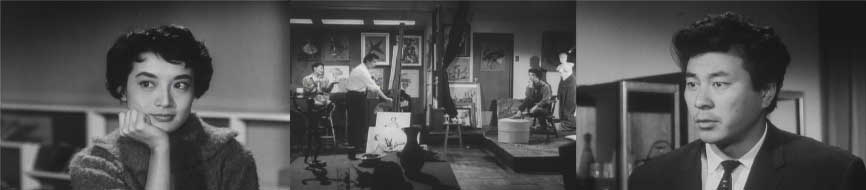
As directed by Evan Yang (Mambo Girl, Air Hostess), this Cathay version
loses much of the frantic screwball pace that the original had and settles
down into a family drama with doses of comedy and romance thrown in. The
other main change – and this speaks to the Hong Kong treatment of male characters
at the time – is that the Robert Cumming’s character is made into a fairly
passive dope who allows the women in his life to control him. In “It Started
with Eve”, there was a much more equal give and take between Cummings and
Durbin and they seemed very suited to one another. At the end of this one,
you really have to wonder if the two main characters belong together and you
rather envision a married life in which he is very much under the thumb of
his very adorable wife.
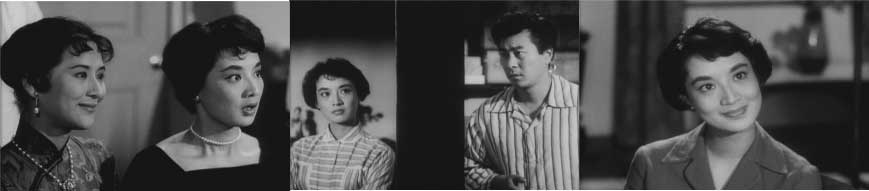
Wenou (played by a disheveled mop top Roy Chiao) has just started up an
advertising agency along with his friend Zhang (Chiang Kwong-chao) and their
first major client is complaining that the model Wenou chose to represent
his product was not in good taste. What he wanted for his Happy Angel Sweater
line was a woman who displayed “purity, tenderness, beauty and happiness”,
but the two men are at a bit of a loss as all their female friends don’t
come close to either purity or tenderness – and in fact it was Wenou’s fiancée
(Hsieh Chia-hua – a former Miss Shanghai in the 1940’s) who was the model
“in bad taste”. Suddenly the daughter of the local shopkeeper shows up with
a bill for Wenou that he can’t pay and the client tells him that this is exactly
what he has in mind and that if they can convince this girl to model the
contract is theirs.
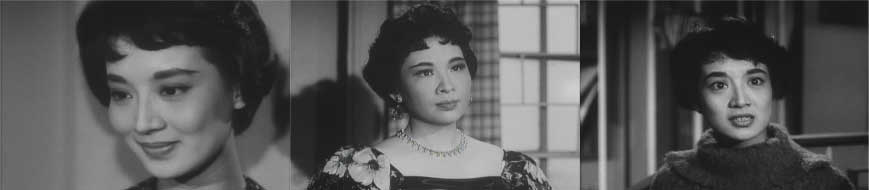
The client has a good eye. No one in the Cathay stable of female stars represented
purity, tenderness and beauty like Lucilla You Min did. She was the girl next
door and was a very different type than some of Cathay’s other famed actresses
– while Grace Chang was extremely spirited and playful, Jeanette Lin Cui
was impish and delightful and Julie Yeh Feng was moody and sensuous, Lucilla’s
characters tended to be very quiet, sweet, passive and respectful of tradition
and family and perhaps it was because of this that she was so popular at
the time. She was also quite lovely in a demure manner with her large expressive
encompassing eyes and a hint of a smile that occasionally plays across her
face. She was very petite and nearly everyone in the film towers over her.
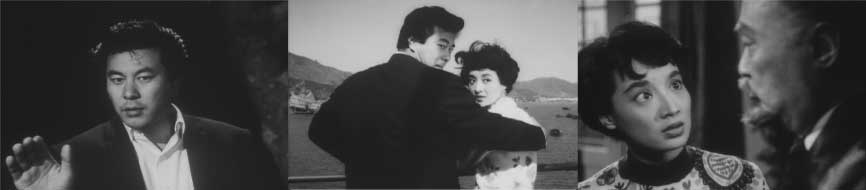
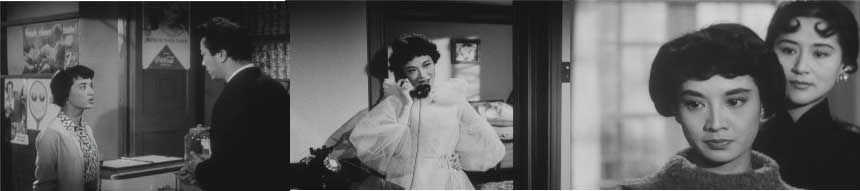
Wenou convinces Wanping (Lucilla) to pose for him and it’s clear that she
is attracted to this young man. After working all night, Wenou receives a
phone call from his aunt (Wang Lai) that his wealthy father is dying and his
last wish is to see Wenou’s fiancée before he dies. He tries frantically
to reach her but can’t – unknown to him she has spent the night with another
man – and so he convinces Wanping to pretend to be his fiancée so that
his father can die peacefully. Of course one look at this beauty and the
old man begins to recover and the doctor tells them that they have to continue
the impersonation or the father will have a set back. Doctor’s orders so
what can you do! Meanwhile, the real fiancée shows up – still in the
same evening gown that Wenou saw her in the night before but being a man
he doesn’t notice – and she begins to cause trouble. She and her conniving
mother are obviously golddiggers while Wanping and her mother are clearly
the salt of the earth and everyone knows this except the poor sap Wenou who
mopes through the film like a high school boy with a bad case of acne. This
sort of set up doesn’t need a rocket scientist to know where it is headed
and it sort of bumps and grinds itself to the happy ever after.
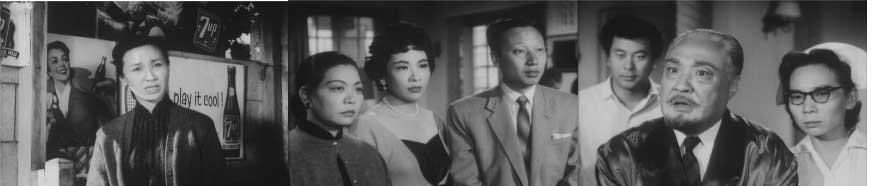
It isn’t a particularly compelling film and the romance generally fizzles,
but Lucilla completely saves it and gives it some emotional impact by simply
being herself – she is impossible to resist. Also in the cast is the wonderful
Liu Enjia as the head servant and it drives me crazy that I can’t put a name
to Wanping’s mother as she shows up in so many of these films in small parts
and I also should know the father but can’t put a name to him as well. If
anyone knows, I will be eternally grateful if you send me the information.
Not sure if it was early product placement or just set design, but it’s rather
fun seeing posters for Coco-Cola and 7-Up all over the little store owned
by Wanping’s mother – also enjoyable seeing all the sampans in the background
in the outdoor scenes at Wenou’s father's house.