Hands in the Hair
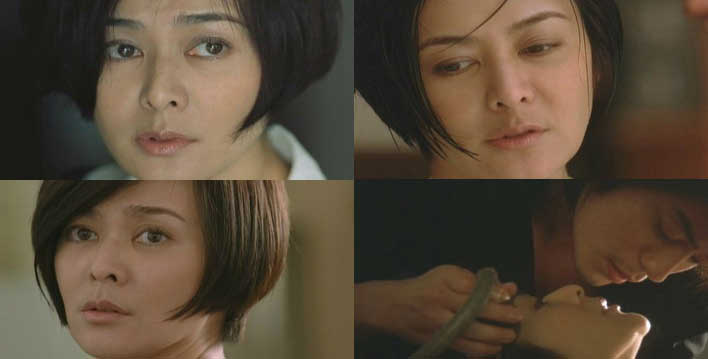
Director: Jiang Cheng
Year: 2005
Rating: 4.0
With some surprisingly
high profile backers, this small film seems to have sunk like a stone in
the middle of the ocean. Charles Heung acts as Executive Producer, Stanley
Kwan as Supervisor and William Cheng (of Wong Kar-wai fame) is credited as
Style Designer. There is some talent on the screen as well, Francis Ng, Rosamund
Kwan and Wallace Huo (a Taiwanese singer/idol), but none of this gives this
lifeless drama a much needed kick in the pants. Based on a novel from Tang
Ying called Hong Yan (Red Face), it feels somewhat musty in a rapidly changing
world. Mainland director Jiang Cheng (“Violin”) first brought the book to
the stage, but felt it needed a film treatment to really get a sense of its
locale – Shanghai.
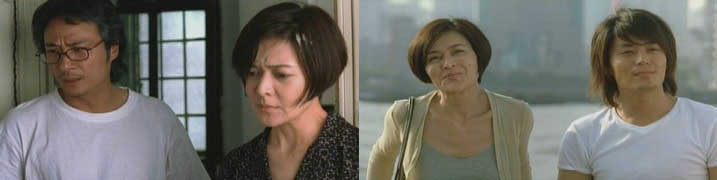
Shanghai has been the subject of a number of recent films of late – often
used as much as a character as a location in films like “Leaving Me, Loving
You” and “Everlasting Regret” (directed by Stanley Kwan) and this is the
case here. Author Tang Ying is a resident of Shanghai and she apparently
often delves into the lives of Shanghai women and gives her books a very
local flavor – a flavor that the director attempts to capture. The problem
though is in the timing of the film. The story in the book takes place in
the early 90’s – a period when China and Shanghai were undergoing rapid cultural
changes – and at that time perhaps the story felt relevant to what was happening,
but now set in modern days it feels anachronistic and inconsequential.
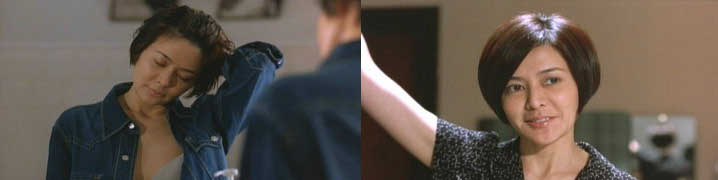
Ainu (Rosamund, whose family came from Shanghai) is a fading beauty in her
forties and seems to have become frozen in time like a butterfly in amber.
In the past she had been well known in the city for her beauty and her style
and she tries to grasp on to those crumbling memories. She now lives in middle
class poverty – married to a poorly paid journalist (Francis Ng) with a young
daughter but gets little happiness from either her role as mother or wife.
Her husband is kind but boring and immune to her sexual needs. She still
expects pampering though and this comes primarily in the form of her nearly
daily visits to the state-owned hairdressing salon. Her picture from a decade
ago still resides in the window with her face enclosed in her “mushroom”
hairdo that she once made the rage of Shanghai. She still wears it like a
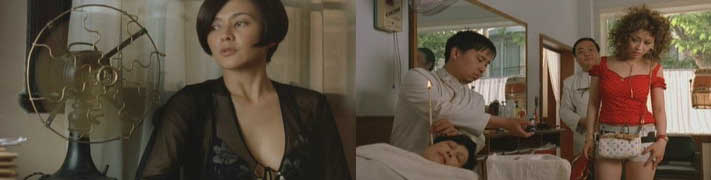
crown of royalty. When she enters the shop, the aging overly-staffed barbers
welcome her like a celebrity and she purrs like a contented cat for a few
hours. One of the hairdressers though is a young handsome stud and Ainu will
only allow him to take care of her. After receiving her hair treatment, she
is all aglow – a radiant smile covers her face and her hair bounces joyfully
as if she is in a shampoo commercial as she walks around the city.
Though nothing has transpired between her and the young hairdresser, Hwa,
clearly the idea is fermenting in her underutilized brain. Then her insular
world begins to collapse – an old rival Lulu (Yang Lu) returns from the United
States like a dolled up strumpet and demands the attention of Hwa to the
point where Ainu’s picture is replaced by hers (gasp), a wealthy friend reminds
her all too well how middle class her life is and finally the salon is set
to be closed by the government in its turn toward capitalism. Her solution
to all this is what felt so jarring and not quite in synch with all that
came before as she sets herself on a path of female liberation by ditching
her husband and daughter, going for a new hair style and setting up her own
business! This being Shanghai, I expected suicide or abject loneliness at
a minimum. A “happy ending” (well except for the poor old husband and daughter
who become yesterday’s newspaper) seemed nearly cheating.
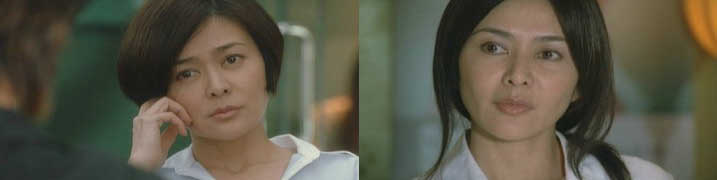
This is an interesting opportunity for Rosamund these days. She doesn’t make
a lot of films anymore as do few Hong Kong actresses who have reached their
forties – and to take on a role that to some small degree may reflect her
own life as a well known actress from a well known acting family entering
middle age is somewhat brave. She still looks great and has a mildly steamy
scene with Hwa that ends symbolically and in rather corny fashion with the
water pouring from a shower nozzle slowly coming to a halt. I expected it
to moan, roll over and go to sleep. She called this the first time that she
felt like a real actress which may be true as she was never one for taking
on very challenging roles in her career and slid by primarily on her acre
wide eyes. The story just didn’t interest me that much – maybe it’s a gender
thing but the theme of her finding herself just didn’t ring true for me and
felt fifteen years too late.
And just because it never hurts to gain a little
knowledge, here is a brief biography about the author from the University
of Iowa.
TANG Ying (fiction writer, screenwriter,
playwright, filmmaker;
b. 1955, China) is a prize-winning, widely anthologized writer, with many
TV and film credits. She has produced and directed in both media, venturing
next to independent filmmaking. She has published over a dozen novellas,
four collections of stories, two novels, and is currently at work on Another
China , a documentary film project about expatriate Chinese writers in New
York, and a new novel. Tang's numerous publications include Tell
Laola I Love Her , a novella selected for inclusion in the Best Chinese Novellas
of 2001 , W ife from America (1994) , a novel that was adapted for the stage,
serialized in Liberation Daily , and won first prize for Stories Serialized
in Newspapers and Magazines, Asexual Partners (2001), a novella that was
also serialized, No Love in Shanghai (2002), and most recently, Senseless
Journey (2003), a novella published in the Chinese journal Harvest.