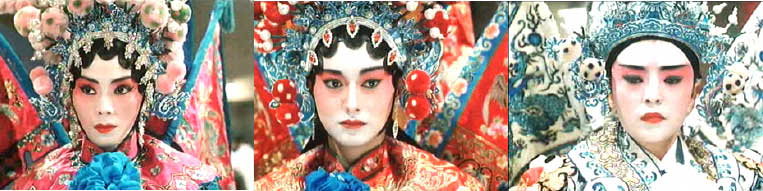
Stage Door Johnny
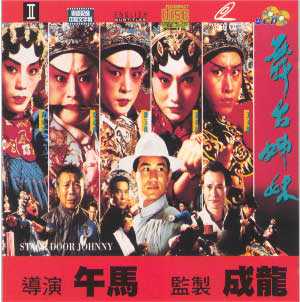
Reviewed by YTSL
This at times highly melodramatic 1990 Hong Kong
film -- whose setting, for the most part, is 1932 Shanghai -- has two big
strikes against it. One of these is the period piece’s terribly abrupt
and generally unsatisfactory ending. The other is that, on account
of its being one of those offerings which has a large cast -- many of whom
appear to be members of Jackie Chan's Stuntmen Association (who also put
in work as the effort’s action choreographers) -- and multi-stranded plot,
it really only becomes coherent upon a second viewing. It doesn’t help
either in terms of structural but also tonal continuity that the movie’s makers
seem to have tried to pack every kind of genre (bar for supernatural horror)
into it.
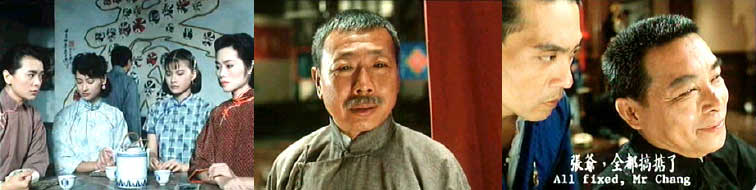
Despite that which would rank as one of Jackie Chan’s lesser productions
having such sizeable problems though, this (re)viewer still found the curiously
English named STAGE DOOR JOHNNY -- whose Chinese title is the more appropriate
“Stage Sisters” -- to be very much worth a watch (and re-watch) and reckons
that she might not be alone in feeling this way. One reason for this
comes from the film’s novel focus being on an all-female -- bar for its father
figure (“Pops” is portrayed by director Wu Ma) and musical accompanists (whose
“divine tea” (i.e., opium) imbibing leader is played by Lam Ching Ying) --
Chinese opera troupe. As one might imagine, “this floating life” --
as it gets described in the music-filled movie’s lyrical main song -- is
depicted as being colorful and eventful indeed, both off as well as on stage.
Considering the five main personalities involved, the chances are high that
this would have been the case even if they didn’t ply the trade that they
do.
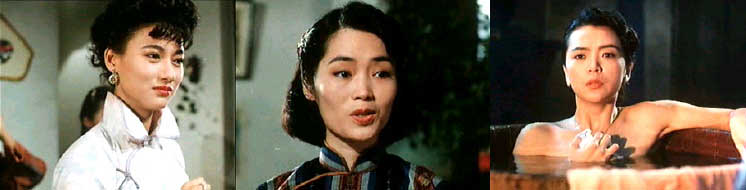
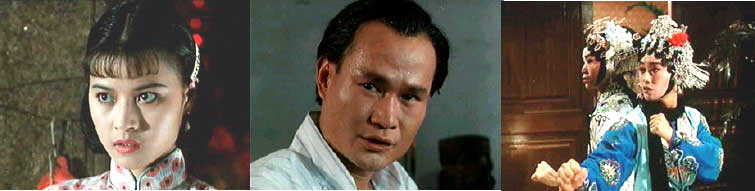
The first opera star to make an appearance in STAGE DOOR JOHNNY is Boss Tsui,
a “do ma dan” artiste who: Specializes in playing males; is trained
in the acrobatic-oriented Peking Opera style; and gets enlisted by “Pops”
to help the Shanghai-based company he heads perform the more popular martial
-- as opposed to the less audience-pleasing “civil” -- acts (Kara Hui Ying
Hung was a great choice to play this actress but I reckon it would have been
even better for her character to not be two months pregnant). The longer
serving divas of the Hsiao Ho Chun troupe comprised: Stern Boss Shen,
a young widow who specializes in playing “chaste” roles (and is essayed by
Anita Mui’s older -- and sadly deceased as of April 2000 -- sister, Ann);
flamboyant Boss Hsiao (a.k.a. Perfume), who invariably appears on stage with
some kind of “Painted Face” (and is played by Wong Yuk Wan); pretty Boss
Sai, with whom more than one man gets enamored (who comes in the form of
Lai Yin Saan); and dignified Boss Ching, who I reckon is the film’s most
noble character (and one who Idy Chan endows with quite a bit of class).
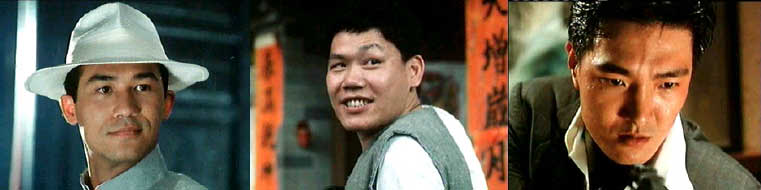
Perhaps inevitably, the male personalities of STAGE DOOR JOHNNY pale in comparison
to that of its women. However, they really should not have been as
one-dimensional and undeveloped as they are. IMHO, this movie -- which
possesses some kick-ass action scenes on account of the Chinese Opera folk
getting involved in more than one way with a couple of major Triad figures
-- would have been so much better served if: More had been known about
Waise Lee’s Lu Tung Tang other than his being the leader of a group intent
on ensuring that the ban on opium was upheld (so that there was one less
way for Chinese men to become weak); Lau Siu Ming’s Mr. Chang had not been
such a stereotypical bad guy; and Ken Lo’s character hadn’t been as silent
as he was strong and adept in the martial arts. As for the rickshaw
puller portrayed by Mars: Here’s stating that I saw no logical reason
for his needing to make the costly sacrifice that he did. Consequently,
his final loving act in a work that really does seem intent on showing that
“the world is fraught with frustration” was not the moving one it probably
was meant to be but, instead, came across as more stupid and senseless than
sad.
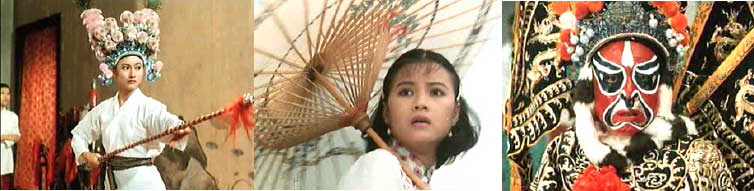
Something else that I think worthy of mention is the obvious high quality
of STAGE DOOR JOHNNY’s sets and props. According to Paul Fonoroff,
they were originally made to be used in Jackie Chan’s “Mr. Canton and Lady
Rose” before being recycled in “Shanghai, Shanghai” as well as in this lower
budget production (See his “At the Movies”, 1998:77). Actually, some
of the Chinese Opera costumes look a lot like those worn by some of the performers
who appeared in “Peking Opera Blues”. If this is indeed so, it sure
is a case of good second hand use being made of filmic elements to make a
second tier movie which nevertheless does successfully entertain more often
than not.
My rating for this film: 6.5