Inner Senses
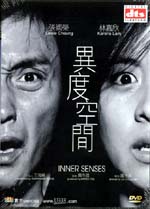
Reviewed by YTSL
Are you the kind of person who could be described
as high strung and prone to being much affected by your viewing of certain
movies? If so, then here’s a suggestion from someone who will readily
admit to fitting the afore-mentioned bill -- albeit with the caveat that she
honestly doesn’t reckon that she is necessarily all that easily scared (N.B.
As proof, I’ll point out my having been impervious to the chill plus fright
tactics of such as Takashi Miike’s “Audition”, Mario Bava’s “Black Sabbath”
and Cheang Pou-Soi’s “Horror Hotline...Big Head Monster”) -- that you approach
this atmospheric, intense and consistently serious 2002 offering from director
Bruce Law and producer Derek Yee with some caution, and at your peril.
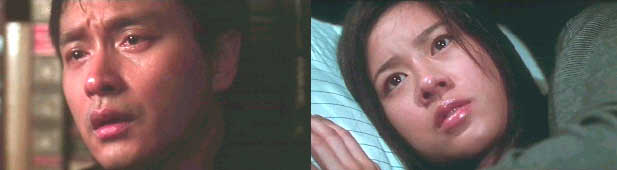
This is on account of my having found the unexpectedly complex plus involving
INNER SENSES -- whose viewers appear as divided in opinion as to whether
it’s really (primarily) a suspenseful psychological thriller or unsettling
supernatural horror (but definitely also contain elements of tragic along
with touching romance) as in whether it’s all that good an effort -- to be
not just hair-raisingly creepy at certain key moments but also actually nightmare-
as well as literally sweat-inducing plus very thought-provoking (especially
when viewed alone when it’s dark outside). And while I do hear the
arguments of some of this work’s detractors re this not particularly big
fan of scary fare’s much more positive reaction to the effort possibly stemming
from my (being unlike them in) not yet having checked out “The Sixth Sense”
and “The Ring”, I’ve also been furnished with the distinct impression by
those same sources that this intelligently scripted (by Yeung Sin Ling) movie
does turn out to riff -- rather than rip -- off essential elements that appeared
in those two non-HKSAR productions.
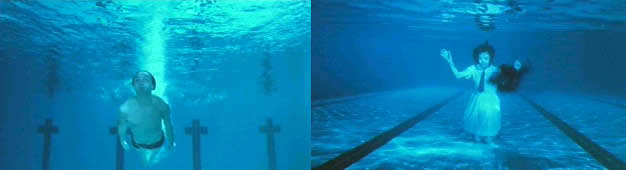
Indeed, so much is this the case that INNER SENSES actually can appear to
wreck havoc with those expectations that people who have viewed those Hollywood
and Japanese hits may have when going into a viewing of that which has: its
primary female character state that “I see ghosts”; a male protagonist coming
in the form of the psychologist who is charged with treating this (at least
initially) troubled youth; and video recordings playing an important part
in the proceedings. Accordingly, it probably would be best if this
characteristically multi-genre Hong Kong effort were to be approached on
its own terms; ones that seem, among other things, to existentially stress
the need for people to be open to the possibility of there being more than
one single -- even if not simple -- or maybe no authoritative answer re such
as the (best way to understand the) inner-most workings of the human mind
and/or whether supernatural beings really can and do exist (and in the often
quite particular way that an individual’s society and culture has taught
and told him or her that they do).

At their first meeting, INNER SENSES’ two main personalities come across
as the human equivalents of the immovable object and the irresistible force.
Yan Cheung (who is portrayed by the mercurial Karena Lam) is adamant that
she is not a sick person even while strongly holding on to a belief that
“I am just someone who can see ghosts all the time”. Consequently,
even while the young woman appears to be under great emotional plus mental
-- and maybe also physically -- duress, she tries (at least for a while)
to resist the professional assistance and support that gets proffered by
Dr. Jim Law, the workaholic psychologist friend and colleague (who gets essayed
by the ever capable Leslie Cheung) of her caring elder cousin’s husband,
whose announcement that “If you believe in ghosts, they will exist” appears
to carry with it the counter-proposition that “If you don’t want ghosts to
exist (and haunt you), you should just desist from believing (in them)”.
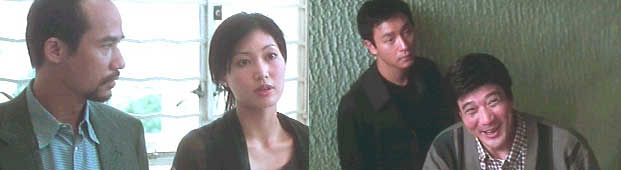
Before too long though, certain eventful developments at the apartment that
she had only recently rented and moved into threaten to send the already
nerve-wrecked Yan Cheung -- who Jim Law noticed has the kind of scars on
her wrist that looked to have been self-inflicted -- over the edge.
For one thing, she -- who explains her living alone by stating that “my family
is in Australia” (even though she technically could have opted to stay with
the supporting characters played by Valerie Chow and Waise Lee) -- frequently
hears disembodied voices inside her bathroom. For another, after being
informed by her voluble landlord (who was barely recognizable as Norman Chu,
of “We’re Going to Eat You” and “Duel to the Death” as well as “Wing Chun”
fame) that he continues to await the return of his wife and son who had accidentally
perished in a landslide some years back, she believes herself to have caught
sight of the deceased duo (who used to call her new living space their home).

Enter Jim Law to resolve his patient’s problematic situation in ways that
seem eminently effective and sensible as well as logical. After Yan
Cheung’s issues appear to have been conclusively worked out (and long before
the half way mark of a full length film), the focus of INNER SENSES switches
to the therapist who had hitherto seemed too capable -- and psychologically
“together” -- to be true as well as an interestingly three-dimensional character.
While there are those for whom this is when the well lensed (by Venus Keung)
and edited (by Kong Chi Leung) throughout movie takes a wrong turn, my own
feeling is that it’s really when things got particularly intriguing and captivating.
Since I don’t want to majorly spoil things for those of this review’s readers
-- and yes, I’m assuming that they exist (even if I often lack concrete proof
re it being so)! -- who have yet to view the work, I’ll just state here that
this is not least since the second half (or may even last third) of the production
is when Peter Kam’s often inspired choice of musical notes and (the) other
orchestrated sounds really kicks into gear, and Maggie Poon’s increasingly
memorable character gets to figure more prominently in this offering.
My rating for the film: 8.
Reviewette by Brian
I suppose if you go in head first looking
for scares you may be badly disappointed with this film, but otherwise I
thought this was one of the more intelligent and mature horror films to come
out of Hong Kong in a long while. Of course that may not be saying a lot!
Though I felt no real jolts of adreneline zap through my body, I found myself
involved with the story from beginning to end. The transition midway through
from the focus being on Karena to Leslie initially seems a bit clumsy, but
in a sense this sudden twist is what made the film take on more depth than
a typical ghost story.
Directed by Law Chi Leung who has only two
other films to his credit - both with Leslie - Viva Erotica and Double Tap
- he brings a nice refined sense of style and slow tension to the narrative
that is rarely overplayed (possibly with a cheap thrill exception or two).
Certainly more creepy and psychological than out and out horror (of which
there is really none), it explores our inner demons - real or imaginary -
it doesn't really matter when that icy heartpounding sense of fear reaches
out for you in the loneliness of the night.
My rating for this film: 7.5