The Eye
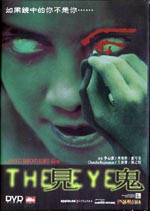
Reviewed by YTSL
One of the more highly touted characteristics
of Hong Kong’s filmic offerings is their regularly appealing to more than
just a single territory’s moviegoers. Even with the appearance of Americans
like Bruce Lee, his two children, Cynthia Rothrock and Michael Fitzgerald
Wong in a number of Jade Theatre works though, it doesn’t seem to have been
as widely, often or immediately realized that many “Hollywood East” players
actually possess(ed) ties to lands beyond those of that which have been referred
to as The Three Chinas. Consequently, the mind can threaten to boggle
somewhat upon its realizing that more than a few contributors to the former
British Crown Colony’s Cinema have hailed from places as diverse plus far
flung as: Vietnam (Tsui Hark); Australia (Christopher Doyle and Joyce Godenzi);
Malaysia (e.g., Michelle Yeoh, Angie Cheung and this transnational hit’s
capable female star); Canada (inc. Sally Yeh, Pauline Wong, Valerie Chow,
Theresa Lee, and this supernatural drama’s main actor); Japan (notably Yukari
Oshima and Michiko Nishiwaki); and South Africa (Lawrence Ah Mon); and France
(the scriptwriters of “Running Out of Time 1” plus “The Touch”).
In part, this is because few truly wholesale multi- or even bi-lateral collaborations
have sailed out of the “Fragrant Harbor” until recently, and maybe even up
until work got underway on the atmospheric Peter Chan and Lawrence Cheng
co-production whose cast and crew look to have been majorly drawn from the
HKSAR and Thailand (but also include other nationalities, like the Singaporeans
-- who are represented on this supernatural horror-drama’s screen by the
medical doctor portraying Pierre Png and Edmund Chen). For the record:
THE EYE is an emphatically non-monocultural and -- what with it containing
lines of Khek, English, Mandarin plus Thai together with Cantonese dialogue
-- at least quin-lingual effort that (nonetheless) is by no means bereft
of the sort of authentic “native” color and content that’s sorely lacking
in the territory-hopping, wanna-be cosmopolitan “Full-Time Killer” as well
as many a shallow Hollywood blockbuster.
Indeed, it is the little local touches with which the haunting movie’s makers
have infused their offering -- including, in the portion that takes place
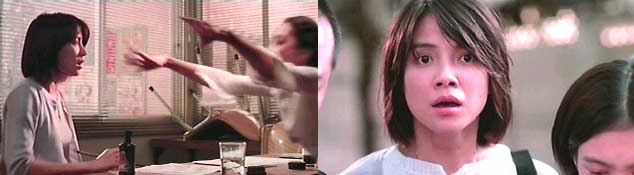
in Hong Kong, those which come in the form of a Taoist priest-exorcist, a
candle-eating hungry ghost and a ghoul who begrudges a living person’s taking
her place in a Chinese calligraphy class -- that effectively works to underscore
that it is not just a(nother) senseless knock-off of “The Sixth Sense” as
well as anchor many of THE EYE’s unusual goings-on onto that which can come
across as everyday reality for many an (Asian) individual. All in all,
the attention that gets paid to all sorts of small but shown-to-be-significant
elements plus minor characters (who include young children, grieving parents,
aged grandmothers, an albino man and a whole orchestra of blind musicians)
is what serves to conclusively establish that this Danny and Oxide Pang (Bangkok
Dangerous) co-directed , -scripted (along with Jojo Hui) and -edited effort
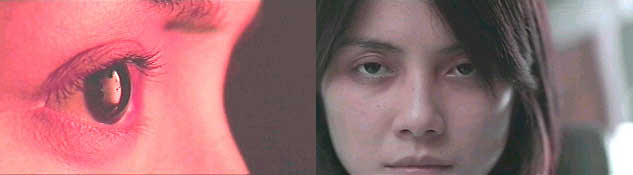
-- whose blind-since-the-age-of-two protagonist starts seeing dead as well
as living people and having a recurring disturbing nightmare after undergoing
a cornea transplant -- is uncommon in quality (along with such as its admirably
sensitive approach to what could have easily been presented as mere juvenile
fright fodder or lurid exploitation fare).
Admittedly, THE EYE’s opening credits’ starting off being in Braille before
transforming into Romanised script may seem a trifle gimmicky -- this especially
since it’s cheekily preceded on the 35 mm print version of the film by that
which is geared to look like the movie’s projectionist is experiencing technical
problems that prevent him from smoothly running it -- even if thematically
appropriate. However, it appears to have been a downright inspired
decision to show the brilliantly lensed by Decha Srimantra offering’s viewers
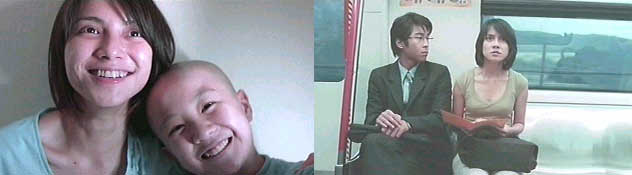
how things look to someone -- specifically, Angelica Lee’s youthful Mun character
-- who is not used to having seeing eyes, to the extent that she requires
a therapist (who is played by a bespectacled Lawrence Chou) to help her psychologically
plus physically adjust to what can seem like a whole new (scary) world.
Additionally, I consider the choice of spectral form for those whose role
it is to herald plus facilitate the progress of human souls from our realm
to the one beyond to be another of this actually more moving than terrifying
work’s fine(r) as well as intriguing details.
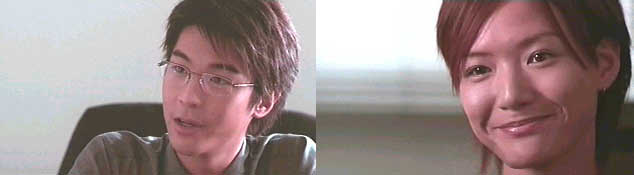
THE EYE also benefits from possessing a few terrific acting performances.
The film’s still not all that experienced lead actress (who won the New Talent
Award at the 2001 Berlin International Film Festival for her work in “Betelnut
Beauty”, and whose name appears on posters of this 2002 movie as Lee Sin
Jie) is to be congratulated for having made her complex, surely difficult
to essay character sympathetic, memorable plus believable. Chutcha
Rujinanon -- who portrayed the heart-breakingly ill-fated Ling -- was impressive
as well. So too was the older Thai actress (whose name I unfortunately
do not know) who played her understandably sad mother. Alternatively,
those expecting big things from Candy Lo in this often very suitably scored
(by Orange Music) effort ought to be warned that her part as Mun’s stewardess
sister is -- like with those accorded to Edmund Chen and Pierre Png (neither
of whom play Singaporeans but, instead, a Hong Konger and primarily Mandarin
speaking Thai-Chinese respectively) -- really not substantial at all.
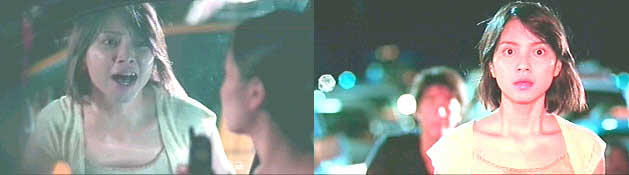
My rating for the film: 8.