Three
There have always been some connections between
the various film industries in Asia – actors appearing in films that cut across
geographies and certainly financing that crosses borders – but for many years
it was Hong Kong film that was the driving engine that brought in the profits
and the other film industries had very little presence on the international
stage. This is clearly no longer the case and the film industries of Korea,
Thailand and Japan have really begun to emerge over the past few years and
have attained huge popularity in other Asian nations. Korean films are a
constant theatrical presence now in Hong Kong as well as the occasional Thai
and Japanese film. This trend has made available the opportunity for producers
to create hybrid films that they hope will have an appeal that crosses over
into different markets. So there have been various HK actors such as Takeshi
Kaneshiro and Kelly Chan starring in Japanese films, the Chinese actress
Zhang Ziyi in the big budget Korean film Musa, the Thai Pang brothers making
a HK film The Eye, that takes place in both HK and Thailand and a Thai film
(Jan Dara) that stars a big HK actress, Christy Chung, and was produced by
a HK film company.
The logical end point of this Pan-Asian collaborative effort is a film such
as Three – a trilogy in which each segment is directed by a top talent from
three different countries and stars actors from the three countries. The
theme that all three segments play with is the supernatural – but all in
a very distinct way that to some degree captures the traits of their own
national film characteristics. “Memories” directed by the Korean Kim Jee-won
(Foul King, The Quiet Family) has a certain cold, crisp modern alienated
approach; the Thai director, Nonzee Nimibutr (Jan Dara, Nang Nak) gives his
story “The Wheel: a very populated look in which culture and fate plays a
strong hand; the final segment “Going Home “comes from Peter Chan (He’s a
Woman, She’s a Man and many other UFO films) and his film is a slow, spooky
heartfelt rendering that delivers a strong emotional blow in the end.
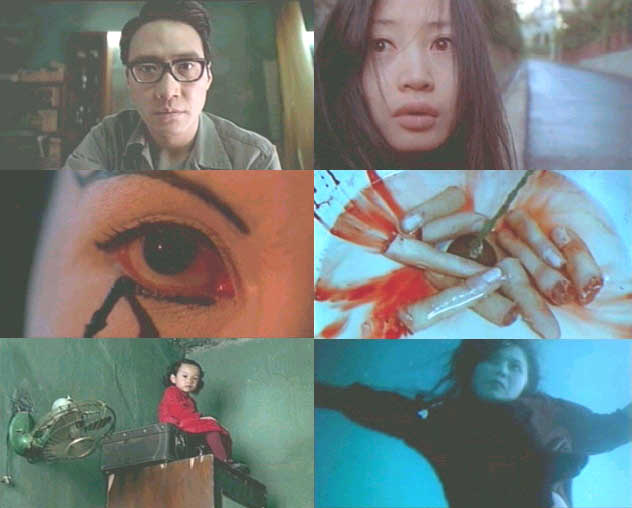
Memories (39 minutes)
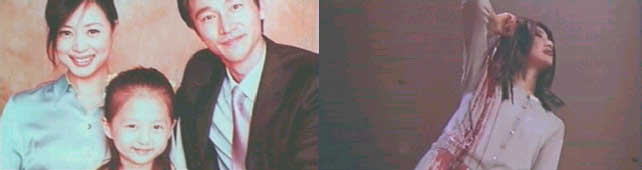
In a jangled nervous manner the story hones
in on a husband (Jung Bo-Seog) overwrought with the sudden disappearance of
his wife. His sleep is fitful and corroded by nightmares that contain terrible
images of his wife – such as sticking her finger into her head and pulling
out her brains. Alternately, the camera is following a woman (Kim Hye-Soo
from Kick the Moon) who is confused with possible memory loss – always getting
a busy signal – and trying desperately to get home. One assumes that this
is his missing wife and as she gets closer to her destination the truth of
what is going on slowly emerges like a bloated corpse from the river.
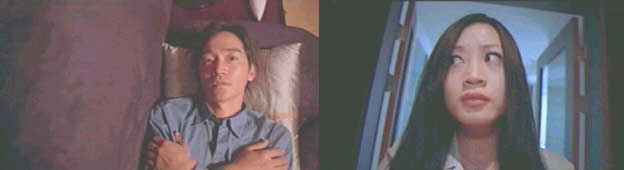
Director Kim Jee-won is best known for his rather dark humor in both the
Foul King and The Quiet Family, but there is no evidence of that here as
the story unfolds in grim fashion. Of the three stories I thought this the
most chilling, but not the most effective. It suffers from a very detached
emotional perspective from the viewer – the characters are both fairly enigmatic
and one never feels very much towards them – and so their fate doesn’t really
have any impact on one. Still the film moves along quickly in an Edgar Allen
Poe sort of inevitably creepy manner and the ending though not shocking feels
bleak and merciless.
My rating for this segment: 6.5
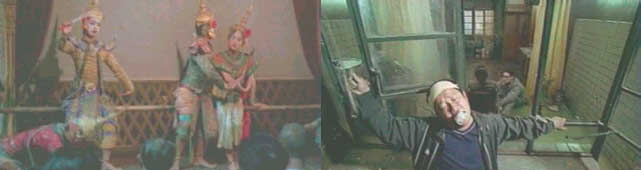
The Wheel (35 minutes)
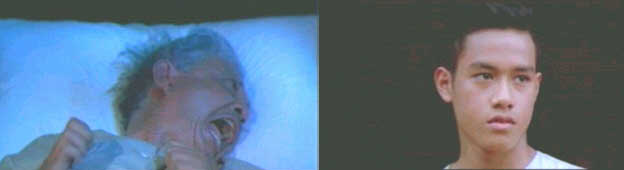
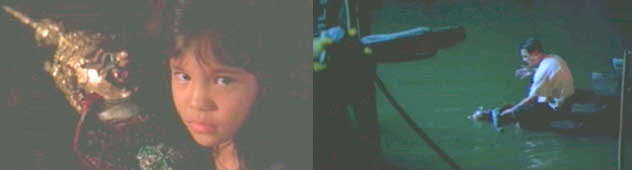
In a travelling Thai troupe of entertainers,
the master puppeteer lies dying haunted by some apparent curse that has been
placed on his puppets. He had instructed his wife and daughter to take the
puppets out on a lake and sink them – but instead it is the wife and daughter
that don’t make it back. Like a bedtime story meant to scare children into
being good, director Nonzee Nimibutr, narrates what seems to be almost an
old wives tale of envy, superstition, sexual attraction, fate and karma.
The apprentice to the Master Puppeteer (Suwinit Panjamawat – Jan Dara and
Tears of the Black Tiger) tells all who will listen that the puppets are
cursed – that they must not be transferred to a new owner – but the head
of the lower caste Khon entertainers (who perform in masks) thinks that by
stealing the puppets he will gain immensely in status – the puppets think
otherwise.
This is the weakest story in the trilogy – it has too many characters for
such a short piece, it is confusing, it doesn’t flow all that well and in
the final analysis isn’t really at all scary – it just sort of lays there
like an over ripe mango that has long lost its tartness. One expects that
one of the characters will emerge to push the film forward, but that never
happens and it all feels rather cheap and underwritten by the end.
My rating for this segment: 5.5
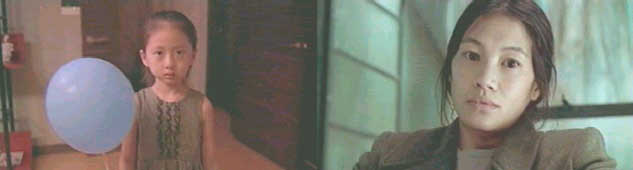
Going Home (49 minutes)
This very sad ode to sacrifice and undying
love (this is much more a love story than a horror tale) is some of Peter
Chan’s finest work in a long time. Though some critics have compared it’s
emotional wallop to his previous classic, Comrades: Almost a Love Story, I
wouldn’t go that far – but this small lovely gem certainly left a huge lump
in my throat and a hurt in my chest. The wonderful thing about this is how
slowly Chan builds it up – he creates an unnerving atmosphere with his sparse
lonely sets and eerie cinematography (from Christopher Doyle) and introduces
only a few characters but then sets about taking you into their lives.
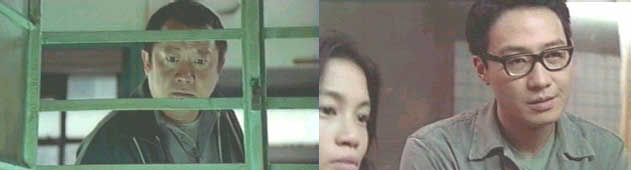
In an almost Camus end of the world like atmosphere, Eric Tsang and his small
son come to live in a large rundown apartment complex. Everyone else has
left or is in the process of leaving – why this is so isn’t explained – why
Tsang a cop is moving in is never explained – just the fact that he is doing
so says enough about his life and the pain somewhere below. The only
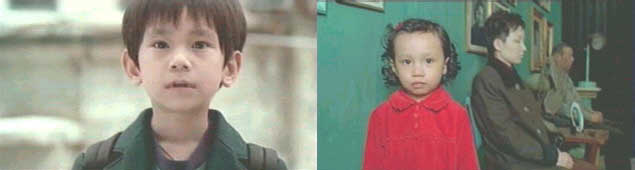
tenants left appear to be a husband (Leon Lai), his invalid wife (Eugenia
Yuan – daughter of Cheng Pei Pei) and their small daughter. Lai wheelchairs
his wife around the complex, talking gently to her and the small girl follows
behind. Tsang has to leave his young son to fend for himself most of the
time and the boy takes to playing with the girl and one day doesn’t come
home. Tsang goes looking for him, but Leon says he knows nothing about the
son and doesn’t even have a daughter. Suspicious that something is wrong;
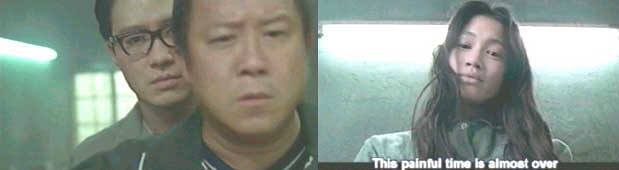
Eric breaks into the apartment and sees something that he shouldn’t. He is
knocked out by Lai and kept captive – but Leon tells him that it is only
for a few days – in three days something wonderful will happen and he will
be allowed to go free.
Clearly, I am trying not to give too much away here – I will only say that
what seems at first to be only a good solid story is made both devastating
and uplifting in the last few minutes. The performance from all five actors
is excellent – the girl is suitably adorable and creepy with her pixie face,
the boy is sweet, Eugenia is as terrific as one can be in her very odd role
and in the end she will gnaw at your heart, Eric gives a restrained but poignant
performance as a tough distant guy who is shattered by the disappearance
of his son – and Leon finds another role that is perfectly suited to him
– one almost devoid of emotion and yet very human and very touching.
My rating for this segment: 8.5