Three . . . Extremes
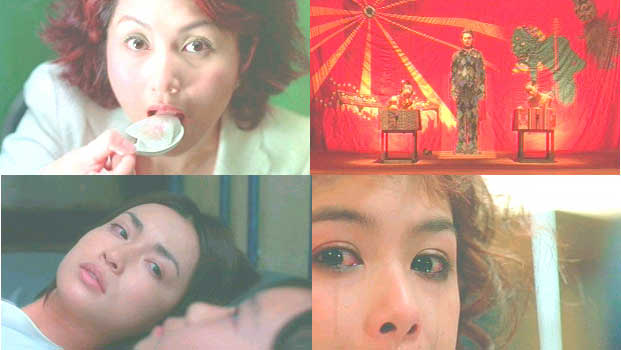
With the success of “Three” in 2002, another
Asian cross-cultural trilogy of horror films has been hatched and unleashed
on the public. This time two of the three are again from Hong Kong and Korea
but the third hails from Japan rather than Thailand and again three of the
top Asian directors were brought into the project. The three stories dramatically
differ from one another in terms of plot, mood, style and sub-genre – one
being a ghost yarn, another grounded in revenge and madness and the third
looks at our fears in everyday living – but all three are solid entries and
would be at home in any of the classic horror anthologies of the sixties
from Hammer or Amicus. All three are beautifully shot with wonderfully designed
sets that are awash in color and detail and simply make the viewing of them
a pleasure.
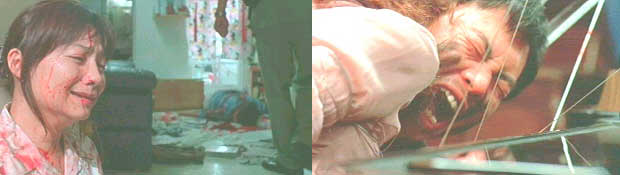
Box (Japan)
Duration: 40 minutes
Director: Takeshi Miike
As quickly as Miike can churn out a film,
making one as short as this probably took him an afternoon. It is nearly
all mood and imagery with an ethereally chilly story as a backstop. It is
far from typical Miike in many ways as he eschews violence and the bizarre
for a surrealistically dreamy tone poem that slowly crawls up on you but
never really bites. In some ways it feels influenced by the Korean film “A
Tale of Two Sisters” in style, plot and a sense of lingering melancholy.
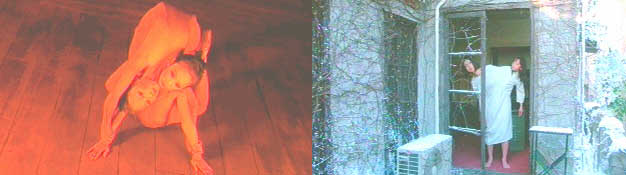
Reality becomes interwoven with dreams and the supernatural as we peer into
the life of Kyoko (Kyoko Hasegawa) who seemingly drifts from the present
into her past and from reality into fantasy until all these lines are blurred
and it becomes almost one. A reclusive writer, she carries the painful memories
of her childhood along like a bag of bricks ready to fall on to her head.
When she was a child, she and her sister (Mai and Yuu Suzuki) danced in their
father’s entertainment act and she feels responsible for a tragic accident
that took place. Ghosts and suffocating memories swirl about her head
until it is ready to explode in despair and madness. Evocative, perplexing
and lyrical, this is a nice change of pace for Miike though it may not feed
the hunger of fans of his more extreme fare.
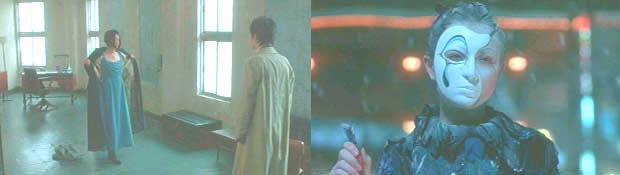
Cut (Korea)
Duration: 48 minutes
Director: Park Chan-wook
Park Chan-wook has received much international
acclaim for his two unnerving and gut-wrenching vengeance films, “Sympathy
for Mr. Vengeance” and “Old Boy” and his contribution here follows along those
same lines though not to nearly the same powerful effect. Bloody yet playful
at times, one is never quite sure how serious this is supposed to be or whether
Park is partly poking fun at himself and parodying his earlier efforts. Shot
in bold clean colors encompassed within a classic giallo horror tableau,
this is really the only part of the trilogy that might comfortably earn the
“Extreme” aspect of the title.
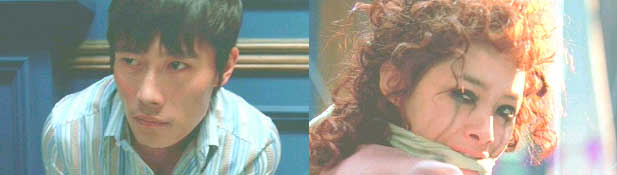
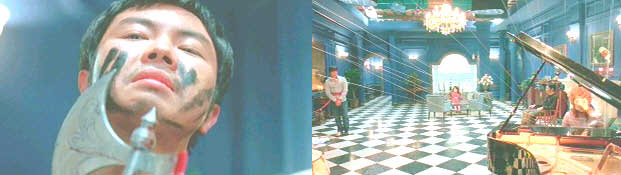
Successful film director, Ryu (Lee Byung-Hun), returns to his movie setting
home after shooting a vampire scene at the studio and is captured and knocked
out by an intruder. When he gains consciousness he finds himself attached
to an elastic material that allows him to roam for a specified distance.
He also finds his wife (Gang Hye-Jung) trussed like a marionette with her
fingers glued to piano keys by a film extra (Lim Won-Hee) who has lost his
mind and is insanely jealous of Ryu’s fame. More than this though he hates
Ryu because Ryu is so ethical and treats everyone with respect. The captor
gives Ryu a choice – to show that he can be evil or he will chop off one
of his wife’s fingers every five minutes. Surprising confessions spill out
of Ryu but this does not satisfy his captor and he gives him one more opportunity
to save his wife – commit murder. It gets intense at times, but one still
senses that Park was chortling behind the camera at much of this.
Dumplings (Hong Kong)
Duration: 37 minutes
Director: Fruit Chan
Fruit Chan is clearly the most surprising
choice among the three directors with his record of non-commercial independent
films that delve into the lives of the lower working class in Hong Kong with
a sympathetic if jaundiced eye and a sly touch of dark humor. Horror has
been a genre that he has stayed away from and to some degree he still does
with this film as it is far from a traditional horror film and yet at the
same time manages to be true to the roots of Hong Kong horror that has been
so influenced by Japan as of late. He hands the camera over to Christopher
Doyle who beautifully seeps the frames in deep colors and shadows. There
are no typical horror scares here - no jump out of your shoes moments
– it is really more a reflection about the sadness of life and in that way
it is similar to the Hong Kong segment “Going Home” from the first film (and
in fact this is produced by Peter Chan who directed "Going Home".
While most horror films surround themselves with the supernatural, malice
or insanity, Fruit chooses a theme of absolute normalcy – one that we all
come face to face with in our lives – what is scarier in the real world than
the inevitability of getting old and our bodies wearing down until death
is a welcome guest. We fight it with workouts, plastic surgery and vitamins
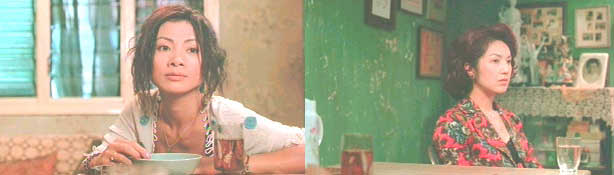
but in the end it always wins. Aging is terrifying to Mrs. Lee (Miriam Yeung)
who after having retired from her successful career in television is approaching
middle age and witnessing her husband’s (Tony Leung Ka-fai) growing lack
of interest in her. He tries keeping himself young with a series of affairs
with infantile women, while Mrs. Lee turns to Aunt Mei (Bai Ling) who reportedly
has a secret for keeping one’s youthfulness.
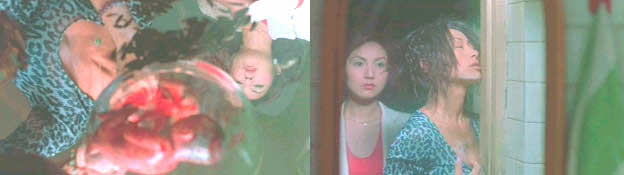
In a plot point that could outrage many, Aunt Mei obtains the remains of
aborted babies in the Mainland and turns them into delicious juicy dumplings.
As she explains to Mrs. Lee there are many sources in Chinese literature
and history that show that the eating of human flesh keeps your youth and
vitality – and if she is doubtful – just look at me – and shows her a picture
of herself in her twenties – from forty years ago. Mrs. Lee is sold and begins
a diet of dumpling fetuses cooked with loving care by Aunt Mei – there is
no remorse – no sense of wrong doing – only a need to floss her teeth afterwards.
With the rejuvenation taking longer than she would like, Mrs. Lee demands
something faster working – no problem – all we need is a five-month fetus
– the most nutritious – soft like kittens she explains.
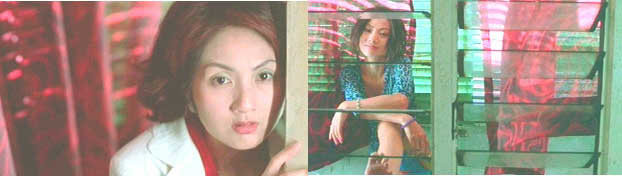
Dumpling has also been released as a separate 90-minute film and so obviously
the differences between the two are dramatic. Having seen the full-length
film first, I found the short version to be much the weaker piece and find
it hard to judge on its own merits without comparing the two. The shorter
version almost completely cuts out Tony and his mistress, the schoolgirl
and her mother, a number of scenes between Miriam and Bai Ling and reduces
Bai Ling's sexuality significantly. These cuts really change the emotional
timbre of the film – for example the origin of the aborted baby is missing
in the short version and this reduces an element of dread. Another brief
but important part cut is a flashback to Mrs. Lee’s wedding – as this is
used as a comparison of her then – full of hope and youth – to her current
state of remorseless need – this is the real point of the film – how age
infects us with dread and corruption that can bring out the monster in any
of us. Most intriguing though is that Chan completely changes the ending
– the long version shows Mrs. Lee being coldly manipulative while the short
version is positively evil and creepy - sort of tragic mood versus horror
jolt. It's odd that Chan cut his film down to 37 minutes while Cut went for
48 minutes - another 10 minutes of added material would really have helped
this segment. But I should add that many of those who have seen Three without
first having seen the full-length Dumplings consider Chan's segment to be
the best of the trilogy by far.
My rating for Three Extremes: 8.0 – in order of
preference – Cut, Box, Dumplings
My rating for Dumplings: 8.0 – a very fine film
with great performances from Miriam and Bai Ling.