Beijing Rocks
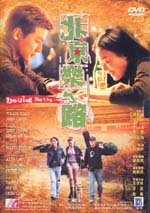
Director: Mabel Cheung
Year: 2001
Rating: 7.0
Director Mabel Cheung
is best known for working slowly and for creating bittersweet romances full
of yearning and restrained passions. In over sixteen years in the film industry
she has directed only six films – that’s a weekend for Wong Jing – and two
of those are classic romances (An Autumns’ Tale and Eight Taels of Gold),
another is a lush love story that falls a bit short (City of Glass) and the
Soong Sisters was an epic tale that mixed politics, history and romance.
Her latest, Beijing Rocks (2001), again tackles the subject of yearning and
romance, but it is so restrained that it is in fact the least exciting part
of the film.
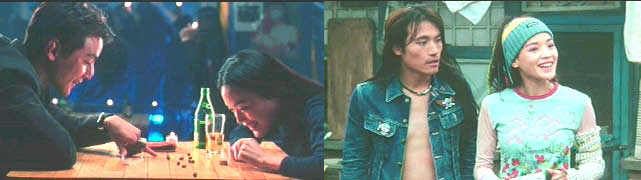
So does Beijing Rock? The movie definitely doesn’t rock – but in many ways
it is one of the more interesting films of the year – almost European in it’s
low key exploration of relationships in which very little actually happens
and very little is expressed – a Chinese Jules and Jim. Now does Beijing
rock. Absolutely. Not that I have seen a lot of films that take place in Beijing
or the countryside – but this felt wonderfully fresh in it’s approach to
depicting the China of today – a combination of the old and the new – of
tradition and a new found rebellious attitude. Looking at China through the
eyes of the characters, it looks to be a fascinating place to be today. To
a large extent, this was why I enjoyed this film as much as I did. The film
becomes a road film and I felt like I was being taken places and seeing people
and situations that were new to me.
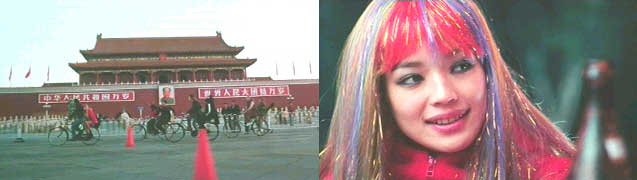
Daniel Wu is an outsider looking in. He is a well-known pop musician from
Hong Kong that is visiting China to improve his Mandarin when he gets involved
in a pool hall brawl that forces him to stay in China until the trial. To
kill time he hits the rock underground scene in the evening and spots Hsu
Chi glammed up in a platinum blonde multi-colored wig and sparkling like a
neon sign. She is there cheering on her boyfriend’s (Geng Le – who I believe
is a Mainland rocker?) ragged rock band. After the show Wu hooks up with the
band over a table of shots and they become friends.

Having difficulties picking up gigs in the capital, the band goes on the
road and Wu goes with them. They are looking for that break ala Faye Wong,
while Wu is looking for inspiration for his own song writing block. They have
no idea of his popularity in Hong Kong – and he doesn’t bring it up because
if anything they would look on his music with disdain – “Does Hong Kong rock”
asks Geng and Wu answers “there is no rock in Hong Kong”. They hit small
towns and smaller venues where the audience is mainly middle-aged men who
are bewildered by the guitar driven music – but entranced by the sexy and
illegal burlesque show that Hsu Chi and some of the other girlfriends put
on to get the crowd in. In one scene, Hsu Chi takes up the microphone and
sings – and to my ears she sounds great – but then I am prejudiced and honestly
am not sure that was really her voice. Soon Wu develops a fascination with
her – which we could all see coming a mile away – and the film edges into
the dramatic.
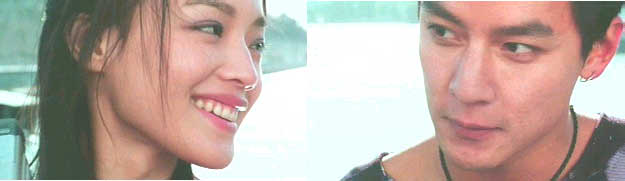
For me this is when the film starts to lose its lovely mood and dreamy atmosphere.
It was better simply as a road film without the adornments of much melodrama.
It does have a touching ending that may not be what you expect, but leaves
you feeling perhaps a bit optimistic about what happens next. Other than the
intriguing milieu in which the film takes place – and with Peter Pau as the
cinematographer – you can imagine that it is beautifully filmed, it has a
loose but very literate script from Mabel Cheung’s usual collaborator, Alex
Law. The film really falls on the shoulders of Wu and Hsu Chi and they come
through in good fashion. It is some of the best work that either has done
to date. Give Wu credit for doing much of it in a language that he isn’t that
versed in (but that fits in with the character) and it is such a pleasure
listening to Hsu Chi in her own language of Mandarin as opposed to her sometimes
fractured Cantonese. She sounds so sexy as she stretches out those consonants.
And if Pau can work wonders with Beijing, think Hsu Chi’s face - it’s a
comet like cataclysm of beauty and light. The film may not generate much
electricity and feel a bit flat at times – but for a number of other reasons
I thought it was a worthy film with a different feel than most Hong Kong
films.
Richard Ng also makes a welcome and
rare appearance these days as Wu's father.