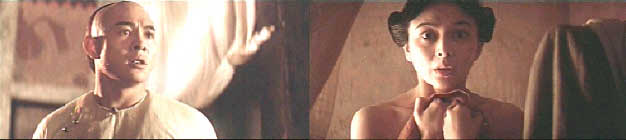
Once Upon a Time in China
II
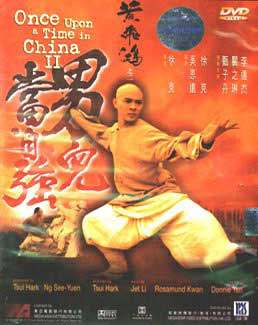
Reviewed by YTSL
In light of the Hong Kong box office success of
“Once Upon a Time in China” (which was the 8th highest earner in 1991, making
HK$29,672,278.00 over its 56 day run), it was only a matter of course before
at least one sequel would get spawned. This being a Film Workshop baby,
one could also justly expect the ante to be upped in the second work of what
turned out to be a six movie series. The appointment of Yuen Woo Ping
as action director appeared to signal such. Ditto re the bringing in
of the likes of former Shaw Brothers star, David Chiang, Max Mok (to replace
Yuen Biao as Wong Fei Hung’s student, Foon) plus two accomplished martial
artists turned actors in Donnie Yen and Xiong Xin Xin to be supporting cast
members. It thus probably wasn’t to many people’s surprise that the
1992 production -- which some fans, including many of the Top Ten List contributors
to Mark Morrison’s <www.heroic-cinema.com> site, prefer to its predecessor
-- succeeded in earning more box office money (HK$30,399,676.00; though,
interestingly, it spent 14 fewer days in theatres and finished 4 rungs lower
in that year’s box office tables).
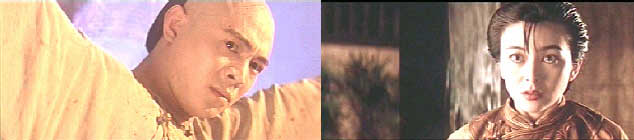
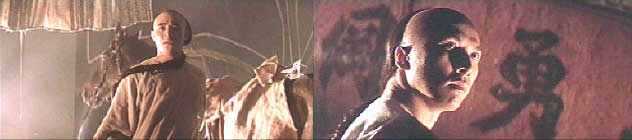
The beginning section of ONCE UPON A TIME IN CHINA II throws the film’s viewer(s)
into initially unfamiliar and terribly exotic looking territory: The
fanatical realm of the White Lotus Sect, who we learn are virulently xenophobic
-- their ritual incantations include the exhortation to “Kill all foreigners.
So we can live in peace” -- and headed by a man who claims to have supernatural
powers vested unto him (Priest Kung is played by Xiong Xin Xin). However,
the scenes that accompany the opening credits and immediately follow them
seem to signal director-producer Tsui Hark’s strong intent to echo -- and
build on -- two thematic elements which had worked well the previous time
around: Demonstrations of the physical strengths and prowess of martial
arts trained humans; and meditations on how best to deal with the Western,
Chinese, progressive and conservative ideological strains coursing through
the province and country of Wong Fei Hung (who gets excellently portrayed
once more by Jet Li) and his (honorary) Thirteenth Aunt (Rosamund Kwan is
softer here than before but just as sweet).
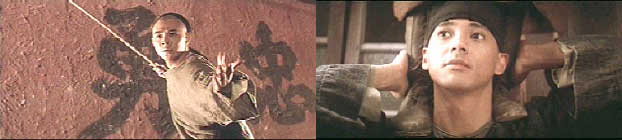
The decision to paint things on a larger canvas can be seen in the great
bulk of events in ONCE UPON A TIME IN CHINA II taking place in 1895 Canton
rather than Master Wong’s hometown of Fo Shan. It is also evidenced
in the staging of more -- and more spectacular -- fights involving Wong Sifu
than there had been in the first film in which Jet Li had starred as the
master exponent of such as the “no shadow kick” (While the two duels with
Regional Commander Lan -- who Donnie Yen shows to be the impressive wielder
of a powerful “cloth stick” -- are convincingly intense and the one-against-many
brawls that the Cantonese folk hero gets involved in allow the movie’s star
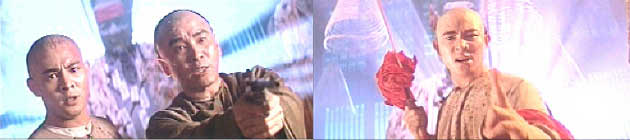
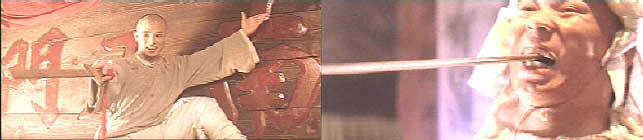
to show his eminently watchable moves, it’s the lengthy battle against Priest
Kung and a pair of his -- literally so -- supporters that makes for truly
breathtaking viewing). An extra dimension gets provided by the incorporation
into this often chaotic picture of Dr. Sun Yat Sen (played here by Cheung
Tit Lam); a nationalist activist revered in real life by Chinese communists,
Kuomintang and followers of still other different political persuasions alike
who is seen in this work being wanted by imperial forces as well as befriending
Wong Fei Hung at an international medical conference (during the course of
which the Po Chi Lam herbalist demonstrates acupuncture techniques to Red
Cross officials and others while Dr. Sun does the Cantonese-to-English translation).
The connection of folk mythology with Chinese (trans)national history --
by way of postulating an actual association between two legendary figures
-- is what allows ONCE UPON A TIME IN CHINA II to have the kind of movingly
spine tingling ending that it does. At least a couple of dramatic scenes
involving an individual named Luke (the Christian money man for the revolutionary
republican movement whose time came in 1912 is solidly portrayed by David
Chiang) also conjure up rather genuine feeling emotions. This (re)viewer
additionally appreciates Rosamund Kwan’s ability to make Sap Saam Ee -- whose
personal name gets revealed here to be Siu Qin -- into something more
than the flower vase character that she on occasion seems in danger of be(com)ing.
For the most part though, my verdict is that ONCE UPON A TIME IN CHINA II
does disappoint somewhat in terms of: Its social commentary coming
across as lacking fire as well as feeling rather scattershot (partly on account
of Wong Fei Hung’s enemies being more misguided and misguiding individuals
-- even if they are ones representing particular organizations -- rather
than actual ideologies or preferred ways of life); its romantic scenes missing
the delightful light touch possessed by its predecessor; and its comedic
sections seeming more labored than fun. Fight fiends could care less
though, what with this 109 minute long production’s containing the kind of
action scenes that really can satisfy as well as astound even those who want
their (martial arts) movies to be amply filled with heart, thought and laughs
as well as majestic displays of physical prowess and technical ability.
My rating for the film: 8.5